
An AI That Doesn't Chat With You—How Can It Justify a $7.5 Billion Valuation?
Let’s say you run a small shop. When you log into your customer service dashboard in the morning, you see some customers rushing you to ship their orders, others asking about sizes, and still others reporting damaged items and requesting refunds. Of course, you could have AI write a polite reply for each person. But before replying, there’s a series of even more tedious tasks: sorting out the issues, prioritizing them, and assigning the orders that need handling to the right people.
These small decisions aren't really suitable for demonstration videos, but they determine whether a store can run smoothly.JevThat is exactly the level of work we are targeting.
This model, designed byTypeSafe AIThe model does not generate text on its own. Following its launch on September 15, 2026, the developer announced on October 9 that it had completed an $870 million Series A funding round, valuing the company at $7.5 billion, with a16z serving as the lead investor. The $7.5 billion figure refers to the company’s post-funding valuation; it does not represent product revenue, nor does it reflect the long-term value that has been validated by the market.
Looking back at this funding round on October 11, the question that deserves closer scrutiny is: Now that AI is already quite articulate, why are people still willing to bet big on a model that only makes judgments?
From writing down the answer to letting the software make a choice
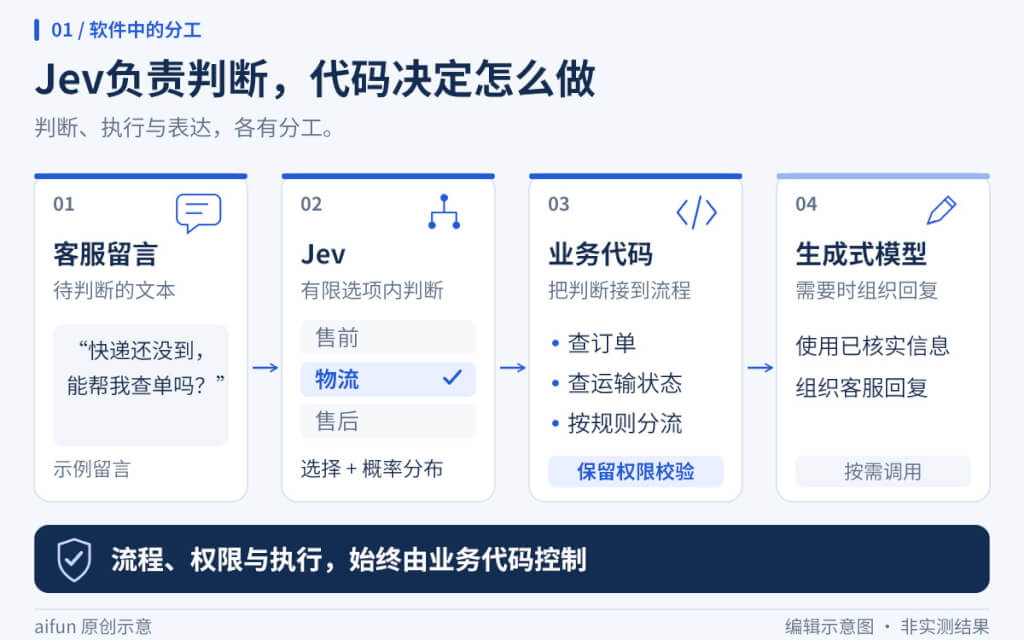
First, think of Jev as a “multiple-choice machine” that can understand context. Give it a customer message and provide several options—such as pre-sales, logistics, and after-sales—and it will return the best choice and associated probabilities for the program to use. Developers can also have it assign scores based on preset criteria or estimate the probability that a particular judgment is true.
These capabilities correspond to “Choice,” “Score,” and “Noul” in the official documentation. Compared to open-ended question-answering, the scope of possible answers is determined in advance, making it easier for the software to integrate the results into the next step of the process. For example, the system first determines whether the issue is related to logistics, then checks the shipping status through the order system; when the customer needs to be reassured, another model—specializing in writing—takes over to craft the response.
The key here is the division of labor. Traditional code handles order numbers, shipping costs, and permissions; Jev handles semantic evaluation; and generative models handle open-ended expressions. Developers still need to design the workflow and should not assume that “selecting the next step” means the model has completed the entire task.
This doesn’t mean that large language models are limited to chatting. They’ve long been capable of classification and structured output. What Jev aims to demonstrate is whether, for certain high-frequency judgment tasks with clear boundaries, specially designed models can operate with more appropriate speed, cost, and stability.
Why did a researcher who had worked on chat models switch to...
In a product launch post, Diogo Almeida, founder of TypeSafe, reflected on his work at OpenAI, where he was involved in research aimed at enabling language models to follow instructions and communicate with humans. After stepping away from that familiar line of work, he found himself repeatedly pondering one question: If models are already so capable of communication, why hasn’t automation happened naturally yet?
This experience offers an explanation for Jev’s choice. When people are having a conversation, they can tolerate explanations, follow-up questions, and on-the-fly corrections; when software is executing a process, it needs clear results and must know how to handle uncertainty. These two usage scenarios place slightly different demands on the model.
In a16z’s investment brief, the focus is also on the software itself: AI has already helped people write code faster, and the next step is to make running software more discerning. This is the investors’ assessment, which reflects a clear business stance, but the questions it raises are worth serious consideration.
Based on this, we can draw the following conclusion: In the future, many AI capabilities may be embedded within existing products. Without users having to open a new chat window, search results will already be organized, customer service tickets will be routed appropriately, and complex issues will be promptly escalated to human agents. While the AI’s visibility may decrease, its actual involvement in the workflow may increase.
The $7.5 billion bet is on the high-frequency call business
Once an article is finished, a single service run of the model can be completed. But for software that runs continuously, it may need to make decisions many times a day: Is this message relevant? Is this material worth reading further? Which tool should handle this request? As long as the business is still operating, similar requirements will arise repeatedly.
This givesDecision-Making ModelThis leaves room for business innovation that could become a foundational component. If enough processes are integrated, even if the value of a single call is small, it could still generate sustained demand. For businesses, what’s truly worth paying for is reduced waiting time, rework, and error handling.
However, this line of reasoning is valid only under certain conditions. Adding a model increases the workload associated with integration, monitoring, and maintenance. If the existing rules are already adequate, or if the workload is minimal, introducing Jev may not be cost-effective. While model calls are inexpensive, the system as a whole may not necessarily be more cost-effective.
This is where the real competition will lie: whether customers will continue to use the service, how much human intervention will be needed to handle complex situations, and whether the service can operate reliably. Large-model providers can continue to optimize their classification capabilities, and traditional machine learning methods still have a role to play. TypeSafe needs to turn early interest into long-term usage habits; funding can only provide the resources needed for this journey.
Just because the format is correct doesn't mean the conclusion is necessarily right.
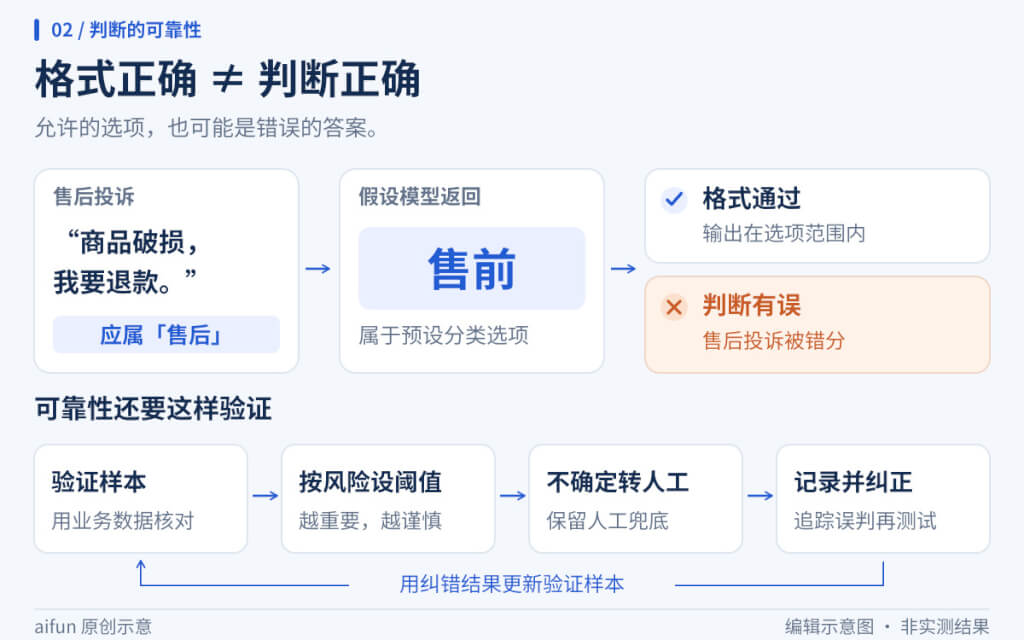
This is the part where you really need to pause when reading Jev’s promotional materials. The model always selects from the allowed options, which can reduce formatting errors; however, in the case of an after-sales complaint mistakenly routed to pre-sales, the response format was still completely correct. Since the selection range is constrained, it cannot resolve all semantic misclassifications.
Probabilities must also be interpreted with caution. The TypeSafe documentation explains that the confidence levels for “Choice” and “Score” are derived from the output probability distribution, which describes how certain the model is about its choice among the options. A high score does not constitute a proof of correctness provided by an external system. When deploying the model, the threshold must be validated using actual business data.
An external evaluation preprint submitted on September 29 tested Jev on 37 datasets. The researchers found that a uniform threshold of 0.5 cannot be simply applied to the probability of binary decisions; on one of the legal provisions datasets, adjusting the threshold significantly improved the results. These findings pertain to a specific version and a specific task and cannot be directly generalized to all scenarios; furthermore, the preprint itself does not constitute a peer-reviewed publication.
Performance figures must also be viewed in context. In the document review case study published by LangChain on September 25, the classification step handled by Jev was 5 to 6 times faster than the control solution. However, this measurement applies to a single step and does not imply that the entire business process will be accelerated by the same ratio. Actual wait times also include retrieval, tool invocation, approval, and manual processing.
TypeSafe’s publicly listed limitations for Jev 1.13 also include precise calculations, date comparisons, complex indirect reasoning, and interference caused by excessive irrelevant information. The current documentation states that it accepts only text input and performs best with English. For domestic teams, Chinese customer service interactions, industry abbreviations, and mixed Chinese-English expressions should all be tested separately; results from English demonstrations cannot be directly applied.
What Should Regular Users Look For?
For most people, understanding the value of Jev doesn’t mean they need to sign up for a developer account right away. It is, first and foremost, a software capability, and the way it truly impacts users may be through its integration into products you’re already using.
The next time you come across an AI tool that claims to offer “automated processing,” try asking yourself these three questions: Which specific step did it actually complete for me? Does it pause when it encounters ambiguous situations? If it makes a mistake, can I clearly see the process and easily correct it? These details are far more informative than simply having a few extra AI buttons on the interface.
If you manage a small team, start by identifying a process with high volume, repetitive tasks, and limited options—such as call routing or initial data screening. Take a set of historical samples that have been de-identified and manually verified, and compare them with your current methods. In addition to accuracy rates, record the number of times important issues were missed, the percentage of cases escalated to human agents, and the total time taken for the entire process. Start by having the model provide recommendations, and after validation, decide which steps are worth automating.
A practical rule for saving money is this: for issues that can be resolved using fixed rules, stick to those rules; for issues that require semantic judgment, compare models; and for matters involving payments, deletions, or important commitments to customers, maintain clear authorization and confirmation processes. Using expensive models a few times less may save on call fees, but avoiding a single erroneous operation is often more important.
It remains to be seen whether Jev can ultimately live up to its $7.5 billion valuation. But it has raised a very practical question: Just how smart does an AI need to be before we feel comfortable entrusting it with a small task? The answer may lie in those unassuming judgments, rather than in yet another polished, lengthy response.
© Copyright notes
The copyright of the article belongs to the author, please do not reprint without permission.
Related posts


No comments...
 简体中文
简体中文  English