
Google Has Started Issuing “ID Badges” to AI—the Office Software Business Is About to Change
A company's address book may soon include a new type of contact: one with an email address, a calendar, and file storage—and the ability to perform tasks on an ongoing basis.AI Colleagues.
On October 8,Google Internet company Cloud atGemini The Gemini agent was unveiled at Work 2026. According to Google, it can handle ongoing tasks; the coworker agent has its own Workspace identity, and teams can add it to a collaboration space to assign tasks just as they would to a team member.
This is more noteworthy than the fact that “AI can now create another PowerPoint presentation.” Email, calendars, and folders form the basic framework of how businesses organize their work. Integrating AI into this framework means it is moving closer to the center of task assignment, information flow, and deliverables. Whoever secures this position will have the opportunity to redefineOffice Softwarevalue.
Only with an identity can AI have the opportunity to be integrated into actual workflows
Let’s consider a common scenario: preparing for a client meeting. Employees need to locate the records of previous communications, confirm the latest quote, gather project progress updates, and then compile them into a presentation. Writing is only a small part of the process; what takes even more time is figuring out “who to contact, which version is valid, and what can be shared with the client.”
A model capable of generating beautiful text may not necessarily solve these problems. It needs access to the company’s information and must also know what it is permitted to do.
The design Google has unveiled includes independent identities, permission controls, and operation auditing. It also proposes allowing tasks to continue running in the cloud and scheduling multiple sub-agents as needed. Work does not have to end when a chat window is closed.
The practical significance of independent identity lies in distinguishing between actions performed by AI and those performed by employees. If a quote is modified, the organization should be able to trace who initiated the change, who carried it out, and on what basis. Attributing all actions to a single employee may be convenient in the short term, but in the long run, it will increasingly blur the lines of accountability.
Of course, assigning an account does not mean that the AI assumes legal liability, nor does it imply that it has been granted unlimited authority. Companies must still determine which processes can be automated and which require human approval. A truly mature AI colleague should be able to take on tasks while also knowing when to stop.
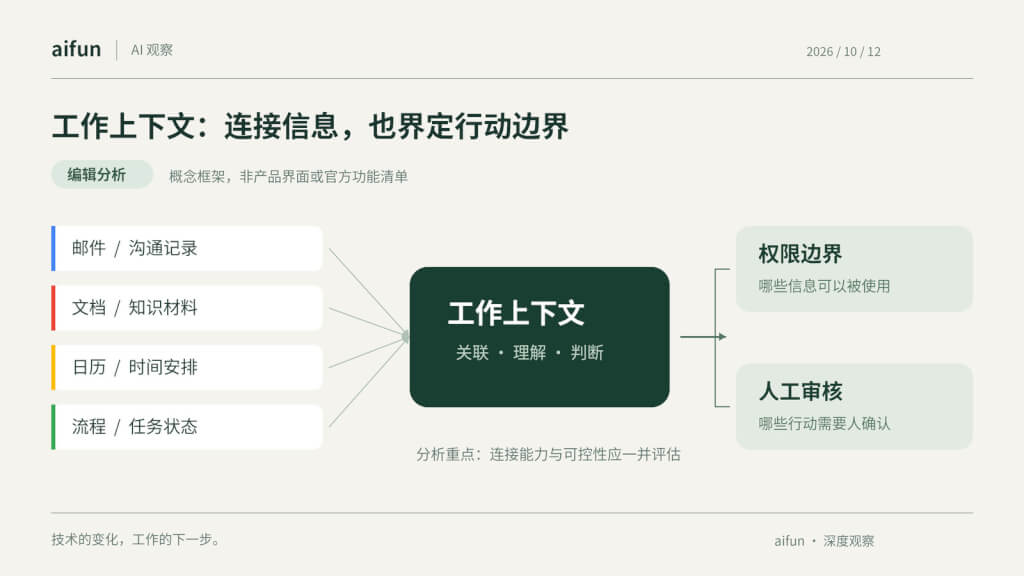
Google's trump card is that the work context is already right here.
There is one aspect of this competition that is easily overshadowed by model rankings: models of equal intelligence can deliver vastly different results when placed in different information environments.
When an employee says, “Send the materials to the same people as last time,” they’re leaving out the contact information, project name, and previous email correspondence; when they say, “Follow our standard approach,” they’re leaving out the templates, approval rules, and organizational practices. Human collaboration relies on a great deal of tacit knowledge,Enterprise AIYou can't avoid learning this either.
Google’s presence in email, Docs, and Calendar provides a starting point for connecting these threads. For teams already using Workspace, there are costs associated with migrating data, organizing contacts, and training users on new workflows. If Agent can seamlessly integrate into their existing work environment, there may be less resistance to adoption than if they were to deploy a standalone tool.
This also explains a seemingly counterintuitive choice: Gemini Agent not only uses Google’s own models but also supports Claude. Google has separated the Agent from the choice of underlying models.
From a business perspective, this is a more flexible defensive strategy. Even if a competing model proves stronger for a period of time, customers may not necessarily need to migrate their entire work system. Task entry points, organizational memory, and management processes may still remain on Google’s platform.
Therefore, future competition cannot be reduced to simply asking, “Which model is better?” We must also ask: Who understands this company better? Who can see a task through to completion? And when switching suppliers, how much of the accumulated work can be carried over? These questions will affect customer retention and also influence the bargaining power between companies and platforms.
Companies will pay for the entire task they save on, but the bill must be calculated in full.
For procurement managers, the range of AI’s capabilities is far less important than one question: How much will it cost in total to complete a task to the required standard?
There are at least three components to the cost here: the cost of the model and computing resources, the implementation cost of integrating with enterprise systems, and the time spent on manual review and rework. If the initial draft is generated quickly but requires employees to review each item individually, the efficiency gains demonstrated in the presentation may not necessarily be reflected in the financial statements.
In this release, Google has added controls such as the ability to select models by task and set spending caps for projects. Once a budget reaches its limit, tasks can be paused. While these mechanisms may not seem as eye-catching as generative capabilities, they better address the real concerns of enterprise procurement: agents running in the background must not become an unpredictable expense.
Different tasks also require different cost standards. Compiling internal weekly reports allows for a small number of revisions, while sending formal quotes to clients requires a higher level of accuracy and more stringent approval requirements. Assigning all tasks to the most expensive model isn’t necessarily cost-effective; focusing solely on low cost may end up shifting costs to rework and incident resolution.
For Google, business opportunities may lie in customer renewals, product upgrades, and cloud resource usage. If Agent can encourage enterprises to keep more of their work on the same platform, it has the potential to increase the platform’s overall value. However, whether a new entry point incurs a separate fee and whether the ongoing background operations involve quota and resource costs are two distinct issues that should not be conflated with the notion of “unlimited free access.”
For a more pragmatic pilot, select a process with clearly defined boundaries and verifiable outcomes, and compare the delivery cycle, the number of manual interventions, and the total cost per unit of qualified output. Only when all three of these metrics improve simultaneously will there be a genuine justification for scaling up the use of AI colleagues.
The more complete the context, the less ambiguous the data boundaries must be.
Allowing AI to gain deeper insights into organizational information can reduce the need for repetitive explanations and highlight the importance of access control. Shared folders that employees may have overlooked, expired group members, and disorganized document versions can all become new sources of risk.
The Google Workspace administration guide allows administrators to control access to Workspace data by relevant versions of Gemini Enterprise and to set scopes by organizational unit or group. Its Enterprise Data Commitment also clearly states that customer data will not be used to train Google’s generative AI models or those of other customers without permission.
However, the statement “not used for training” addresses the issue of data usage and does not replace a review of retention periods, the scope of sharing, external connectors, and audit logs. For an agent that operates continuously and retains context, these details directly determine whether a company can confidently grant authorization.
Organizations can start by defining the minimum scope of data required and then gradually expand it as the effectiveness of the initiative becomes apparent. Clear approval steps should be maintained for outgoing emails, formal contracts, payments, and changes to access permissions. Usability and controllability must be designed with equal consideration; they cannot be addressed retroactively after deployment.
Look at the results first, then at the scale of the “AI colleagues”
This announcement should also be viewed in the proper context. The new Gemini agent is currently in private preview for select customers; Google’s official guidance for small and medium-sized businesses also uses the term “early access” and does not provide a specific date for general availability. The financial and legal editions are in the preview phase, so the demonstration at the conference should not be interpreted to mean that all Workspace users can already access them directly.
This provides companies with a window of opportunity to observe its performance. What will truly be worth watching next is whether it will follow up when data is missing, whether it can resume operations after a task is interrupted, and whether it can consistently produce acceptable results when working across applications.
Sending emails to AI is just a catchy opening line. Google’s broader goal is to embed the model’s capabilities into the daily processes by which companies assign, execute, and verify work. If this approach proves successful, the way we measure the value of office software will shift further toward “how much work has been completed.”
Ultimately, what determines whether a company continues to pay is still the results—delivered on time and reliable enough to use with confidence.
© Copyright notes
The copyright of the article belongs to the author, please do not reprint without permission.
Related posts


No comments...
 简体中文
简体中文  English