
AIGC: The Age of Intelligent Creation
Explore the frontiers of AI innovation, lead a new era of intelligent creation, and transform the future of power work.
Focusing on prompt design, context organization, RAG, and agent workflows, learn how to build evaluable, iterable large-model applications. Suitable for AI application developers and technical product managers with a background in programming.
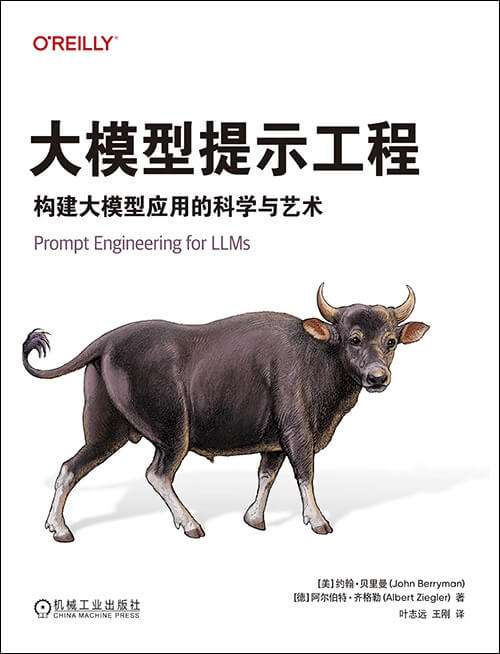
做过知识库问答、文本整理或smart (phone, system, bomb etc)助手的人,往往会遇到同一个问题:一条提示词在演示中表现不错,换一批问题、加几段材料,结果就不稳定了。《大模型提示工程:构建大模型应用的科学与艺术》适合带着这类问题阅读。它把提示工程放进完整的应用流程,讨论输入怎样组织、上下文怎样取舍、模型输出怎样接入后续步骤,以及改动后如何判断效果。
The original title of this book is Prompt Engineering for Large Language Models, authored by John Berryman and Albert Ziegler, both of whom were involved in the early development of GitHub Copilot. The Simplified Chinese edition was translated by Ye Zhiyuan and Wang Gang and published by China Machine Press in June 2026, with ISBN 9787111810117. Edition details and the complete table of contents can be viewed via the publisher’s book page link at the top of this page.
The foundational section begins with morphemes, text generation, and dialogue models, before moving on to application design and quality evaluation. As you read, it’s worth repeatedly asking yourself: How can user needs be transformed into input that the model can process? How can the generated text be turned into results that users can actually use? Thinking through these two conversion steps is usually more helpful than repeatedly revising a single command.
The technical section focuses on prompt content, fragment assembly, output control, and model selection, covering few-shot examples, RAG, summarization, and the spatial relationships and dependencies among pieces of information. The most valuable perspective to bring back to the project here is to examine the purpose of each piece of material: Is it meant to explain the task, provide evidence, or specify the output format? When time is limited or sources conflict, this breakdown can help the team discuss what to omit and what to retain.
The advanced section continues the discussion on tool usage, conversational context, task workflows, and offline and online evaluation. Readers can compare these concepts with their own processes to determine which steps should be left to the model to decide and which are best handled using explicit rules, and then examine how errors might affect the next step. For the chapter structure and topics, seeO’Reilly Original Catalog.
Before reading, it is best to have a basic understanding of APIs, JSON, and basic programming workflows; the practical sections require the ability to save input and output, modify call parameters, and compare results. While you can read the conceptual chapters even without development experience, applying the methods in practice still requires a foundation in programming and API calls. The original official version is intended for intermediate to advanced readers; when selecting this book, you should assess your own project experience.
Below, we compare the three books based on learning objectives to help you decide which one to read first. While there is some overlap in their content, the main differences lie in their focus.
| Dimensions of Comparison | Prompt Engineering for Large Language Models | AI Engineering | A Visual Guide to Large Models |
|---|---|---|---|
| Reading Focus | Input, Context, and Interaction Flow | Applying Engineering Trade-offs Throughout the Entire Process | Illustrated Concepts and Practical Applications of Various Models |
| Priority Issues | How to Organize Prompts and Validate Changes | How to Select, Evaluate, and Deploy Solutions | How to Understand Model Mechanisms and Common Uses |
| A Good Starting Point | A simple model call or prototype already exists | Start considering reliability, cost, and maintenance | I hope to develop a systematic understanding and technical intuition. |
| Suggested Companion Exercises | Rewrite a prompt template and test set | Write a proposal comparison for the project | Run the example and draw the data flow |
If you’re trying to figure out why your model’s performance fluctuates, start by reading this book; if your model is already running smoothly and your next steps involve deployment, evaluation, and cost control, move on to *AI Engineering*; if you still lack a comprehensive understanding of concepts such as vector representations, attention mechanisms, and retrieval, *Illustrated Large Models* is a good reference to consult alongside this book.
This book is designed to help readers develop a more structured approach to their work: when encountering performance issues, first break down the input, context, model behavior, and evaluation methods before deciding where to make changes. For readers who need to iterate on AI applications repeatedly, this analytical framework is more easily transferable to new tasks than simply collecting a large number of ready-made prompt templates.
When studying, be sure to refer to the official documentation for the current model. Tool calls, structured outputs, and model inference interfaces are subject to change, so the strategies described in this book must be revalidated for your specific tasks. Prompt engineering alone cannot guarantee factual accuracy, data security, or the reliability of business processes; for applications involving external operations, you should also implement access controls, result validation, and necessary manual verification.


 简体中文 简体中文
  English