Considering the engineering challenges of AI applications as a whole
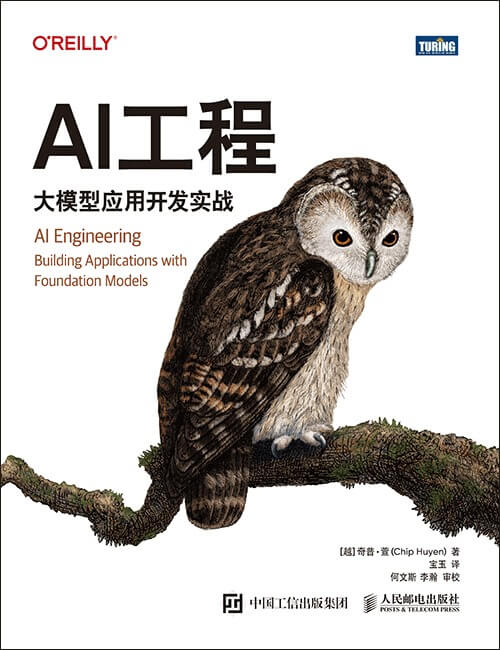
After selecting a model, AI application developers still face a series of challenges: how to measure response quality, how to integrate corporate knowledge, whether fine-tuning is necessary, and how to balance response speed with cost. *AI Engineering: Practical Guide to Large Model Application Development* addresses these issues and discusses methods for building applications using off-the-shelf foundation models.
Author Chip Huyen integrates models, data, evaluation, and deployment into a single development workflow. This approach is suitable for readers who have already created simple prototypes and are ready to address reliability and maintenance issues, and it can also help technical teams establish a common language for discussing solutions.
Four Engineering Topics Worth Watching
- Model Selection and Evaluation:Determine the evaluation methods based on specific tasks so that comparisons between models and solutions have a verifiable basis.
- App Adaptation Methods:Understand the challenges associated with prompt engineering, RAG, fine-tuning, and agents, and consider when to use each approach.
- Data and Feedback:Focus on dataset quality, user feedback, and the iterative process to understand how to continuously improve the application's performance.
- Delays and Costs:Identify performance bottlenecks in the foundation model service and incorporate user experience and operational overhead into the design.
Who Should Read This, and How to Use It in Projects
Intended for AI application developers, machine learning engineers, technical leads, and technical product managers. Readers should ideally have prior experience in software development or technical projects; for chapters covering models and inference, a willingness to acquire the necessary foundational knowledge is required.
We recommend reading this site with a specific project in mind, such as a customer service knowledge base or a document organization tool. Start by listing typical inputs, expected outputs, and scenarios where things might go wrong, then review the sections on evaluation, data, and architecture to identify any gaps. This makes it easier to determine whether a technical solution can address your current problem.
Reasons for Recommendation and Reading Guidelines
The long-term value of this book lies in developing the ability to make engineering trade-offs: how to define “good enough,” how to compare different approaches, and how to consider post-deployment feedback and maintenance. For teams transitioning from prototyping to actual deployment, these issues often require more systematic preparation than simply calling an API.
This book focuses on systematic approaches and technical decision-making; however, readers should still refer to specific framework documentation, experiments, and tests while reading. The information in the book regarding model pricing, APIs, and the ecosystem is subject to change; readers should refer to official documentation at the time of actual use. Reading this book does not replace security reviews, data permission verification, or deployment validation.





 简体中文
简体中文  English