
Luchen Technology
Focusing on the research, development and application of AI big model technology, we provide efficient and low-cost AI big model solutions for various industries through our self-developed deep learning system, Colossal-AI.
Integrate existing ERP and procurement data; use AI agents to investigate and resolve anomalies such as order changes and invoice discrepancies, while maintaining approval and audit controls.
 Fragment
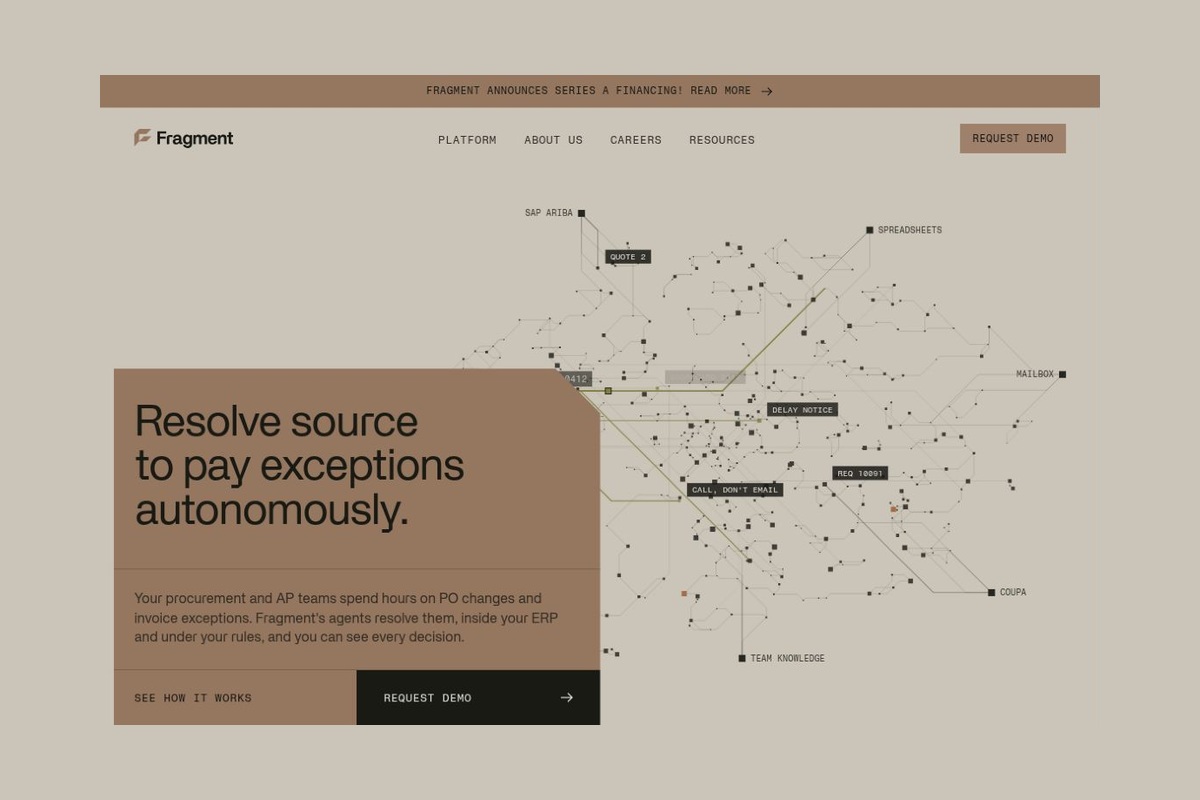
 is an AI platform for procurement and accounts payable designed for large manufacturers, distributors, and energy companies. It focuses on cross-system anomalies such as purchase order changes, invoice discrepancies, and missing receipt records. By understanding corporate policies, contracts, and business records, it enables agents to investigate issues, take corrective actions, and maintain an audit trail—all within their authorized scope. For teams that still rely on manual, back-and-forth verification between ERP systems, spreadsheets, and supplier emails, it offers a path to automation without requiring a replacement of core systems.
This product is provided by Fragment Data Technologies, Inc. Its official website is fragment.ai... and is unrelated to other trading or development tools with the same name. On October 28, 2026, the company announced the official launch of the platform and disclosed that it had raised a cumulative total of $56 million in funding, including a Series A round led by 8VC and a previous seed round. This is the cumulative funding amount and should not be interpreted as the amount raised in the Series A round alone.Company Press Release
At the core of Fragment is the Autonomous Context Engine (ACE). According to the official description, it connects ERP, MES, spreadsheets, and supplier portals, organizing corporate policies and business relationships into context that agents can use; processing logic and actual actions should be traceable. The term “no migration required” here refers to continuing to use existing data systems; it does not mean that companies can skip interface authorization, field verification, and security reviews.ACE Description
This solution is typically suited for procurement operations, accounts payable, and shared services teams that handle large volumes of orders, operate on disparate systems, and frequently deal with exceptions. Individual users with only a small number of invoices, or companies that simply need to recognize invoice images, may not require such a comprehensive enterprise-level implementation.
| programmatic | Positioning and Functional Focus | Tasks Suitable for Assessment | Important Boundaries |
|---|---|---|---|
| Fragment | Handling Cross-System Exceptions in the Context of Procurement Operations Using AI Agents | Repetitive processes requiring judgment, such as order changes, invoice discrepancies, and supplier confirmations | This requires coordination, authorization, and pilot programs by enterprises; automated enforcement should not be interpreted as eliminating oversight. |
| SAP Ariba | Procurement and Expense Management, covering guided procurement, catalogs, supplier collaboration, and invoice processing | A team seeking to centralize procurement and invoice management and integrate with SAP systems | The specific product portfolio, site configuration, and ERP integration affect actual workflows; it cannot be assumed that all features are included by default. |
| UiPath Source-to-Pay | Orchestrate agents, bots, and staff on top of the existing system to handle requests, match them, and resolve exceptions | Organizations that need to automate procurement as well as other cross-application processes that require unified orchestration | Connections, workflows, and manual control points need to be designed; the existing ERP system continues to serve as the record-keeping system. |
The basis for comparison is SAP Procurement-to-Pay Product Descriptionup to UiPath Procurement-to-Pay Guide. There may be overlap among these three categories, and they may also work in tandem with existing systems; the decision to replace them should not be based solely on whether or not they incorporate AI. A more effective approach is to compare them using the same set of exceptions, the same approval criteria, and the actual integration costs.
Fees:The public portal focuses primarily on corporate demonstrations and solution discussions; there is no publicly available price list that can be used to calculate a standard monthly fee. The Terms of Service stipulate that fees, terms, and usage rules are determined by the specific order. When requesting a quote, you should separately confirm implementation costs, the number of processes, processing volume, overage charges, and ongoing support; do not interpret funding announcements or demo appointments as free trials.Terms of Service
Supervisory Responsibilities:The terms explicitly state that model outputs may be incomplete or inaccurate; customers must review them with due consideration of the associated risks and establish appropriate approval processes, sandboxes, and rollback mechanisms. Fields such as purchase quantities, supplier information, and payment-related records may result in actual financial losses; therefore, read access and execution permissions must be authorized separately.
Data and Availability:Before deployment, you must verify the system version, APIs, data processing locations, retention policies, and third-party model providers. Chinese-language business support, region-specific availability, and on-premises deployment options cannot be inferred from the English-language website; these should be confirmed by the sales and implementation teams. The fact that no ERP replacement is required does not mean that no implementation work is needed.
Effect Assessment:The customer case studies and automation rates displayed on the official website are based on information disclosed by the vendor and do not constitute a guarantee for all industries. What deserves greater attention is why an anomaly was handled, who approved the action, and whether the issue can be identified and resolved after an error occurs.
Before signing the contract, you should also agree on who is responsible when an exception occurs: where the process should stop, who should take over, and how to avoid duplicate submissions of the same change if the supplier fails to confirm, data conflicts arise, or the approver leaves the position. These details directly impact day-to-day usability.
If a company already has a core procurement system but is still being slowed down by a large number of cross-system exceptions, Fragment is worth adding to the list of candidates for a pilot evaluation. Establishing a reliable closed-loop process around a single exception type first, then expanding to adjacent processes, typically makes it easier to assess the benefits and risks than pursuing “fully autonomous procurement” all at once. Its value should be demonstrated by verifiable processing results, rather than determined by the number of agents or the amount of financing.





 简体中文 简体中文
 English