Company Overview
Cyera is an enterprise data security company co-founded in 2021 by Yotam Segev and Tamar Bar-Ilan, who serve as CEO and CTO, respectively. The company addresses data in the cloud, SaaS, and on-premises environments, helping security teams answer several fundamental questions: What data does the organization have? Where is it stored? Who or what systems have access to it? And which risks should be prioritized?
As companies begin to adopt generative AI and intelligent agents, data access has become more complex. Cyera links data content, identity and access permissions, and usage behavior to help organizations make the information needed for business operations available while reducing the risk of sensitive data being exposed due to overly broad permissions, accidental sharing, or anomalous activity.
Milestones
In its early stages, Cyera built products centered on data discovery, classification, and data security posture management, enabling security professionals to gain visibility into dispersed data assets. In 2024, the company integrated access relationships between human and non-human identities into its platform; on October 17 of that year, it announced the acquisition of Trail to enhance its data loss prevention capabilities, extending static asset inspections to the data flow process.
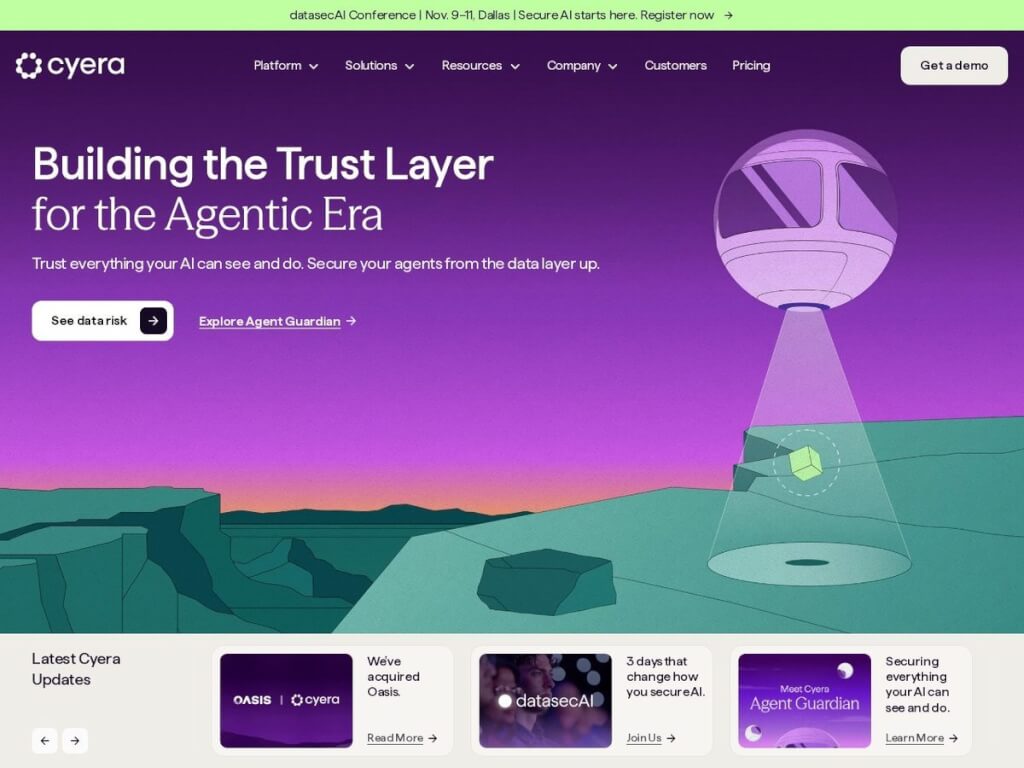
On August 4, 2025, the company unveiled AI Guardian, marking the start of a focused effort to address data risks associated with the use of enterprise AI tools. By 2026, the unified platform on the company’s official website featured modules such as DSPM, Omni DLP, Cyera Identity, and Agent Guardian, and the product’s focus had shifted further toward the integrated governance of data, identities, and agent behavior.
Products & Services
- DSPM:Discover data in the cloud, software-as-a-service (SaaS), and on-premises environments; identify sensitive and proprietary content; and prioritize risks based on exposure and business context to help teams establish a data view that can be sustainably updated.
- Omni DLP:Aggregate and analyze data leakage alerts to help adjust risk levels, optimize policies, and reduce redundant investigations, enabling security personnel to focus more on incidents that have a real impact.
- Cyera Identity:Monitor access relationships between human and non-human identities and data, identify unnecessary permissions, and support access governance for sensitive data.
- Agent Guardian:Identify the AI and intelligent agents used by the enterprise, and combine data classification with identity and background assessments to determine the information they can access and the actions they can perform, thereby controlling related data leakage risks.
- Access Trail and Repair Tools:Log access activities involving sensitive data to provide evidence for investigations and drive issue resolution through alerts, workflows, or automated remediation.
core technology
Cyera’s technology is built on automated discovery and AI-driven classification. The platform emphasizes an agentless discovery approach and uses machine learning to understand the meaning and context of data, covering both structured records and unstructured files. The classification results are then linked to identity, permissions, and usage paths, helping security teams determine why a particular piece of information is sensitive, who has access to it, and what business impact a data breach might have.
The key to this approach lies in incorporating classification into subsequent decision-making processes, rather than simply assigning labels to files. The same content may pose different risks in different access scenarios; therefore, the platform integrates detection, assessment, and remediation. The actual effectiveness still depends on the scope of data source integration, classification accuracy, and policy configuration; automated handling also requires managing false positives and minimizing the impact on normal business operations.
For example, if a document containing customer information is set to be shared externally and can be accessed by a specific application, it may be given higher priority than a similar document stored in isolation. Examining the content and access relationships together can help explain this difference. Whether to disable sharing or adjust permissions should be determined in consultation with the data owner and based on business needs.
development prospect
Given the trend toward expanding AI applications within enterprises, Cyera is poised to benefit from the shift in data governance from periodic audits to continuous monitoring. Business units want AI to have sufficient context, while security teams need to restrict unauthorized access; products that can understand both data and identities have a clear market opportunity.
Its success continues to depend on cross-system coverage, the ability to identify complex data, and the effectiveness of actual remediation. When evaluating such platforms, organizations should focus on whether they can clearly explain risks, maintain auditable records, and integrate with existing security processes; they should not assume that a single certification or product claim means all data risks have been eliminated.


 简体中文
简体中文  English