
ByteDance Merges TRAE Work and Code: AI Office and AI Programming—Why Are They Converging on the Same Platform?
A developer’s work often begins with a requirements document and ends with a user manual. In between, they write code, fix bugs, and run tests; before and after that, they also develop solutions, prepare presentations, and explain results.
If AI only handles one part of the process, users will still have to piece the entire workflow together themselves.
On October 9, a subsidiary of ByteDanceTRAEIt was announced that TraeWork and TraeCode have merged to form the all-new TRAE: a one-stop solution offeringAgentThese two modes—IDE and others—span desktop, web, and mobile platforms. Products that were previously geared toward office tasks and those designed for coding are now being integrated into a single workflow.
Why is a single client merger worth discussing separately? Because it touches on the next phase of growth for AI development tools: now that they can already help programmers write code, who else can they serve, and why would users continue to pay for them?
Beyond programmers, there’s a group of people who just want to create things.
The primary users of traditional development tools are people who can understand code and maintain projects. They are willing to spend time setting up their development environment, and they care about autocomplete speed, debugging capabilities, and plugin compatibility.
However, the group of people with practical development needs is far broader than that of professional developers. Operations teams need event pages, designers need interactive prototypes, and small business owners want to build internal management tools. These individuals are more concerned with the end result and may not be willing to learn an entire development environment first.
Two types of users face the same screen, but the barriers they encounter are not the same. The directories, terminals, and debugging panels that engineers consider essential may all be obstacles for those new to product development; conversely, an overly simplified dialog interface may deprive professional developers of fine-grained control.
TRAE supports two modes precisely to try to meet both of these needs simultaneously. The developers use the Agent mode for task decomposition, delivery, and cross-project scheduling, and the IDE mode for in-depth editing, debugging, and detailed modifications.
From a product strategy perspective, this is an attempt to broaden the user base while maintaining professional depth. Users can start with a small, working project and then move on to a more specialized work environment when they encounter complex modifications. This approach allows the learning curve to unfold in stages, rather than overwhelming users the first time they open the software.
However, this does not directly prove that the paid market has expanded. A single demo may result in only one use; the basis for renewal lies in users having work to submit the following month.
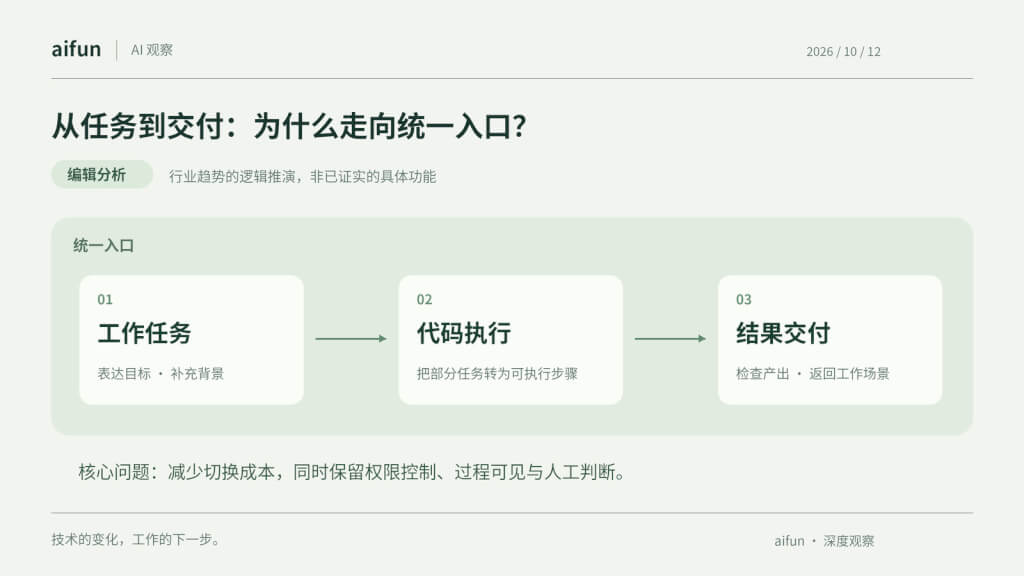
The purpose of merging is to eliminate handoff loss, not just to combine two icons.
For example, a small team preparing to launch a registration tool first needs to organize the rules, then generate the pages, integrate the data, and finally write a user guide. Switching tools takes only a few seconds; the real hassle lies in having to re-explain the project, move files, and confirm which version the changes were made in.
The TRAE announcement specifies that deliverables such as code changes, HTML, PowerPoint presentations, Word documents, images, videos, and reports will undergo a unified review and iteration process. This provides a concrete way to assess the value of the merger: Can a given requirement continue to be developed within the original project?
If, after the agent finishes a page, the IDE opens a different file; if the documentation still refers to the pre-modified features; or if returning to the task interface requires explaining the background all over again, then even though the product is integrated, the work remains disconnected.
Conversely, if the code, test results, and delivery specifications can be continuously updated around a single project, users are spared some of the invisible coordination effort. This is especially important for small teams, as they often lack a dedicated person to tie all the pieces together.
There’s also a business implication here: the more comprehensively a product covers all workflows, the greater the chance it will be used consistently. A user who creates a webpage today, edits a document tomorrow, and handles feedback the day after may return to the same entry point each time. But this is only true if every step of the process is well-designed—a list of features cannot substitute for usability.
Whether a membership business can grow depends on whether the new tasks are worth it.
According to the individual pricing page on TRAE China’s official website, the free version and the various membership tiers are differentiated by benefits such as points, concurrent cloud tasks, and priority support. The free version is listed as offering 500 points and two concurrent cloud tasks per month; the Pro tier is listed as offering 4,000 points and ten concurrent cloud tasks. Prices vary depending on the purchase method and available promotions.
This shows that product monetization is no longer just about “whether a particular feature can be unlocked.” Usage volume, wait times, and the number of tasks that can be processed simultaneously have all become part of the monetization strategy.
The merger of the two platforms may reinforce this pattern. Funds that were previously used solely for coding may now be applied to a wider range of project types; users who previously opened Office Assistant only occasionally may increase their usage frequency as they develop practical tools. This represents a business opportunity worth watching following the merger, but it is not yet possible to estimate revenue or paid conversion rates based on this.
For users, the issue is even more straightforward: How much of this additional resource consumption translates into valuable outcomes? If tasks require repeated retries or stall for long periods, the more resources are consumed, the greater the frustration. Users will not automatically accept more unpredictable costs simply because a product offers broader coverage.
Therefore, consumption alerts before a task begins, progress updates during the task, and how failures are handled can all influence a user’s willingness to pay. The closer a product is to fully automated execution, the more it needs to make it clear to users where their money is going.
For heavy users, the ability to work on multiple projects simultaneously may indeed provide a compelling reason to upgrade; for casual users, reliably completing a single small task is more important. The merged TRAE needs to prove that it can accommodate both of these priorities.
Whether existing users are willing to stay is the first hurdle after the merger.
A new entry point can reduce the decision-making burden for new users, but it may also disrupt the workflow that existing users are already familiar with. An engineer who opens the IDE every day might not view a new feature as an improvement if the update requires an extra step.
Users in the official community have already discussed the access points for the merged features and the migration of history records; some posts regarding access issues have been marked as resolved. While this feedback does not represent the experience of all users, it serves as a reminder to the product team that the smoothness of the migration is, in itself, an integral part of product quality.
TRAE has officially promised to preserve and migrate chat histories, accounts, local data, commercial points, and other content, while noting that the new version is still being rolled out in phases. It is important to distinguish between the promises made in the announcement and the actual upgrade results for each individual user. For those with important local projects, it remains a prudent practice to keep backups of their own projects.
From a business perspective, the value accumulated by existing users extends beyond code files to include keyboard shortcut habits, model selections, task history, and trust in the tool’s stability. If the merger were to render these accumulated assets obsolete, the benefits of expanding the user base might be offset by user churn.
A good upgrade should make both modes clear: beginners should know where to start, and experienced users should know how to pick up right where they left off. The more a product aims to serve a wider audience, the more it needs to avoid forcing everyone’s workflow into a single interface.
From “One-Time Use” to “Willing to Keep Using”
For AI development tools, creating a polished demo is no longer enough to demonstrate long-term value. It is the post-launch modifications, troubleshooting, changing requirements, and maintenance that will truly put the product to the test.
This TRAE merger offers a window into the question: When office tasks and the development environment are combined, will users actually complete more projects, or will they just see more buttons?
Three things to watch for moving forward: the percentage of general users who complete their first usable project; whether professional developers continue to use it as their primary tool; and whether existing projects can be smoothly modified several weeks later. These factors correspond to customer acquisition, retention, and long-term value, respectively—and are more closely tied to the business itself than the speed of a single generation.
ByteDance wants TRAE to take on a longer-term role, and there is a practical need for this approach. Whether this is feasible depends on whether the reduction in hassle resulting from the merger is sufficient to outweigh the new complexity it introduces.
Ultimately, the reason users are willing to continue paying should be that it truly makes their work easier.
© Copyright notes
The copyright of the article belongs to the author, please do not reprint without permission.
Related posts


No comments...
 简体中文
简体中文  English