Translate deep learning concepts into experiments that can be run and interpreted
After being introduced to large models, many people find themselves revisiting fundamental concepts such as training data, loss functions, overfitting, and evaluation. The 3rd edition of *Deep Learning with Python* offers a learning path that takes readers from basic concepts to practical models. It is ideal for readers who are willing to write code, observe results, and gradually develop technical judgment.
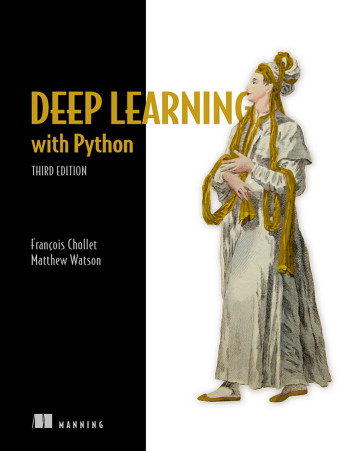
This entry introducesEnglish Original, 3rd Edition: Co-authored by François Chollet and Matthew Watson, published by Manning in September 2025, 648 pages, ISBN 9781633436589. According to the publisher, *Deep Learning with Python* has sold over 100,000 copies in total; this figure represents cumulative sales across all editions of the book and should not be interpreted as the sales of the 3rd edition alone, nor does it reflect its ranking on real-time bestseller lists in 2026.Verify the official bibliography and the basis for recommendations.
What levels of study does the new edition cover?
The official description covers the fundamentals of deep learning, Keras 3, an introduction to TensorFlow, PyTorch, and JAX, image and text tasks, time series, as well as generative content such as GPT-style models and diffusion models. Chollet is the creator of Keras, and Watson is also a core maintainer of Keras. The book requires an intermediate level of Python proficiency but does not require readers to have prior experience with machine learning.
- Understanding the Training Process:By linking the input data, model output, loss, and parameter updates, we can explain why changes occur during a single training run.
- Observing the common structure across different tasks:Image, text, and time-series data differ in format, but all require a clear problem definition, training split, and evaluation criteria.
- An Introduction to Generative Models:Understanding generative tasks based on existing neural network intuition makes it easier to see the connection between sampling, training objectives, and output quality.
Who should use this as their primary textbook?
Software developers with Python experience, learners looking to transition from using models to conducting training experiments, and data professionals who need to brush up on their deep learning fundamentals can all start with this book. Since it is quite lengthy, it’s best to study it in stages rather than running all the code at once.
If your most pressing task right now is to build a question-answering product, it might be faster to start by reading materials on applied engineering; if your goal is to delve into mathematical proofs, you’ll also need to supplement your knowledge with linear algebra, probability, and optimization. The hands-on coding exercises in this book can help you identify gaps in your knowledge, but they cannot replace every foundational course.
We recommend reading this in three stages.
- Establish a minimal training loop.Start by running a small-scale example, recording the data structure, model parameters, and training/validation metrics. Be able to explain situations where training performance improves but validation performance worsens, and then continue scaling up.
- Complete a reproducible task.Select the image or text orientation, fix the data partitioning and random seed, retain the baseline, and compare the differences resulting from a single specific change.
- Further exploration of generative AI.Save your input, configuration, and generated results; compare multiple samples; and distinguish between random good results and consistently valid ones.
A practical reading habit is to set aside three things after each chapter: a flowchart you’ve drawn yourself, a notebook with code you can run again, and a question that hasn’t been fully explained. That way, when you go back to review the book, you can quickly pinpoint the areas where you really need to brush up.
Differences from *Illustrated Guide to Large Models* and *Building Large Models from Scratch*
If you want to build a comprehensive practical foundation in deep learning through a variety of tasks, you should consider this book first; if you’d like to start by understanding language models through visualizations, you can use it in conjunction with"Illustrated Guide to Large Models"; If it has already been determined that we will delve deep into the internal implementation of the language model, then we can choose"Building Large Models from Scratch". Since each of these three focuses on different aspects, there’s no need to read them all from start to finish just to “keep up with the latest trends.”
Precautions Before Running the Example
First, make sure you are using the Version 3 supporting materials; do not mix them with installation instructions from older versions. Lock down dependencies according to project requirements, and record hardware specifications and runtime durations. When using cloud GPUs, set a budget first and ensure that idle resources can be stopped promptly. Just because a sample runs well for learning purposes does not mean it will perform equally well after you replace the sample data with actual business data.
In real-world projects, data permissions, outliers, privacy, and evaluation set leakage all require separate scrutiny. It is recommended to break down the question of “whether the model is useful” into observable questions: where do errors occur, what is the cost, and is it worth continuing to increase complexity?
The cover image is from Manning's official book page; copyright belongs to the respective rights holders. This page features original book recommendations and study tips; it does not provide unauthorized downloads of the entire book.Official Catalog, Sample Chapters, Supplementary Resources, and Purchase Information.


 简体中文
 English