
Noiz AI
Text-to-speech and video dubbing tools, with self-developed voice models to achieve high-quality, emotionally rich voice synthesis, suitable for multi-scene content creation.
A voice model designed for real-time business calls that allows responses to undergo a text review before they are spoken.
 Rime Prism
A voice model designed for real-time business calls that allows responses to undergo a text review before they are spoken.
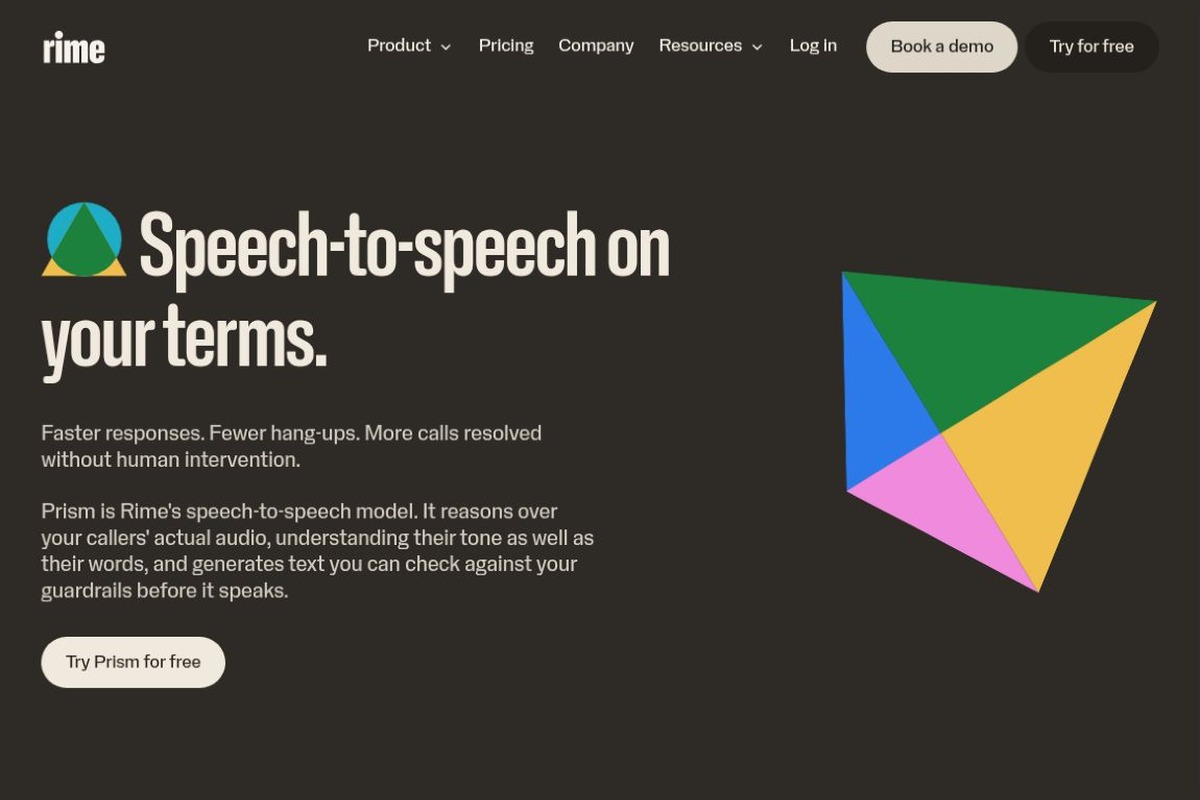
Prism is a speech-to-speech model launched by Rime, an enterprise voice AI company, primarily targeting call center customer service, food ordering, and other real-time conversational systems. Rime announced the product on October 28, 2026, Eastern Time, which corresponds to October 29, Beijing Time. Founded in 2022, the company focuses on enterprise conversational voice technology; Prism places an even greater emphasis on customizable, auditable, and deployable real-time voice interactions.Rime Issues an Announcement
For businesses, of course, voice is just one part of the equation. Customer service representatives must also follow refund policies, accurately repeat order details, obtain confirmation before charging or placing an order, and escalate complex issues to a human agent. Prism’s product design is worth noting precisely because it attempts to address both the call experience and business controls simultaneously.
Prism makes decisions directly based on the audio, first outputting the text to be spoken and then generating the speech. Applications can use this text stage to verify compliance with policies, mandatory prompts, and content requirements. This differs from approaches that simply transcribe the audio into text and feed it to a language model: here, the text serves as a checkpoint for verification, rather than the sole input. The product supports cloud, VPC, and on-premises deployment, and also offers options for fine-tuning using enterprise call data.Prism Product Page
Rime’s technical overview also highlights the integration of tool invocation and speech, as well as training based on real-world business calls. Its self-service reinforcement learning and supervised fine-tuning APIs are currently being developed in collaboration with pilot customers; the fine-tuning capabilities available for discussion with enterprises should not be interpreted as meaning that all accounts have already gained access to a mature, comprehensive self-service process.Official Technical Overview
- Companies that already have a voice agent development team: We hope to integrate the model with order, appointment, or customer service systems and control business operations.
- High-Frequency Repeated Call Services: The scope of the problem is relatively stable, and there are sufficient real-world samples, making it easy to assess the quality of task completion.
- Organizations with specific deployment location requirements: We need to assess how the private environment connects to the existing telephone and audit systems.
If you're simply creating voiceovers for short videos or reading a piece of text aloud, you generally don't need this type of full-fledged dialogue model. Prism is better suited for “understanding users, engaging in continuous interaction, and invoking business tools”—it's not just a simple voice-synthesis tool.
1. Create a free account on the official website to first verify whether the target voice, device, and network environment are functional.
2. Choose a task with clearly defined boundaries, such as checking an order status; connect to the test system first to avoid triggering actual charges or order changes during the trial.
3. Incorporate the required disclosures, conditions for refusing to answer, and rules for transferring to a live agent into the app workflow, rather than simply including them in a single prompt.
4. Conduct specific tests for situations such as user interruptions, long pauses, background noise, names and numbers, and “withdrawing a previous request.”
5. Record the task results, errors, manual interventions, and costs for each call. When fine-tuning or deploying on-premises is required, confirm the data requirements and delivery plan with Rime.
One practical evaluation criterion is “whether the system continues to execute the previous command even after the user changes their mind.” Another is “whether the system proactively asks for clarification when the order quantity is not clearly understood.” These criteria more closely reflect real-world risks than simply listening to a demo recording.
Prism has been added to the official price list. The Free plan offers a $50 monthly usage allowance; Flex is billed by audio call minutes, while Prism is $0.080 per minute; Scale costs $100 per month and includes a $100 credit; Prism costs $0.064 per minute, with a maximum rollover of $200. Enterprise uses custom pricing and offers benefits such as VPC/on-premises deployment, fine-tuning, and custom voices. The deployment locations listed for Free, Flex, and Scale are Rime Cloud; the private deployment promotion cannot be applied to Free accounts.Comparison of Official Prices and Plans
When estimating costs, in addition to the per-minute model fee, you should also factor in telephone lines, calls to business tools, storage, engineering maintenance, and manual intervention. A lower cost per minute does not necessarily mean a lower cost per successfully processed transaction.
|
offerings |
Main Routes |
A Situation Worth Considering Even More |
Key Considerations for Selection |
|---|---|---|---|
|
Rime Prism |
Audio comprehension combined with pre-speech text checkpoints; the enterprise solution offers fine-tuning and private deployment |
We need to refine the model based on regular business calls and retain output control. |
Fine-tune delivery, speech quality, and actual end-to-end latency |
|
Deepgram Voice Agent API |
By integrating speech recognition, language model orchestration, and text-to-speech into a single interface, you can import models or voices. |
We hope to retain component selection and reduce the effort required to integrate voice links. |
Component Compatibility, Billing Criteria, and Fallback Mechanisms |
|
Gemini Live API |
Real-time audio and visual interaction, with support for interruptions, tool invocation, and transcription |
Requires voice combined with video, images, or broader real-time interaction |
Cloud Services, Model Availability, and Session and Application Permission Boundaries |
Basis for Comparison:Deepgram Product and Technical Specifications,Gemini Live API Documentation. Deepgram also offers a self-hosted option, so “can be deployed on-premises” cannot be presented as a unique advantage of Prism.
The Prism page still states that dedicated documentation is coming soon. You should obtain specific details regarding the scope of Chinese language support, dialects, mixed-language capabilities, and hardware requirements for on-premises deployment before signing a contract, and verify this information using your own corpus. The number of languages supported by other Rime models does not equate to Prism’s language capabilities.
The customer trials and benchmark results presented by the official sources can serve as testing guidelines, but they do not guarantee performance in any industry. When evaluating a solution, you should standardize the test set, network environment, model configuration, and scoring methods, and separately observe response speed, task accuracy, the need for confirmation, and the rate of manual intervention. For teams that genuinely require high-frequency conversations, Prism offers clear value; however, for individual users without the integration and operational capabilities, it is not yet a complete, out-of-the-box customer service system.







 简体中文 简体中文
 English