
Qwen2.5-Max
The mega-scale Mixture of Experts model introduced by AliCloud's Tongyi Thousand Questions team stands out in the AI field for its excellent performance and wide range of application scenarios.
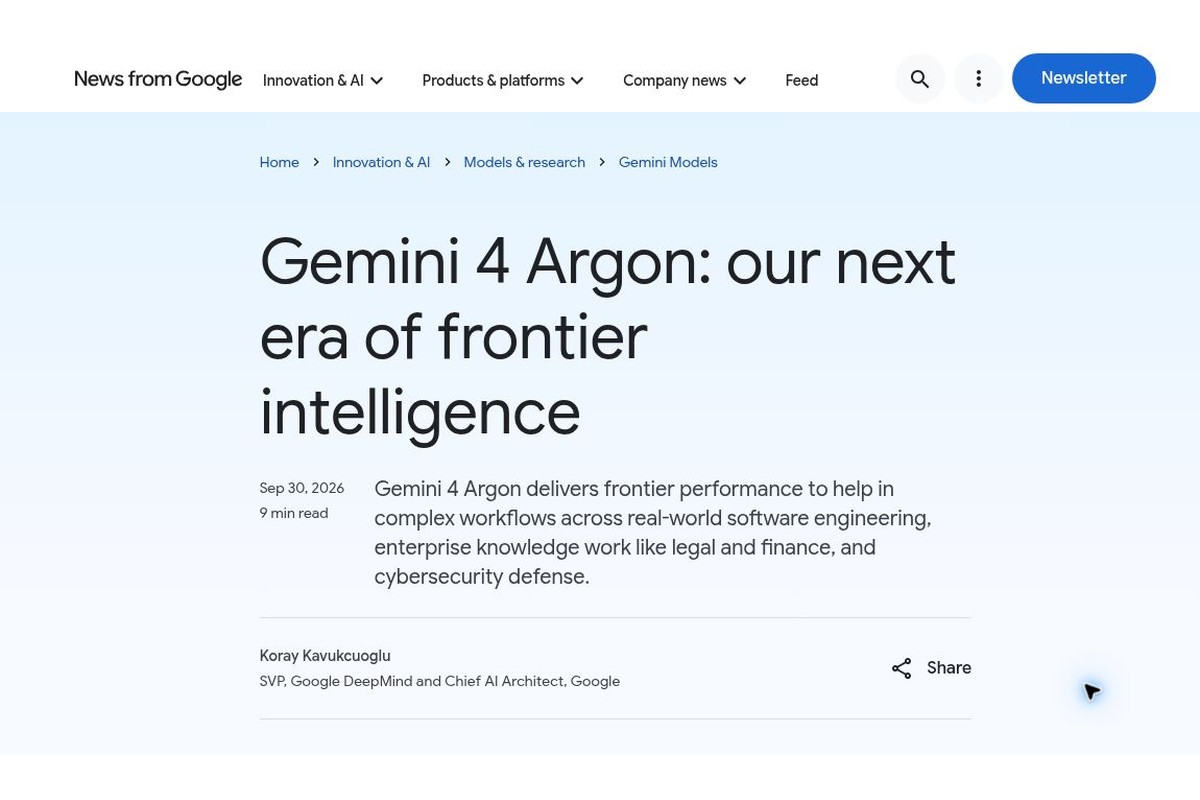
Google DeepMind's models for complex reasoning, software engineering, and multimodal long-form data analysis are available through the Gemini app, AI Studio, and APIs.
 Gemini 4 Argon
Gemini是Google DeepMind研发的multimodal模型系列。Gemini 4 Argon面向需要持续推理的复杂任务,包括软件工程、多资料分析和科学研究。它于2026年9月30日公布,最初通过Fairwind计划向受信任的网络防御伙伴开放;10月13日扩展至开发者、企业和消费者渠道。此次升级的价值不只是回答问题,而是把读资料、制定方案和调用工具串成多步骤工作流。
gemini-4-argon, set the inference level to "low," "medium," or "high" based on the task.Argon on the Gemini API does not offer a free tier. Standard pricing through November 30, 2026, is $2 per million input tokens and $10 per million output tokens; the official announcement states that these rates will adjust to $4 and $20, respectively, starting December 1. Keep in mind that tokens are counted as output; tools such as search may incur separate charges, and an application subscription does not equate to API quotas.
Argon does not generate images or audio on its own and does not support the Live API; desktop operations are limited to preview functionality. The model’s knowledge is current as of March 2026, but it may still fabricate information or experience slow responses or timeouts. Legal, financial, and scientific materials, in particular, require professional review. AI Studio and the API are subject to regional availability, account requirements, and quota limitations; please check the official list of supported regions first.
| mould | Focus | Things to Keep in Mind When Choosing |
|---|---|---|
| Gemini 4 Argon | Multimodal Long-Form Data, Complex Reasoning, and the Google Tool Ecosystem | The API does not offer a free tier; long outputs and tools require separate configuration. |
| GPT-6.1 Terra | Visual Comprehension, Computer Skills, and Everyday Writing | Native input types are text and images; native audio and video input is not supported. The tool requires the Responses API to function. |
| Claude Sonnet 5.5 | Routine work with clearly defined boundaries, code fixes, and documentation creation | Inference intensity affects speed and cost; complex tasks should be evaluated using real-world samples. |
If you have a large amount of multimedia content, consider Argon first; if screen-based operations are a priority, compare it with Terra; if you frequently edit documents and code, compare it with Sonnet. This comparison is based on official positioning and capability limits and does not represent a performance ranking under uniform conditions.


 简体中文 简体中文
 English