Why We Recommend This Series
Just because you can call a model’s API doesn’t mean you understand why the model works the way it does. *Machine Learning Methods (2nd Edition)* is designed to address the latter issue: it helps you fit disparate algorithm names into a systematic framework and gradually understand how they define tasks, optimize objectives, and complete the learning process. It is a technical reference that requires a time investment, not a quick-start guide to AI tools.
Author and Authentic Version
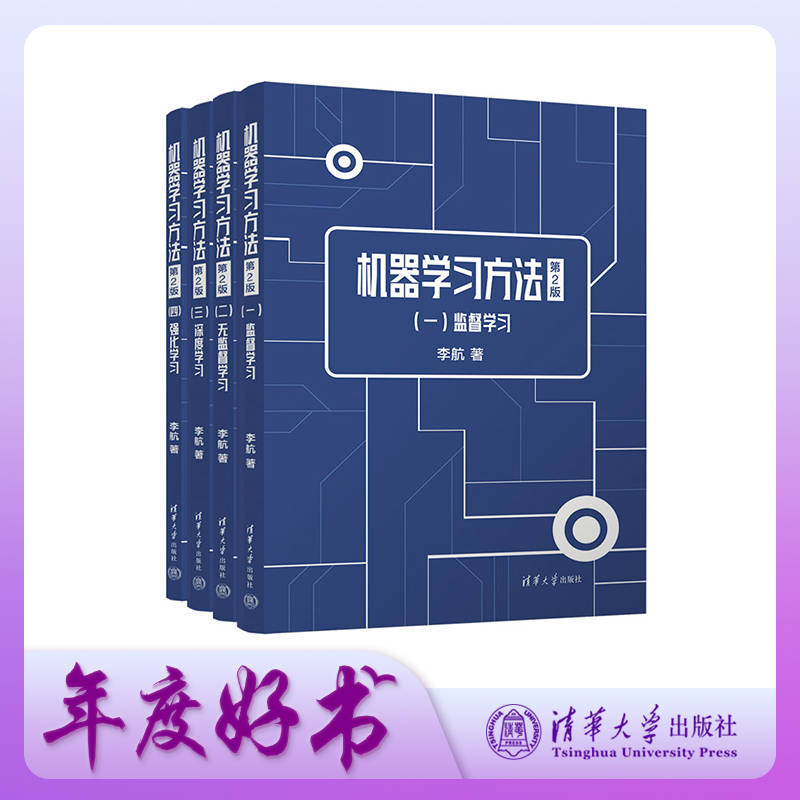
The author, Li Hang, has long been engaged in research in the fields of machine learning and natural language processing. This entry refers to *Machine Learning Methods (2nd Edition)*, published by Tsinghua University Press on July 1, 2025, with ISBN 9787302696469. It is a continuation of *Statistical Learning Methods*, but the titles, editions, and ISBNs of the two books should not be used interchangeably.
Creating a Methodology Map in Four Dimensions
This edition is a four-volume set. The book is divided into four parts: supervised learning, unsupervised learning, deep learning, and reinforcement learning. It covers both foundational methods—such as linear models, support vector machines, and clustering—as well as more advanced topics, including Transformers, diffusion models, and reinforcement learning techniques. A key feature of this book is its focus on explaining models, strategies, and algorithms, supplemented by examples, derivations, and exercises to aid understanding.
Who Is This Book For?
This series is suitable for students majoring in computer science, artificial intelligence, and related fields, as well as for algorithm engineers and R&D professionals seeking to strengthen their theoretical foundation. It is recommended that readers have a basic understanding of linear algebra, probability and statistics, and calculus before beginning. If your current goal is simply to write prompts, perform office automation tasks, or stay informed about industry trends, you may want to start by reading applied or popular science books before deciding whether to proceed with this textbook series.
A More Practical Approach to Reading
It’s not recommended to treat “reading from the first page to the last” as your sole goal. Instead, start by selecting a chapter related to the task at hand, identify the input, output, and loss function, and then try to reproduce the key steps using a small dataset. When it comes to derivations, simply understanding the last line isn’t enough; it’s best to be able to explain why each intermediate step holds true.
After completing a chapter, compare the two methods using the same task: how much data is required, what the training and inference costs are, whether the assumptions hold, and where the errors lie. These small experiments can help translate mathematical understanding into engineering judgment and can also reveal knowledge gaps that are difficult to identify through reading alone.
Reading Limits and Pairing Recommendations
This book serves as a useful reference for fundamentals and methodologies, but for data governance, deployment monitoring, API versioning, and the operation of specific frameworks in production environments, readers should consult specialized resources. Compared to *A Brief History of Artificial Intelligence*, which focuses more on historical context, this book places greater emphasis on mathematics and algorithms; and compared to product management methodologies, it focuses on the methods themselves rather than on requirement prioritization and business design.
Official Source
Tsinghua University Press: Book Information, Catalog, Author Biographies, and Book Covers



 简体中文
 English