Integrate the conversational model into a testable workflow
Creating a demo that can provide responses is often just the starting point for AI application development. Once the system is actually put into use, developers must also answer the following questions: What tools can it call upon? Where does it stop when a task fails? Does the retrieved information support its conclusions? Can a response that appears successful on one occasion be reproduced? “AI AgentThe second edition of *S in Action* is ideal for reading while reflecting on these questions.
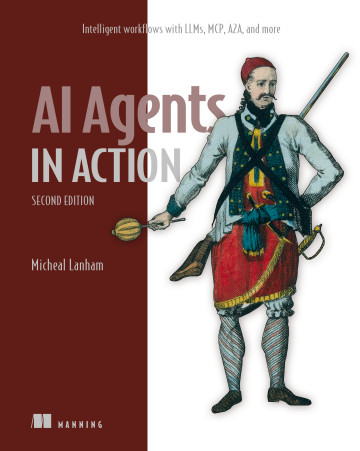
This entry introducesEnglish Original, 2nd Edition, authored by Michael Lanham; the official Manning book page lists the publication date as June 2026, 392 pages, ISBN 9781633434530, and provides resources for the e-book, paperback, and table of contents. Verified on October 17, 2026. The reason for recommending this book is the relevance of its focus on Agent practices to the content of the new edition; it is not being labeled as the day’s bestseller.View Publisher Information and Edition Details.
Research Path: From a Single Agent to an Observable Collaborative System
The publisher lists the key features of this new edition as integration with tools and MCP, reasoning and planning, knowledge and memory, evaluation and feedback, and multi-agent processes. It is intended for readers with intermediate Python skills and does not require prior experience in agent development. The author has extensive experience in software development and has also written technical books on deep learning.
- First, clarify the task and context:As you read, try to write a minimal task description that clearly defines the input, output, and termination conditions, and avoid using loops to handle problems with vague objectives.
- Check the tool boundaries again:For each callable tool, document its purpose, parameters, failure responses, and scope of authorization. When studying MCP, it is especially important to distinguish between a successful connection and the correct execution of a business operation.
- Is it helpful to use tests to assess memory?Prepare a few questions that require research so you can compare the evidence supporting the answers before and after conducting a search. Don’t assume that a longer answer is necessarily better.
- Finally, consider multiple roles:First, maintain the single-agent baseline, then try splitting the tasks; compare the results in terms of quality, time, and cost to determine whether collaboration truly solves the problem.
Who Is This Book For?
If you already know how to write Python scripts and call APIs, and want to build a knowledge base assistant, an internal workflow assistant, or a multi-step research tool, you can use this book as a starting point for your projects. Product and technical leads can also use the table of contents to understand the engineering process, but to evaluate the quality of the implementation, you’ll still need to work with colleagues who can read code and write tests.
For readers with absolutely no programming background, we recommend first familiarizing yourself with functions, exception handling, HTTP requests, and virtual environments. If your goal is simply to improve your everyday chat prompts, investing time in an entire technical book might be a bit much; you can start by reading the official preview before deciding whether to follow along with the project.
I suggest doing a very short exercise.
- Select a read-only task.For example, answer questions using information you are authorized to access; do not use the email, payment, or delete functions at this time.
- I've compiled a dozen or so test questions.Include scenarios such as missing information, conflicting data, and unavailable tools, and specify what constitutes an acceptable answer.
- Save the route.Observe the search, tool invocation, retry, and termination processes, and use the same set of questions to compare the results before and after the modifications.
- Add only one ability at a time.First, implement the tools; then, perform retrieval and memorization; finally, attempt multi-role collaboration, while retaining a simple version that allows for rollback.
How to Pair It with Other Books on the Site
This book can serve as a resource for the Agent specialization practical assignments. If you’d like to start by planning the application of large models from the perspectives of quality, cost, and evaluation, you can use it in conjunction with"AI Engineering"; If you want to learn more about the model's internal attention mechanisms and training methods, you can turn to"Building Large Models from Scratch". When choosing a book, first determine whether you want to improve your application workflow or your model implementation; this will make your learning path clearer.
Things to Know Before You Read
The Agent framework and APIs change rapidly. We recommend using the code and errata linked in the publisher’s resources section; first verify the dependency versions, then run the examples. The demonstrations in this book do not automatically guarantee the security of production systems; when handling real user data or performing external operations, you must also implement least privilege, manual verification, budget limits, and timeouts. Evaluation results should also include records of failed cases; a single successful demonstration should not be taken as a substitute for reliability testing.
The cover image is from Manning's official book page and is used solely for identification and introduction purposes; copyright belongs to the respective rights holders. The main text consists of book recommendations and reading suggestions; the bibliography and scope of content are subject to the publisher's page.Official Catalog, Sample Chapters, and Purchase Information.



 简体中文
简体中文  English