
Tongyi Xiaomi
The intelligent, multi-modal enterprise service solution launched by Aliyun supports the integration of omni-channel contact centers with AI applications, helping enterprises to improve service efficiency and customer satisfaction.
A customer service platform that offers AI agents, customer service assistants, and ticket collaboration, combining a knowledge base to handle inquiries and transferring them to human agents as needed.
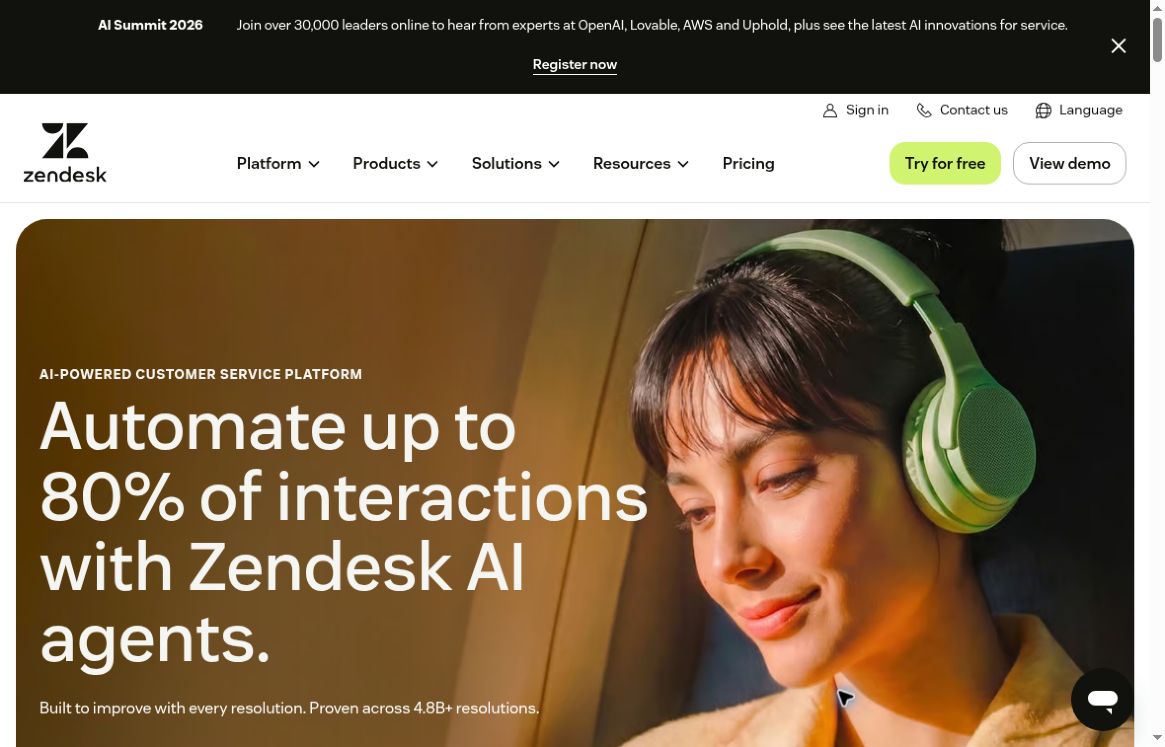
Zendesk is an enterprise platform for customer and employee service that combines tickets, knowledge base content, communication channels, human support teams, and AI automation to help businesses consistently handle inquiries and issues. Its AI products are not standalone, general-purpose Q&A tools; rather, they operate based on a company’s knowledge and business processes: AI agents for customers handle automated responses and issue resolution, while Agent Copilot for support agents helps them understand tickets, prepare replies, and move tasks forward. Companies can implement these capabilities in phases, rather than handing over all service processes to AI at once.
Zendesk was founded in Copenhagen, Denmark, in 2007 by a team that included Mikkel Svane, Morten Primdahl, and Alexander Aghassipour. Its early product was cloud-based help desk software. On March 26, 2025, the company launched the Zendesk Resolution Platform, integrating agents, knowledge, business actions, governance, and performance analytics into a problem-solving-centric platform. In 2026, Relate further announced plans to expand dedicated agents, cross-channel capabilities, and Copilot. Some of these new features are being rolled out via early access or phased releases; actual availability depends on account verification.Company History|Founding Team|Resolution Platform Launched
Knowledge-Driven Automated Services:AI agents can generate responses using the help center or connected knowledge sources, and gradually expand to handle business processes involving multiple steps. For scenarios requiring highly fixed processes, scripted conversations can be used; for tasks that need to progress based on context, generative workflows can be configured and then connected to authorized actions and external systems. Capabilities vary across different channels, so the correspondence between features and channels should be verified before deployment.Introduction to AI Agents
Live Customer Service Support:Agent Copilot covers areas such as ticket summaries, suggested first replies, macro suggestions, text optimization, references to similar tickets, and intelligent categorization. It is designed to help agents quickly understand lengthy conversations, reduce repetitive writing, and continue handling cases within the same work environment. Summaries can reduce the burden of sifting through information, but customer service representatives still need to verify key facts—especially any commitments previously made to the customer, the timing of the issue, and the resolution steps already attempted.Agent Copilot Documentation
Service Governance and Continuous Improvement:The Resolution Platform uses knowledge, actions, governance, and analytics as a common foundation, with the goal of not only reducing the time to first response but also ensuring that issues are resolved. The product roadmap for 2026 continues to expand capabilities for administrators, knowledge management, and analytics-driven support. For operations teams, the most valuable insights come from identifying which inquiries frequently fail, which content is outdated, and at which points manual intervention is required—and then adjusting the system accordingly. We cannot assume that the service experience was successful simply because the customer did not send any further messages.2026 Product Updates
E-commerce and subscription services can first have AI handle standard inquiries such as shipping instructions, product usage guidelines, and account operation instructions; for processes that require accessing order information or making changes, reliable identity verification and system actions must be configured first. Software companies can organize help documentation, known issues, and troubleshooting steps into a knowledge base, allowing AI to assist in pinpointing problems, while reserving complex issues and cases requiring engineering investigation for human intervention.
For customer service teams that have already reached a certain scale, Copilot is often a more manageable starting point for risk mitigation: the AI organizes the context and offers suggestions, while customer service representatives retain the final say on what to send and how to handle the interaction. Businesses operating across multiple brands and channels need to prioritize knowledge isolation, brand tone, and continuity of handoffs to ensure customers don’t have to re-explain their entire issue when switching from chat to email.
If a company’s knowledge is primarily scattered across employees’ experiences and casual conversations, it should first establish consistent, standardized answers. AI cannot replace missing policies, and it should certainly not be used to make up refund eligibility criteria, service terms, or compensation promises on the spot. For complaints, legal disputes, payment anomalies, and inquiries involving sensitive data, it is recommended to establish clear escalation rules in advance rather than waiting to remedy the situation after the system has provided an incorrect response.
Step 1: Conduct a sample analysis of existing work orders and select a category of issues—one with a high volume, consistent rules, and manageable risk—to serve as a pilot. Define success criteria as verifiable outcomes, such as the user being able to complete the operation or clearly knowing when manual intervention is required. Step 2: Organize the Help Center: Clearly state the applicable conditions, resolution steps, exceptions, and last updated dates for each article; remove conflicting content to ensure that external documentation aligns with internal processes.
Step 3: Configure the communication channels you plan to enable, create an AI agent, and select the brand, knowledge sources, tone, and language. When cross-system processing is required, add workflows and actions for specific tasks; do not grant permissions beyond what is necessary for the business at the outset. Step 4: Use test questions to cover normal requests, ambiguous queries, missing information, and unauthorized requests, and verify that necessary context is retained when the interaction is transferred to a human agent. For actions that modify orders or accounts, validate the results in cases of incorrect input or repeated execution.
Step 5: Launch on a small scale and conduct ongoing spot checks. In addition to response speed, you should also evaluate actual resolution rates, repeat contacts, the quality of manual handoffs, and customer feedback. Zendesk’s AI agent usage is measured by automated resolutions; any plans that include usage quotas and rules for additional consumption are subject to your current subscription terms; Copilot and advanced capabilities may also involve different licensing terms. When selecting a solution, factor in the costs of the base platform, human agent seats, AI usage, external integrations, and implementation and maintenance. Generative features may still produce inaccurate outputs, so clear boundaries for human intervention are required for sensitive commitments.Generative AI Overview
together withIntercom FinIn contrast, both platforms distinguish between customer-facing agents and agent-facing assistance capabilities. Intercom’s official workflows emphasize the integration of Fin, Copilot in Inbox, and automated processes; Zendesk, on the other hand, organizes its services around existing tickets, the knowledge base, communication channels, and the Resolution Platform. Teams already using Zendesk’s ticket system can first evaluate a native upgrade; teams currently using Intercom’s conversation environment should assess the integration costs associated with the native Fin. What’s truly worth testing are the response criteria for the same issue, handover processes, and channel coverage.Fin and Copilot Instructions
together withFreshdesk's Freddy AIIn comparison, both cover automated services, customer service support, and operational insights. Freshworks officially refers to Freddy as AI Agent, Copilot and Insights offer capabilities tailored to customers, customer service representatives, and managers, respectively. Budget-conscious teams should base their calculations on actual seats and inquiry volume, rather than simply comparing advertised starting prices or maximum automated resolution rates; teams with complex operations should further evaluate requirements for knowledge governance, integration methods, auditing, and manual intervention.Introduction to Freshdesk AI

 简体中文 简体中文
 English