
CosyVoice
Alibaba's open-source large-scale speech model supports zero-shot cloning in 3 seconds, multilingual capabilities, and command-based emotional control, enabling ultra-low-latency streaming synthesis at 150 ms.
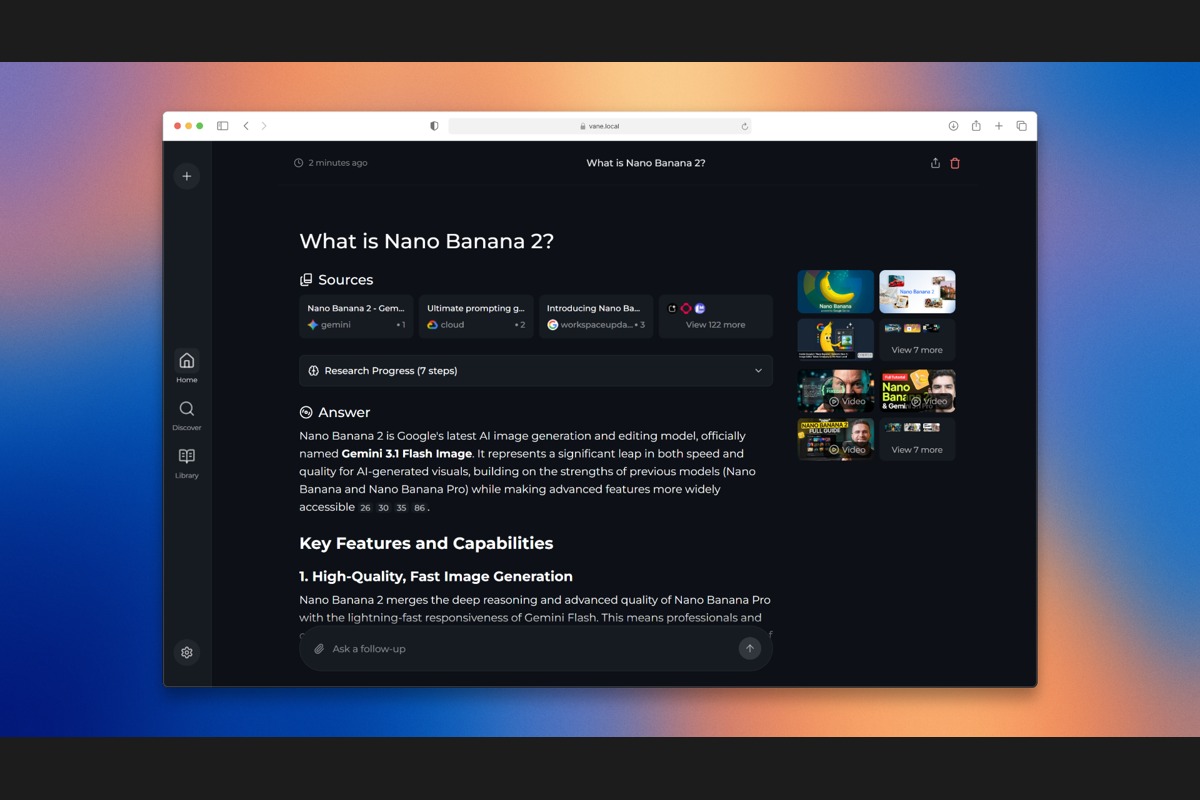
Formerly known as Perplexica, this self-hosted, open-source AI search engine combines online search with local or cloud-based models to generate answers with citations.
 Vane (formerly Perplexica)
Vane is the current name for the former Perplexica project, maintained by Kushagra Srivastava (GitHub username ItzCrazyKns) and community contributors. The old repository has been redirected to Vane, so both names refer to the same project. It integrates web search, content retrieval, and large-model responses into a self-deployable search interface, making it suitable for technical users who want to control their choice of models and deployment methods.
As of October 26, 2026, the official GitHub repository has accumulated approximately 37,800 stars and is licensed under the MIT License. The high number of stars reflects community interest but does not guarantee that every answer is accurate, nor does it mean the project was just released today. The latest official release is v1.12.2, dated April 10, 2026.
Vane is ideal for developers building personal search assistants, technical teams validating local models through Q&A, and researchers conducting preliminary analysis of viewpoints across multiple web pages. It is closer to a ready-to-use, interactive product than a simple web crawler or parsing library, but it still requires deployment, model configuration, and service maintenance. If you’re simply looking for a low-maintenance, everyday search tool, a hosted service is usually more convenient.
When it comes to research, the most useful approach is not to “draw conclusions for you,” but to integrate searching, reading, and citing into a single process. Important facts should still be verified by clicking through to the source, especially dates, numbers, policies, and controversial conclusions.
| sports event | Primary Focus | user-friendly | Responsibilities |
|---|---|---|---|
| Vane | With citationsAI searchQ&A App | Technical users who wish to deploy the search interface themselves | Models, Search Services, Access Control, and Answer Verification |
| Crawl4AI | Web Scraping and Data Cleaning Component | Developers who build their own data pipelines | Collection Policies, Frequency, Structuring, and Source Permissions |
| Docling | Complex Document Parsing Component | Team for Processing PDF and Office Documents | Document Conversion, Sampling Verification, and Subsequent Retrieval Integration |
Vane is closer to a final Q&A interface, while the other two are geared toward data input and processing. It makes more sense to base your choice on whether you need a ready-made interface, the data type, and maintainability, rather than just looking at the number of stars.
Open-source at MIT does not mean zero operating costs: on-premises models require hardware resources, and cloud-based models may charge per call. Self-hosting does not equate to being completely offline or ensuring absolute privacy; online searches involve interactions with search engines and external websites, and when using cloud-based models, relevant content is also sent to the model provider. Before using sensitive data, you should clearly understand the complete data flow and the provider’s policies.
Please note that the accuracy of the responses is not guaranteed. Results may be affected by the quality of upstream search data, model capabilities, context length, and network connectivity. The Tavily and Exa integrations marked as “coming soon” in the official roadmap should not be considered supported features. Release notes should be reviewed in conjunction with the actual installed version.
GitHub Repository and Installation Documentation - v1.12.2 Release Notes - MIT License
Screenshots and Logos: Vane Project, Copyright © 2026 ItzCrazyKns, MIT License. Links to the official repository and license are retained; the answers shown in the interface examples do not serve as factual basis for this article.


 简体中文 简体中文
 English