What is Paperclip?
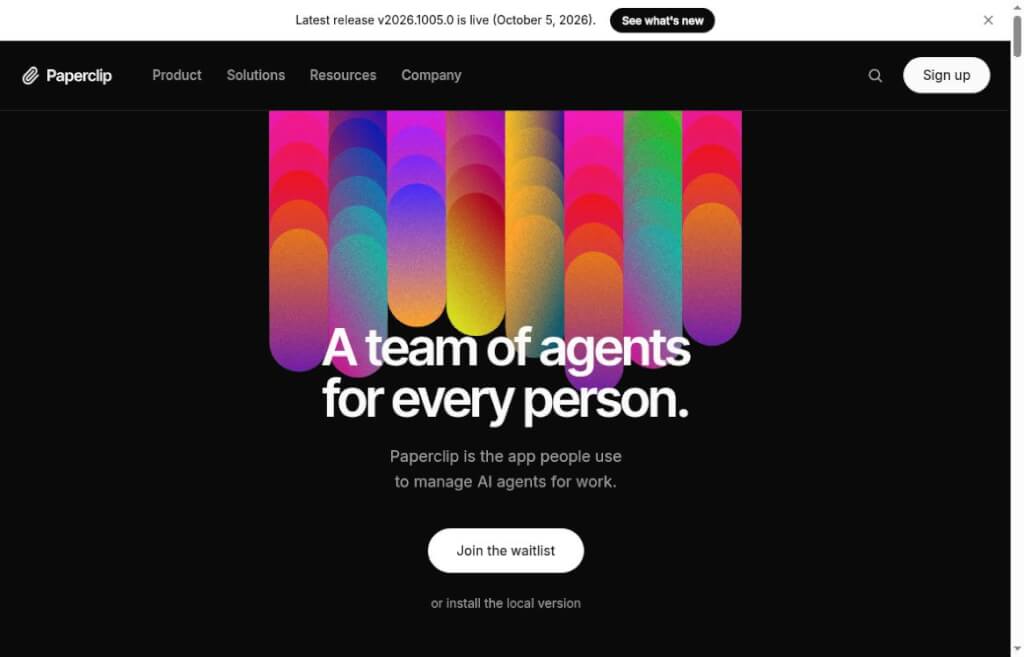
Paperclip is an open-source multi-agent collaboration platform licensed under the MIT License. Through a Node.js service and a visual interface, it centrally manages the tasks, goals, budgets, permissions, and work logs of various AI agents. It is ideal for individual developers and small teams who already use multiple code assistants or automation tools and want to reduce the need to switch back and forth between the terminal and their tasks.
Version v2026.1005.0 introduces features such as agent-level cross-task file sharing and GitHub skill synchronization, making it easier to reuse existing data and team skills across different tasks. Before deployment, you must verify the integration method, runtime permissions, and model costs for the agents you plan to use.
core functionality
- Unified Task Management:Keep task descriptions, discussions, deliverables, and activity logs all in one place to make it easier to track progress, review results, and resolve roadblocks.
- Multi-Agent Orchestration:Assign roles, objectives, and models to different agents, integrate them with existing operational tools, and ensure that their respective tasks are aligned with a common goal.
- Budgeting and Cost Control:Track reported expenses by organization, project, or entity; set budgets and alerts to help identify unusual spending; and always reconcile final invoices with the model provider.
- Approval and Governance:Configure review stages and permission boundaries, ensuring human intervention before critical operations, and allowing tasks to be paused, reassigned, or stopped.
- Skill and Context Management:The maintenance team shares skills and historical data, and by combining this with the recently added ability to retain documents and synchronize skills, they reduce the need to prepare materials repeatedly.
Target Audience and Practical Value
When running multiple AI assistants simultaneously, the challenge often lies in knowing who is responsible for what, how much each has cost, and where the results are. Paperclip consolidates these management tasks into a single interface, making it ideal for multi-step workflows such as R&D, data organization, or content collaboration. Users who only occasionally use a chat assistant, however, may not need this management system for the time being.
The platform requires users to integrate agents and models on their own; business operations cannot be completed automatically simply by installing the interface. The cost of the open-source software itself is separate from the costs associated with external models, cloud sandboxes, and connectivity services; users should set a budget and confirm the billing method before running the software. The completion status of a task does not guarantee the reliability of the results; important deliverables still require manual verification.
Procedure for use
- Read the official installation instructions and ensure you have Node.js 24.11 or later installed. Source code development also requires dependencies such as pnpm and the native runtime; check the requirements based on your chosen deployment method.
- First, set up a local test instance and complete the initialization. The project provides an embedded PostgreSQL instance, which is a good way to familiarize yourself with the task interface and data storage methods.
- Integrate a selected agent and model, assign specific subtasks, and set the budget, file scope, and approval steps.
- After reviewing the execution logs and outputs, add additional agents; when using the system remotely, enable authentication and appropriate private network access as described in the official deployment documentation.
By default, the local loopback mode is intended for local use and should not be exposed to the public internet without proper configuration. Before integrating with code repositories, browsers, and third-party services, you should verify credential permissions and data flow. Automated operations may still result in errors; it is recommended to start with low-risk tasks and maintain backups of critical data.
Comparison with Similar Solutions
| programmatic | main application | Recommendations for selection |
|---|---|---|
| Paperclip | Centralized management of tasks, budgets, and approvals for multiple agents | Ideal for teams that need to collaborate continuously and review results |
| Single Coding Assistant | Complete the development work around a single session | Suitable for scenarios where tasks are relatively concentrated and there is little need for collaborative management |
| General Task Board | Track tasks, progress, and to-do items | Agent execution, model cost, and access logic must be configured separately. |
Project Address
- Official website: Learn about the product's positioning and the latest developments.
- GitHub Repositories: Get the source code, MIT license, installation instructions, and embedded demo video.
- Official Documentation: View deployment, agent onboarding, and permission configuration.
data statistics
Relevant Navigation

A Microsoft open-source framework that automatically optimizes agent skills—just like training a neural network—without fine-tuning the model, enabling consistent improvement in capabilities and cross-environment transfer.

Figma AI
The intelligent design assistant integrated into the Figma platform dramatically improves design efficiency and collaboration through natural language generation, layer optimization and content filling.
Ask ChatGPT

DeepSeek-R1
The AI model, which is open-source under the MIT License, has advanced reasoning capabilities and supports model distillation. Its performance is benchmarked against OpenAI o1 official version and has performed well in multi task testing.

R1-Omni
Alibaba's open-source multimodal large language model uses RLVR technology to achieve emotion recognition and provide an interpretable reasoning process for multiple scenarios.

PromptEnhancer
Tencent's open source Chinese text-to-image prompt word enhancement framework that optimizes user-input prompts and improves the image quality and semantic accuracy of the generated model.

AutoGPT
Based on the GPT-4 open-source project, integrating Internet search, memory management, text generation and file storage, etc., it aims to provide a powerful digital assistant to simplify the process of user interaction with the language model.

QwQ-32B
Alibaba released a high-performance inference model with 32 billion parameters that excels in mathematics and programming for a wide range of application scenarios.

Chitu
The Tsinghua University team and Qingcheng Jizhi jointly launched an open source large model inference engine, aiming to realize efficient model inference across chip architectures through underlying technological innovations and promote the widespread application of AI technology.
No comments...
