
Pika
Valued at over $470 million, focused on AI video generation, founded in 2023, based in California, USA
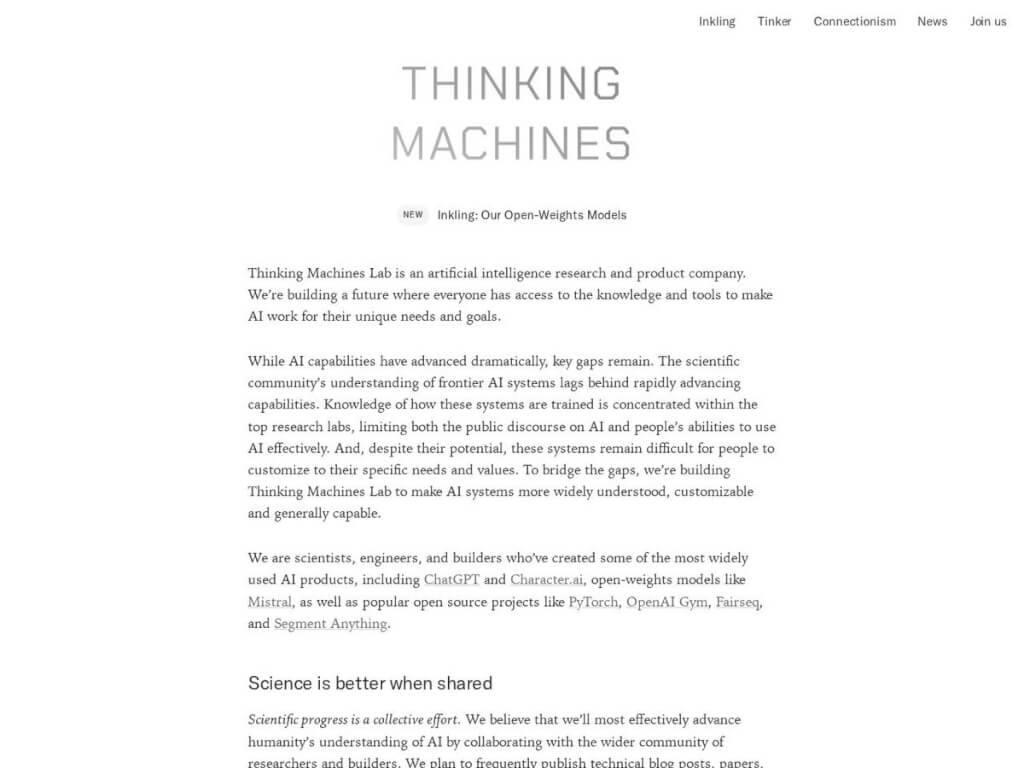
Thinking Machines Lab, founded by Mira Murati, develops customizable multimodal AI and serves developers through the Tinker training platform and the Inkling open-weight model service.
Thinking Machines Lab is a U.S.-based artificial intelligence research and product company founded by Mira Murati. It aims to make AI easier to understand, adapt, and apply to the practical needs of different people, with a focus on human-machine collaboration, multimodal interaction, and model customization. The company was named to Forbes’ 2026 AI 50 list.
The team has experience with foundational models, AI products, and open-source infrastructure. Their public roadmap encompasses both research and application: they gather real-world feedback through their products and then feed these insights back into the development of models and training systems, rather than simply pursuing individual scores in general-purpose tests.
In 2025, the company unveiled its research philosophy to the public and launched Tinker on October 1, enabling researchers to perform post-training on models via an API. In December 2025, Tinker entered general availability and added support for visual inputs, as the platform gradually transitioned from early beta testing to broader adoption by developers.
In July 2026, the company released the Inkling and Inkling-Small open-weight models, which support text, image, and audio input. It subsequently announced a research grant program focused on security and interaction, encouraging external teams to conduct research on model customization, real-time multimodal collaboration, and security evaluation. By October 2026, open models and training services had become parallel product lines, allowing users to either leverage existing capabilities or perform fine-tuning tailored to their specific tasks.
Tinker separates training algorithms from low-level computation management: researchers can organize steps such as forward passes, backpropagation, and sampling, while the infrastructure handles cluster-level complexities. The platform uses parameter-efficient fine-tuning methods, such as LoRA, to enable multiple training tasks to share computational resources; this combines the flexibility of algorithm design with the convenience of resource management.
Inkling employs a hybrid expert architecture and supports native multimodal input. The open-source nature of the model’s weights enables teams to inspect the model, customize it, and choose their deployment method; however, “open-source” does not automatically equate to unrestricted use—users must still review the applicable license and model card. The company also emphasizes red team testing, post-deployment monitoring, and the continuous improvement of security practices through experimentation.
When actually using Tinker, developers still need to prepare training examples and independent evaluation data to verify whether model improvements can be transferred to unseen tasks. The platform handles computational management but does not decide on behalf of users what constitutes the correct answer. For domain-specific models, experts can first define the task and design feedback, then observe the results through small-scale experiments to avoid deploying the model to real-world operations simply because the training loss has decreased. Multimodal inputs also require corresponding testing to ensure that key information in images or audio is not overlooked.
From the perspective of a dual-track approach combining platforms and models, Thinking Machines Lab is poised to serve researchers and companies seeking to adapt general AI to industry-specific tasks. Training tools, open-source models, and practical examples can form a mutually reinforcing ecosystem, encouraging more teams to participate in experimentation and provide feedback.
The scope for growth depends on the model’s actual capabilities, training costs, infrastructure stability, and the ease of use of the tools. Customizability does not mean that companies can simply upload data and receive a reliable system; it also requires data governance, evaluation datasets, and deployment reviews. Its long-term advantage will be reflected in its ability to help users achieve consistent, reproducible, and explainable improvements—rather than merely providing more training options.


 简体中文 简体中文
  English