
Cohere
Valued at over $5 billion, focused on AI big model R&D, founded in 2019 and headquartered in Toronto, Canada
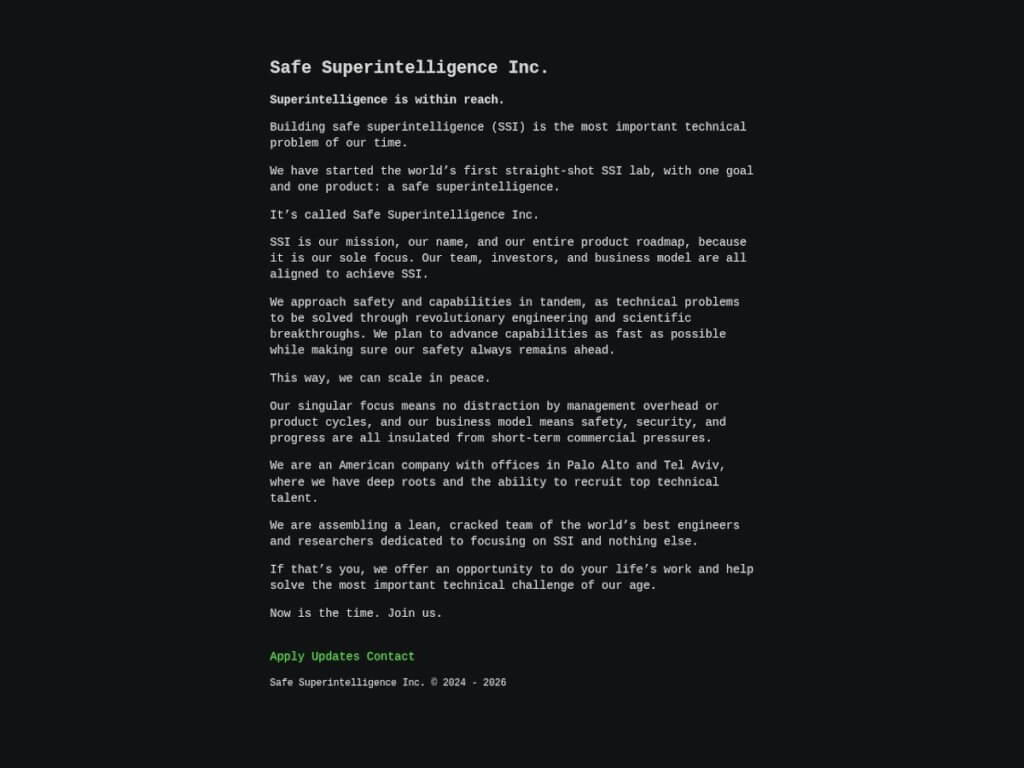
Founded by Ilya Sutskever and others, Safe Superintelligence focuses on research into safe superintelligence, advancing capability expansion, safety, and long-term computing capacity development in parallel.
Safe Superintelligence Inc.简称SSI,是一家2024年成立的人工智能研究公司,在美国帕洛阿尔托和以色列特拉维夫设有团队。公司由Ilya Sutskever等人创办,把开发安全的超级智能作为长期目标。它入选福布斯2026年度AI 50榜单,但这一荣誉不意味着该目标已经实现。
SSI employs a highly centralized research structure. Its official website treats capabilities and security as technical challenges that must be addressed simultaneously, and emphasizes minimizing the disruption that short-term product cycles can cause to research. Compared to companies that primarily showcase chat applications or developer APIs, SSI discloses fewer product details publicly; to understand its positioning, one must distinguish between its research vision and the capabilities it has already delivered.
On September 4, 2024, SSI announced that it had secured $1 billion in funding from investors including NFDG, a16z, Sequoia, DST Global, and SV Angel. On July 3, 2025, the company announced its management structure: Ilya Sutskever officially assumed the role of CEO, Daniel Levy became President, and the company confirmed that Daniel Gross had left the company.
In July 2026, SSI and NVIDIA announced a long-term strategic partnership involving investment, computing resources, and technical collaboration on computing platforms. Both parties stated that they would leverage the Vera Rubin platform to expand their research capabilities. The announcement outlines future expansion plans and should not be interpreted to mean that all computing resources have already been delivered or that research results have been commercialized.
SSI has not yet disclosed the architecture, training processes, or security evaluation results necessary to fully reconstruct its model; therefore, one cannot infer—based solely on the founders’ past experience—that the current project uses a specific algorithm or has achieved a certain level of intelligence. A well-established technical principle is to advance safety and capability in tandem, ensuring that safety remains a priority as capabilities expand.
The 2026 collaboration announcement noted that the company is exploring a new research direction and believes the related research warrants scaling up computational resources. While computational power can support more comprehensive experiments, the reliability of the model still requires evaluation, adversarial testing, and externally verifiable evidence. The most critical limitation at present is that research objectives, partner confidence, and proven capabilities are not one and the same.
When understanding this research area, it is also helpful to distinguish between capability testing and safety testing: the former examines what tasks a system can perform, while the latter focuses on how it behaves in the face of erroneous instructions, abnormal environments, or conflicting objectives. Both types of research require well-defined experimental conditions and reproducible evidence. The principles currently disclosed by SSI indicate that it values this parallel relationship, but the publicly available information is insufficient to determine which specific challenges its implementation has already resolved.
From an organizational perspective, SSI may provide a space for cutting-edge research that is not driven by the pace of short-term application development. If security methods can be combined with advancements in capabilities to produce verifiable results, their impact could extend beyond individual products to influence how future strong AI systems are developed and evaluated.
This outlook is subject to significant uncertainty, depending on whether breakthroughs can be achieved in scientific questions, the efficiency of computing power investments, and the disclosure of results. To outside observers, the scale of funding and the team’s background can only indicate resources and experience; they cannot substitute for technical validation. It remains to be seen whether clear capabilities, security evidence, and independently verifiable research results will be published in the future, and how any identified issues will be addressed.


 简体中文 简体中文
  English