
Character.AI
Valued at over $1 billion, focused on chatbot development, founded in California in 2021
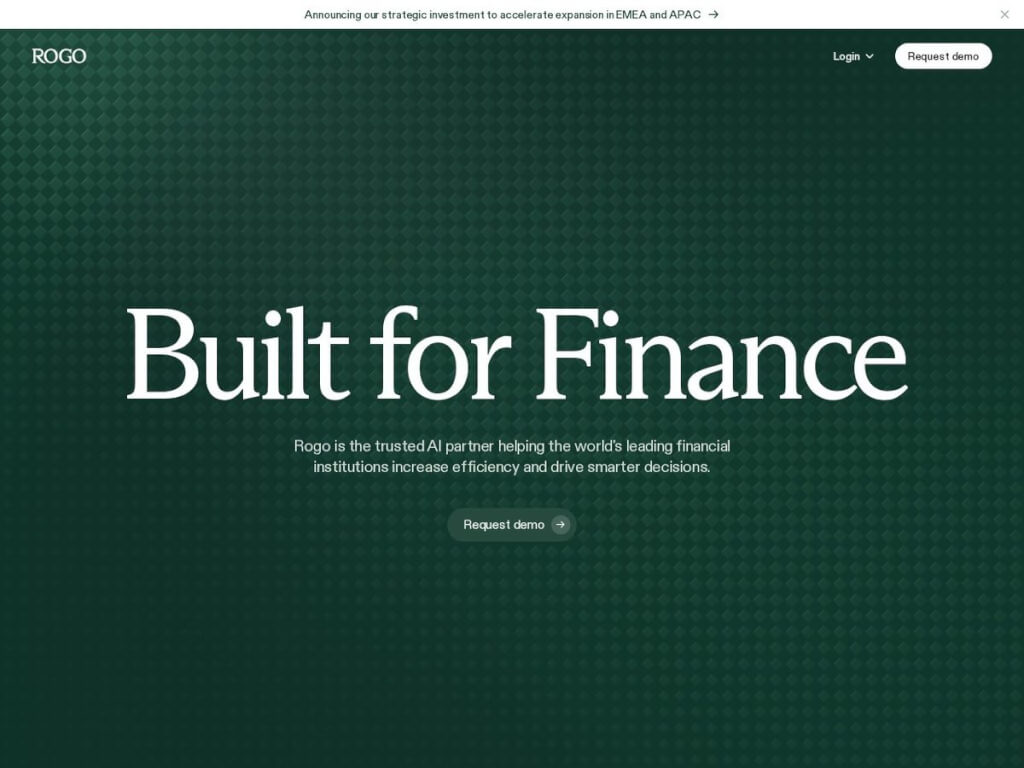
Rogo provides a financial AI workspace for investment banks, asset management firms, and private equity firms, connecting trusted data, specialized AI agents, trading projects, and corporate governance.
Rogo is a New York-based financial AI company founded in 2022 by Gabriel Stengel and others that serves investment banks, asset management firms, and private equity firms. The platform brings research, document organization, financial analysis, and institutional knowledge management into a single workspace, helping professionals reduce the time spent repeatedly searching for information and piecing together deliverables. The company was named to Forbes’ 2026 AI 50 list.
It is designed for organizational work environments that require data access permissions, auditing, and team collaboration. The system’s output must be used in conjunction with the original documents and professional judgment; the automatically generated analysis should not be regarded as a guarantee of investment results.
Rogo started out as a financial research assistant and gradually began connecting professional data providers with internal institutional data. In 2025, the company announced partnerships with organizations such as PitchBook, Preqin, and LSEG to expand the sources of data available for analysis.
On April 29, 2026, the company announced a $160 million Series D funding round led by Kleiner Perkins, stating that it would strengthen its data integration, on-site finance, and engineering teams, and expand its international operations. On September 10, the company announced strategic investments from several financial institutions, indicating that its development focus is shifting from point solutions to enterprise-level deployments.
Rogo employs a multi-model orchestration approach, continuously evaluating the performance of different models on financial tasks before integrating them into actual workflows. Its Big Finance Benchmark uses tasks designed by financial teams, focusing on capabilities such as valuation, peer comparisons, and cross-document reasoning, thereby avoiding the selection of models based solely on general chat performance.
Another core component of the platform is context management: models need to know the current institution, client, transaction, and data permissions in order to provide useful output. Rogo supplements this context through data connections, project spaces, and the organization of institutional knowledge, while integrating model usage with governance tools. Final figures, references, and judgments still require verification by business personnel, particularly when transaction documents and investment decisions are involved.
For example, a single company analysis may draw on public financial reports, paid databases, and internal notes from the trading team. The system must identify the sources and access permissions, and avoid directly comparing figures from different dates or using different accounting standards. For results that are to be included in formal deliverables, the firm should still maintain a process for verifying source materials and revising conclusions. In this context, AI is best suited for tasks such as retrieval, organization, and preliminary synthesis, while leaving the ultimate responsibility to the existing professional review system. Teams should also clearly identify the dates when data was updated, as well as the currency and accounting standards used, to avoid combining metrics from different sources that appear superficially similar and drawing erroneous conclusions.
From a product architecture perspective, Rogo is poised to transform the industry knowledge and trading experience that clients have accumulated over the long term into reusable operational capabilities. The participation of financial institutions in investment and deployment provides a foundation for enhancing industry-specific adaptation and customer service, but client support alone does not directly prove that all workflows are fully mature.
Long-term competitiveness will depend on data licensing, output traceability, consistent performance after model updates, and the cost of integrating with legacy systems. If the platform can consistently save analysis time and reduce rework in real-world projects, its value may become even more apparent; however, if governance and verification are inadequate, the speed of generation may actually amplify the spread of errors.


 简体中文 简体中文
  English