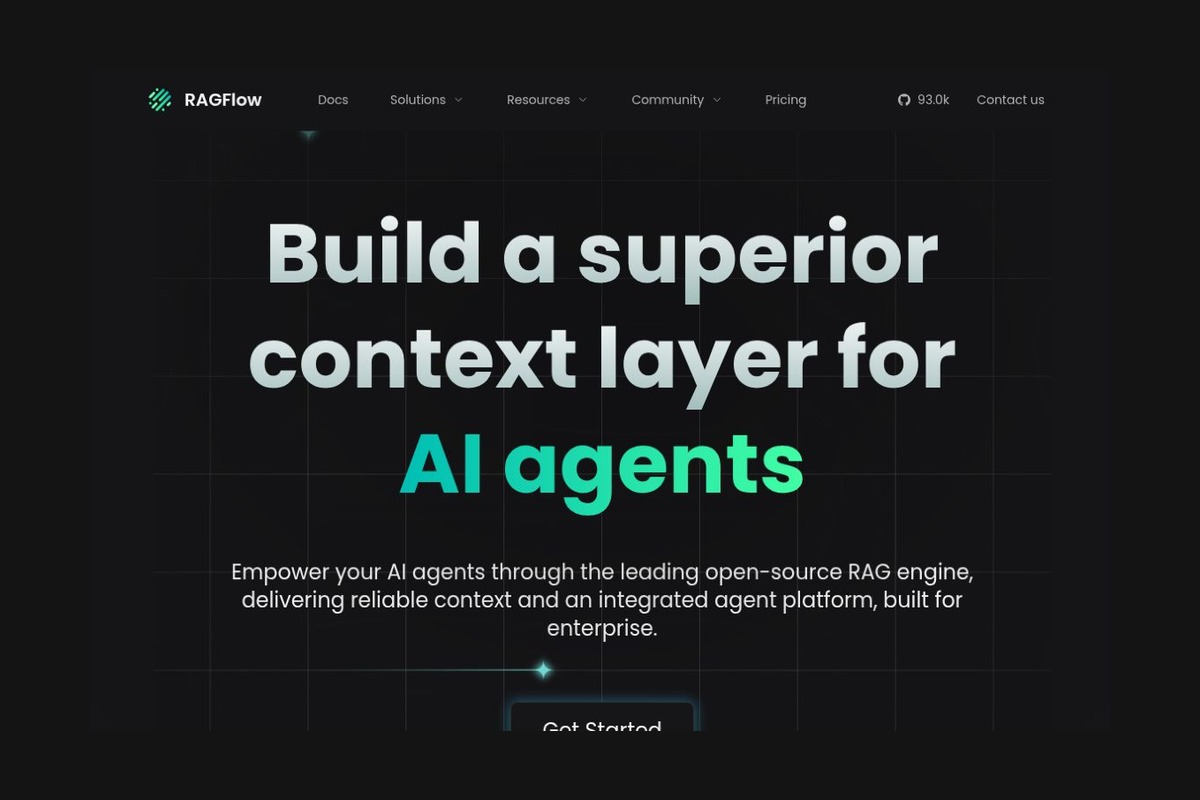
What is RAGFlow?
RAGFlow is an open-source retrieval-augmented generation engine maintained by InfiniFlow, with its core code licensed under the Apache 2.0 License. Its focus is not on “how to build a chat interface,” but rather on how to transform documents with complex formats into searchable, traceable knowledge, and then make that knowledge available to language models and agents.
For content such as corporate manuals, scanned documents, forms, and research materials, the quality of responses is often influenced by parsing, segmentation, and retrieval. RAGFlow integrates these steps into a relatively comprehensive workflow, allowing users to review document processing results, adjust retrieval strategies, and integrate the knowledge base into applications or bots.
Core competencies
- Handling a variety of documents and data:Supports PDF, Office documents, images, scanned documents, web pages, and other file types, making it ideal for building knowledge bases with documents in various formats. Actual results depend on the quality of the original files; complex layouts, blurry scans, and special tables may require manual review.
- Making knowledge segmentation more verifiable:Provides chunking templates and processing workflows, allowing users to view the parsed content so they don’t just see the final answer without knowing where the error occurred.
- Combining Different Search Methods:Combine vector search, keyword search, and re-ranking to address tasks where semantic similarity and precise terminology coexist. Parameters and models should be evaluated using your own dataset, rather than simply adopting the default settings.
- Supports agent orchestration:By combining knowledge retrieval, tools, and MCPs within a visual workflow, question-answering can be expanded into multi-step tasks. Citing sources makes it easy for readers to return to the original text for verification, but it does not eliminate model hallucinations.
- Further Organization of Knowledge:The project provides knowledge compilation and multi-round retrieval capabilities, enabling the organization of information into wikis, knowledge graphs, or other structured formats, while adjusting the depth of retrieval and reasoning based on the complexity of the problem.
Who is it for?
It is better suited for technical teams willing to invest time in data organization, deployment, and operations—for example, turning equipment manuals into maintenance reference guides, converting product documentation into internal support knowledge bases, or providing researchers with traceable data retrieval. When there is only a small amount of plain text and the primary use is for personal, everyday chat, a lightweight desktop tool may be more convenient.
How do I get started?
- First, select a small dataset and define a clear task, compile the correct answers and their sources, and establish criteria for subsequent evaluation.
- Select the appropriate release tag according to the official Docker guidelines. The official recommended starting configuration is 4 CPU cores, 16 GB of RAM, and 50 GB of available storage; document size, concurrency, and local models may result in additional requirements.
- Configure the dependency services, persistent storage, models, and embedding services, and proceed to the web interface only after confirming that the health checks have passed. Before deploying to production, you should change the default credentials, restrict network access, and set up backups.
- Create a dataset, select a parsing and chunking method, and after uploading the data, verify that the text, tables, and key fields are correct.
- Build a dataset-based chat application and use test questions to check for recall of excerpts and citations; then adjust the reordering, model, and workflow—don’t judge quality based solely on the fluency of the responses.
Version and Cost Restrictions
The v1.0.0-rc2 release dated October 16, 2026, is still marked as a release candidate (RC). Before using it, you should read the documentation for that version; do not treat it as the officially stable 1.0 release. The development version documentation may include features not present in older release packages, so you should check for data migration and compatibility issues before upgrading.
Open-source self-hosted solutions and RAGFlow Cloud are used differently. Self-hosted code can be used in accordance with its license, but servers, storage, model inference, and operations and maintenance are not cost-free; cloud services, on the other hand, have their own pricing plans, quotas, and terms. If connecting to external language models or data sources, you must separately verify data flow and access permissions. Important business conclusions should still be determined by humans in conjunction with the source text; responses that include references should not be automatically considered correct.
How do you choose among similar projects?
| sports event | Main Focus | More suitable | Implementation Priorities |
|---|---|---|---|
| RAGFlow | Complex Document, Retrieval, and Knowledge Processing Workflows | Corporate Knowledge Base, Q&A on Traceability Documentation | Data Cleaning, Parsing and Sampling, Retrieval and Evaluation, and Operations and Maintenance |
| AnythingLLM | An AI Workspace That Integrates Individuals and Teams | Quickly engage in casual chats and tackle simple tasks | Selecting Local or Cloud Components and Workspace Management |
| LibreChat | Multi-Model Chat and Tool Access Points | A Unified AI User Experience Across the Organization | Model Integration, Account Permissions, and Tool Configuration |
Reasons for Recommendation:When the project’s bottleneck lies not in the chat interface but in “whether the documents are interpreted correctly and whether the right evidence can be retrieved to address the issue,” RAGFlow’s process-oriented capabilities become even more valuable. We recommend first demonstrating the retrieval quality for a specific type of real-world data, and then expanding the data volume and scope of automation.
Official Website:RAGFlow Official Website - GitHub Source Code - Deployment Documentation - v1.0.0-rc2 Release Notes - Explanation of Terms for Cloud Services and Self-Hosted Solutions
data statistics
Related Navigation

An open source AI engineering optimization platform focused on AI engineering from first principles. It helps users collect, understand and use data to improve the quality of LLM (Large Language Model) applications.

Open-Sora 2.0
Lucent Technologies has launched a new open source video generation model with high performance and low cost, leading the open source video generation technology into a new stage.

Deep-Live-Cam
Python-based open source AI real-time face replacement tool that supports millisecond face replacement effects and can be used in a variety of fields such as entertainment, art creation and education.

Shortest
An end-to-end testing framework based on natural language processing and AI technologies which streamlines the testing process, increases testing efficiency, and lowers the testing threshold.

DocsHound
AI-driven intelligent document tools, one-key automated generation of multi-language product documentation, efficient collaborative optimization of knowledge management, help enterprises reduce costs and increase efficiency.

Tülu 3 405B
Allen AI introduces a large open source AI model with 405 billion parameters that combines multiple LLM training methods to deliver superior performance and a wide range of application scenarios.
WeKnora
Tencent's open-source knowledge platform integrates document search, agent tasks, and Wiki organization into a single knowledge base.

LayerBack
An AI-powered diagram-to-image conversion tool that intelligently reconstructs diagram-based images—such as flowcharts and architecture diagrams—into native, editable files in formats like Visio, PowerPoint, and draw.io. It supports online fine-tuning and integration with AI Agent workflows.
No comments...