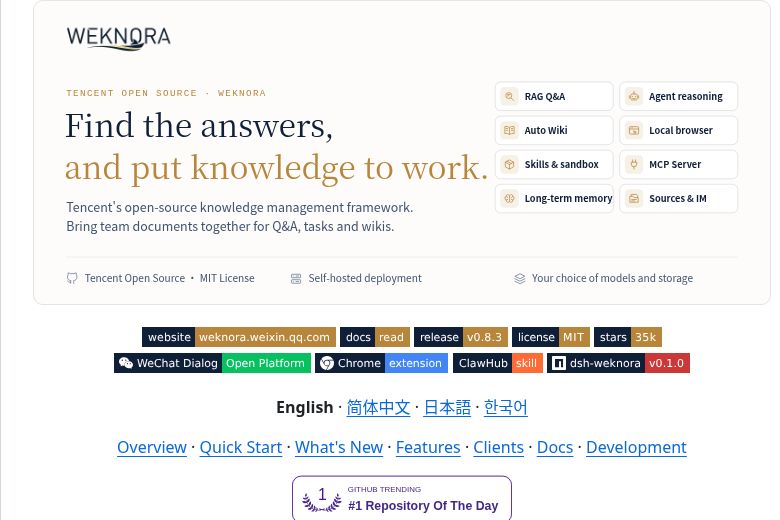
Tencent's open-source knowledge platform integrates document search, agent tasks, and Wiki organization into a single knowledge base.

What is WeKnora?
WeKnora is maintained by Tencent and is designed for team-based document comprehension, semantic search, and knowledge organization. Users can ask questions based on existing materials or have the AI agent perform multi-step tasks by combining knowledge and tools, then organize that knowledge via a wiki. It is well-suited for technical teams that need to maintain control over their data environment.
Key Features and Use Cases
- Q&A: Use search results and citations from the original text to help locate product manuals, internal policies, and research materials.
- Agent Task: Connect tools to handle data processing tasks that require multi-step reasoning; select models, storage, and vector databases as needed.
- Wiki Organization: Organizes scattered documents into browsable knowledge content and shares a knowledge base with the Q&A section.
How to Get Started
- First, prepare a set of sample documents that are authorized for processing to define the scope of the Q&A and the model service.
- Install Git, Docker, and Docker Compose according to the official guidelines, copy the environment configuration, and fill in the service parameters.
- Start the core service, complete initialization, import documents, and check the parsing status.
- Test citation and recall using questions with known answers, then gradually expand the scope of the materials.
The standard deployment includes multiple services; the Lite version offers a more lightweight setup. In a production environment, you must also consider access control, backups, model calls, and server costs; therefore, you should not directly expose your local demo configuration to the public internet.
Licenses, Fees, and Boundaries
The core project is licensed under the MIT License; third-party components remain subject to their respective licenses. The fact that the software is open source does not mean that cloud hosting, model APIs, or external services are free. When integrating cloud models, you must verify the scope of data transmission and the terms of service as outlined in the documentation. Search results may still omit or misinterpret information; for important conclusions, you should cross-reference the original source.
Release Notes
v0.8.3 was released on October 14, 2026, and includes improvements to search, citation location, document parsing, and the user interface. Before upgrading, please read the release notes and back up your existing data.
How to Choose Among Similar Tools
| sports event | Main Focus | Suitable for the task | Important Limitations |
|---|---|---|---|
| WeKnora | Q&A, Intelligent Agents, and Wiki Share a Common Knowledge Base | Document Search and Team Knowledge Management | The model and deployment environment must be configured. |
| RAGFlow | In-Depth Document Understanding, RAG, and Knowledge Compilation | Applications for Complex Document Analysis and Retrieval | Docker deployment requires certain resources; choose an environment based on the official platform's support. |
Official Portal and Resources
data statistics
Related Navigation

An open source AI Agent framework that supports localized deployment and multi-intelligence collaboration to efficiently complete complex tasks.

SpeciesNet
Google open-sourced a model that uses artificial intelligence technology to analyze camera trap photos to automatically identify animal species.

NVIDIA Ising
The world's first open-source quantum AI model series, through AI-driven quantum chip calibration and error correction, provides a high-performance tool chain for practical quantum computing and reshapes the quantum industry ecosystem.

HunyuanVideo-Avatar
Tencent hybrid open source voice digital human model, upload pictures and audio that generate multi-style, highly dynamic personalized dynamic video.

SAM 3D
Meta open source revolutionary single-image 3D generation model, support one-click from 2D photos to generate high-fidelity, interactive 3D models, covering the object/human body scene, empowering e-commerce, AR/VR, film and television, and other multi-industry cost reduction and efficiency.

BettaFish
Open source AI public opinion tool, multi-agent collaboration to analyze the whole network data, can accurately insight into the trend, predict the direction, applicable to brand public relations, market research and other scenarios.

FacePoke
Open source real-time facial expression editing tool that allows users to adjust facial expressions and head orientation in static images in real time with simple operations.

CosyVoice
Alibaba's open-source large-scale speech model supports zero-shot cloning in 3 seconds, multilingual capabilities, and command-based emotional control, enabling ultra-low-latency streaming synthesis at 150 ms.
No comments...
