
Lyra 2.0
NVIDIA's revolutionary 3D scene generation system supports free roaming and interactive exploration, providing an efficient and realistic solution for building virtual environments in multiple fields.
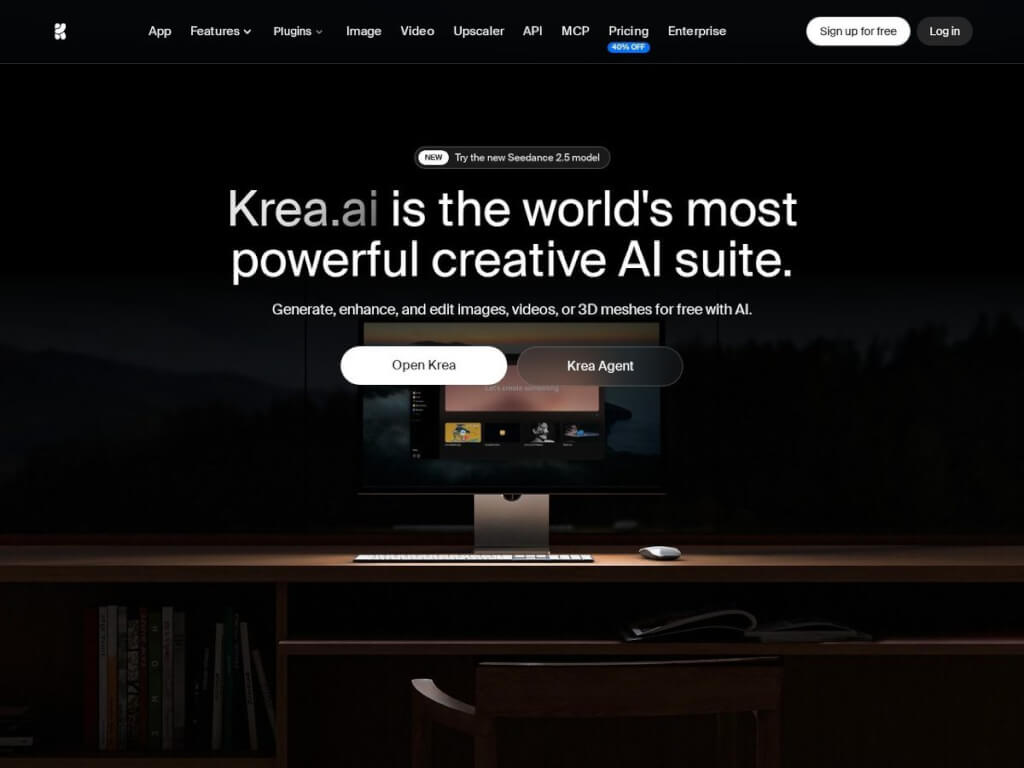
Krea provides image, video, and 3D generation and editing tools for creative professionals, combining real-time interaction, model customization, and visual exploration to help users control their creative outcomes.
 Krea AI
Krea is an AI company focused on visual creation, founded by Victor Perez and Diego Rodriguez, with its team based in San Francisco. The company aims to transform the capabilities of its models into tools that designers, photographers, marketers, and other creators can use directly, covering images, videos, and 3D content. Krea was named to Forbes’ 2026 AI 50 list, and its official service can be found at krea.ai.
It emphasizes control over the creative process: in addition to entering text, users can gradually refine the results using sketches, reference materials, a real-time canvas, and editing tools. The product brings together different models and editing methods within a single environment, making it ideal for teams that need to repeatedly compare visual concepts, work with existing materials, and create subsequent versions.
In its early days, Krea focused on real-timeImage GenerationWith a focus on enhancing the user experience, the company subsequently added video, customized training, and team workflows. On April 7, 2025, the company announced its Series B funding round and disclosed that it had raised a total of $83 million, while also introducing the Krea AI Research Lab, which identified aesthetics, controllability, and high levels of personalization as its research priorities.
On July 31, 2025, the team announced the release of the open-weight version of FLUX.1 Krea, developed in collaboration with Black Forest Labs, and introduced its image quality and aesthetic training methods. By 2026, the company’s product lineup had expanded to include Krea 2, video editing, 3D generation, and various creative software plugins, forming a suite of tools that bridge different visual tasks.
Krea’s technical work encompasses interaction design, model inference optimization, and image post-training. A 2025 technical report explains that the team first selects data that meets aesthetic standards for supervised fine-tuning, then uses human preference feedback to further improve image quality. The version developed in collaboration with Black Forest Labs also employs model distillation to balance output quality with compatibility with the existing ecosystem.
Real-time experiences require the system to provide rapid feedback after the user makes an input change; therefore, in addition to model performance, deployment latency, resource scheduling, and consistency across tools are also critical. Personalized models, meanwhile, require appropriate training data and access control; users should verify the licensing of source materials and ensure that the generated content remains consistent with the brand or subject.
This research does not imply that every model will automatically understand everyone’s aesthetic preferences. The official technical report emphasizes specific aesthetic preferences and identifies more personalized results as a direction for future research. For brand teams, consistently maintaining reference images, curating generated results, and comparing stylistic consistency across different tasks is often more important than simply adding more prompts. Ultimately, controllability comes down to whether users can consistently obtain materials that meet their requirements and are easy to further modify.
From a product roadmap perspective, Krea is poised to become a creative workspace that bridges the gaps between ideation, generation, and post-processing. If real-time interaction, style control, and integration with professional software continue to improve, users will be able to incorporate AI into their existing workflows without having to switch between separate tools for each task.
This outlook still hinges on the consistency of generation quality, inference costs, content licensing, and enterprise-level collaboration capabilities. Visual creation requires not only novel results but also the ability to modify, deliver, and maintain stylistic consistency. The ability to translate research advancements into reliable, everyday tools will determine long-term value more than the sheer impressiveness of a single demonstration.


 简体中文 简体中文
 English