
Seed-OSS
ByteDance's open-source 36 billion parameter-long contextual big language model supports 512K tokens, a controlled mind budget, excels in inference, code and agent tasks, and is freely commercially available under the Apache-2.0 license.
Parses complex documents—such as PDFs, Office files, and scanned documents—into structured data, supporting both on-premises deployment and RAG workflows.
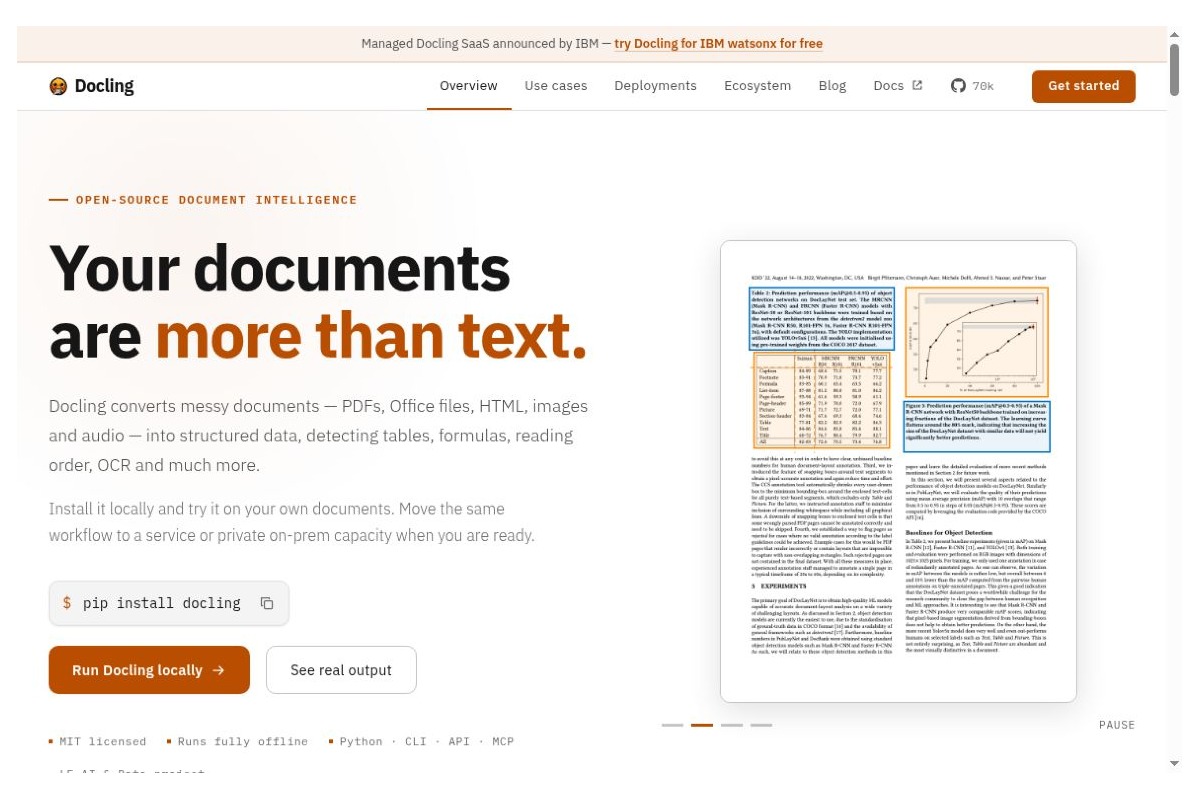
 Docling
 is an open-source document processing project for generative AI, initiated by the AI for Knowledge team at IBM Research Zurich and currently part of the LF AI & Data Foundation project ecosystem. It addresses an often-overlooked step in knowledge base construction: PDFs and office documents contain more than just text—they also include fields, tables, images, and reading order—and simply copying text often causes these relationships to be lost.
Docling converts various types of input into a unified document structure, then exports it as Markdown, HTML, JSON, or searchable snippets. As of October 26, 2026, the official GitHub repository had accumulated approximately 69,600 stars. The project code is licensed under the MIT License, but the rights to the models, third-party dependencies, and source files used must be verified separately.
If a team is adding product manuals, corporate policies, and research papers to a knowledge base, Docling can handle the parsing process “before documents enter the search system.” It is particularly valuable in scenarios requiring table formatting and source attribution, as preserving the original structure makes it easier to trace back to the source during subsequent searches and responses. For the average reader, it is not a ready-to-use chat platform; rather, it is better suited as a data processing component for developers.
Documents such as contracts and bills can also be fed into the subsequent processing workflow; however, parsing is not the same as legal review, financial accounting, or factual determination. Significant amounts, clauses, and tables should continue to be checked manually or by specialized verification programs.
| sports event | Input and Objectives | More suitable | Key Limitations |
|---|---|---|---|
| Docling | Converting Complex Files into Structured Documents | PDF/Office Knowledge Base, Document Archiving | OCR and complex layouts require sampling; some pipelines have additional dependencies. |
| Crawl4AI | Convert Web Pages to Markdown or JSON Online | Authorized Web Scraping and Data Cleaning | You need to manage the access rules for browsers and target sites. |
| Vane | Search results are consolidated into answers with citations | Self-hosted Search and Q&A App | The answer depends on the model and the upstream source. |
The selection process should be based on the input data and objectives: If you already have a large number of PDFs, prioritize evaluating document parsing solutions; if you need to collect web pages, consider scraping components first; and if you require a functional Q&A interface, you’ll also need an application layer. These three approaches are not entirely interchangeable.
Local use does not require uploading files to a public service, but the model may need to be downloaded the first time the program is run; in offline or sensitive environments, model files should be prepared in advance, and you should confirm that remote models or external services are not enabled. The MIT license does not imply that all models are licensed under the same terms, nor does it exempt you from copyright and privacy responsibilities regarding input data. Fees may still apply for servers, computing power, and hosting services.
Low-quality scans, mixed-language layouts, and complex tables may affect results; 100% accuracy cannot be guaranteed. Extensions such as visual models and audio may require additional hardware and dependencies. Version v2.142.1, released on October 23, 2026, includes fixes for resource boundary and parsing robustness; when processing untrusted files, ensure the software is kept up to date and limit resource consumption.
GitHub Repositories - Official Documentation - official website - Release Notes - MIT License
Screenshots and logos from the official website: Docling official website and project repository; used solely for project introduction purposes.





 简体中文 简体中文
 English