
Gemma 3n
Google introduced a lightweight open source large language model , both high performance and easy to deploy , suitable for local development and multi-scenario applications .
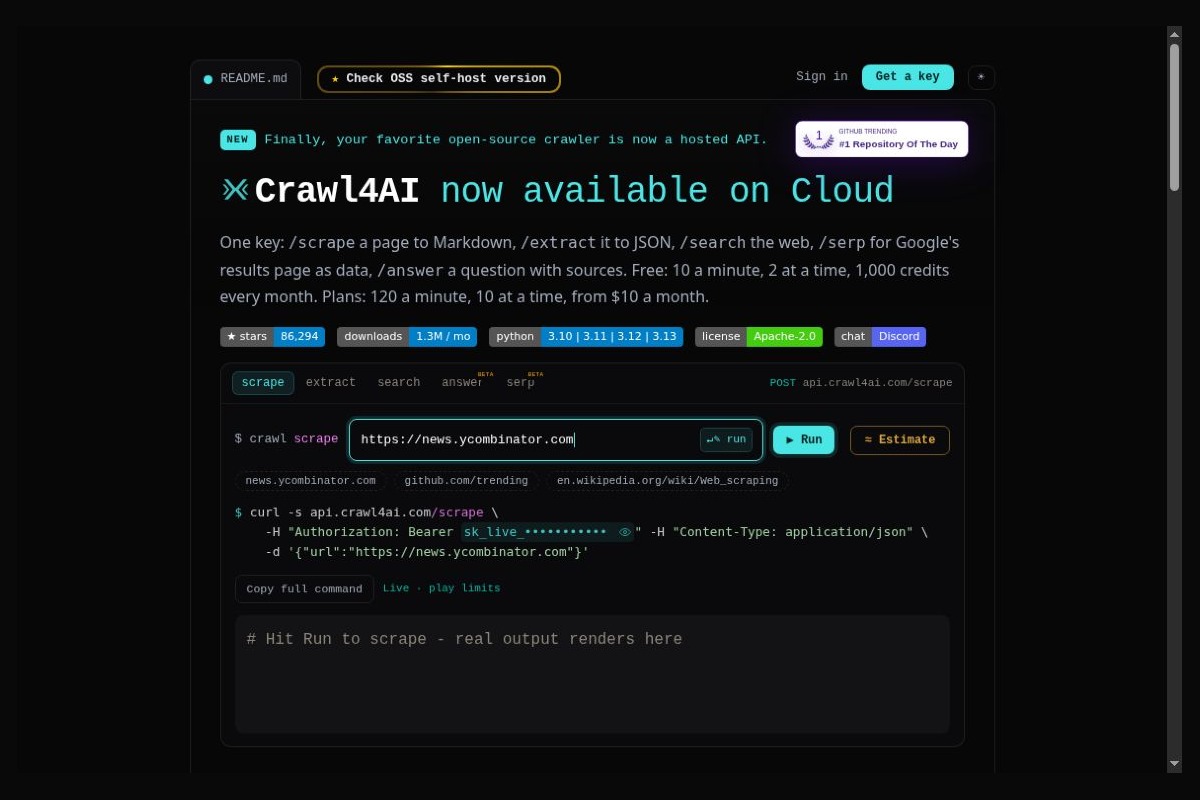
An open-source web scraping tool designed for large language models and agents that converts authorized web pages into Markdown and structured data.
 Crawl4AI
 is an open-source web scraping and data cleaning tool maintained by UncleCode and the community. Its focus is not on building yet another chatbot, but on converting web pages into Markdown or structured data that large language models can further process. It is well-suited as a data ingestion point for knowledge bases, research assistants, and intelligent agents: it first retrieves authorized content, then cleans up noise such as navigation bars and footers, while preserving the body structure and source links.
As of October 26, 2026, the official GitHub repository had accumulated approximately 86,300 stars. This reflects developer interest but does not equate to a performance ranking or a guarantee of accuracy. The project code is licensed under the Apache-2.0 license; the free self-hosted repository and the separately offered Crawl4AI Cloud hosting service should be considered separately.
Typical use cases include synchronizing in-house technical documentation, compiling authorized product catalogs, gathering publicly available policy materials for corporate knowledge bases, and preparing web snippets with traceable sources for research agents. It is particularly well-suited for developers with a foundation in Python and deployment who want to maintain control over the data collection process. If you’re just looking up an issue occasionally, off-the-shelf Q&A apps are usually more convenient.
| sports event | Main Focus | Suitable Tasks | Important Boundaries |
|---|---|---|---|
| Crawl4AI | Online Web Data Extraction, Cleaning, and Structuring | Building Your Own Web-Based Knowledge Base and Data Pipeline | You must maintain your browser environment and comply with the target site's access rules. |
| Docling | Analysis of the Structure of PDF, Office, and Other Documents | Tables, Reading Order, and OCR Processing in Existing Documents | This is not a general-purpose web crawler; complex documents still require sampling and verification. |
| Vane | Integration of Search and Model Responses | Self-hosted, citation-enabled search and Q&A interface | Depending on the search source and model, the accuracy of citations is not automatically guaranteed. |
These three tools complement each other: Crawl4AI is responsible for fetching web pages, Docling handles complex documents, and Vane is closer to the final interactive search product. Technology selection should not be based solely on the number of stars.
The open-source library itself does not charge license fees, but there are still costs associated with servers, browser resources, and calls to third-party models. Pricing plans and quotas for hosted cloud services are subject to the official website and do not equate to the free open-source library. Data collection capabilities do not equate to access authorization: Users must comply with website terms of service, robots.txt rules, copyright laws, and reasonable frequency limits, and must not use these capabilities to bypass logins, CAPTCHAs, or access restrictions. When processing untrusted URLs, users must also implement network isolation and access controls.
Version 0.9.5, released on October 14, 2026, includes security-related fixes. Deployers should review the official release notes and adopt a version suitable for production environments, rather than continuing to use outdated versions. Conversion results still require verification, particularly for dynamically loaded content, tables, and source references.
GitHub Repositories - User Guide - v0.9.5 Release Notes - Apache 2.0 License
Screenshots and logos from the official website: Crawl4AI official website and project repository.




 简体中文 简体中文
 English