
Hatz AI
Specializes in AI-as-a-Service (AIaaS) solutions for Managed Service Providers (MSPs), covering areas such as AI applications, AI agents, vector storage and custom large-scale language models.
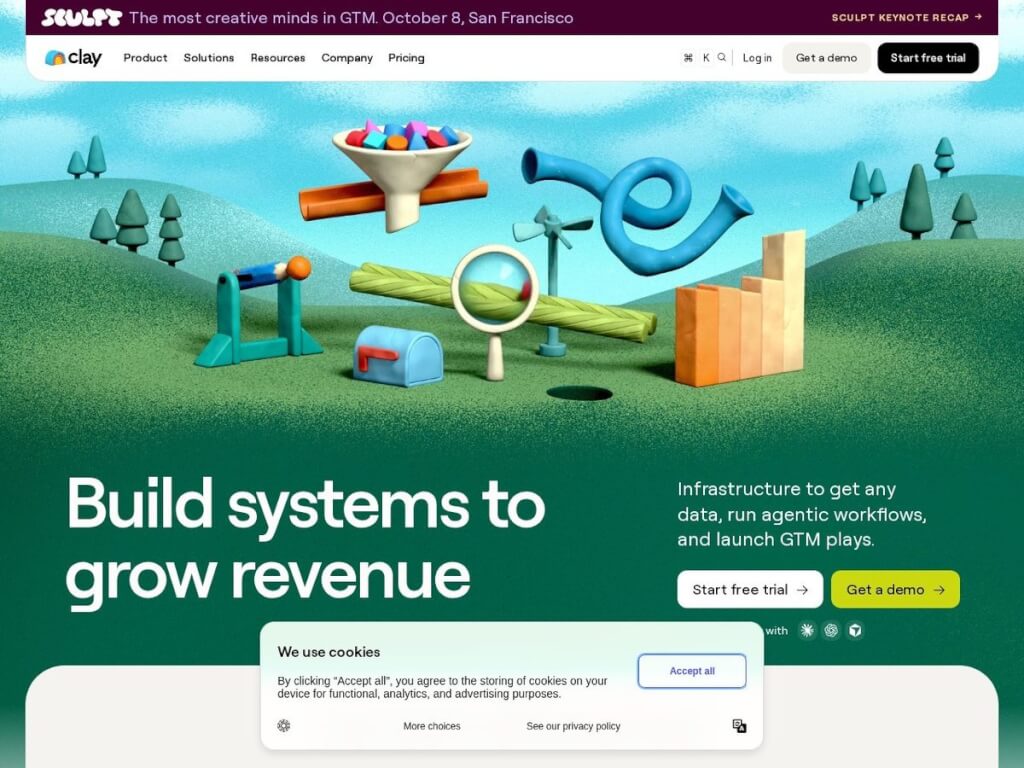
Clay brings customer data, AI research, and workflow automation together on a single platform, helping sales and marketing teams identify target customers, fill in missing information, and execute personalized growth strategies.
Clay is an AI software company serving sales, marketing, and growth teams. It was founded in Brooklyn, New York, in 2017. Early co-founders included Kareem Amin and Nicolae Rusan; Varun Anand joined in 2021 and became a co-founder. The company initially aimed to enable non-programmers to connect data and automate tasks, but later shifted its focus to enterprise customer acquisition and customer engagement.
Clay supports the entire process—from identifying target companies and understanding client needs to screening leads and preparing communication materials. Users can integrate their customer relationship management systems, data warehouses, and external business data into a single environment, reducing the need to copy and paste between multiple tools, and supporting team work with reusable workflows.
In its early stages, Clay focused on programmable forms and data integration, aiming to enable users to automate tasks by flexibly combining information sources. As the team gained a clearer understanding of sales and marketing use cases, the company shifted its product focus to customer data orchestration. In 2024, when investors described the company’s development, they identified lead generation, data enrichment, and personalized communication as the platform’s primary use cases.
Since then, Clay has continued to expand its capabilities in AI research, business signal monitoring, and workflow management. The official website currently categorizes its products into areas such as data infrastructure, agents, orchestration, and engagement, and offers courses and community resources to help users transform one-time data organization into a sustainably maintained growth system.
Clay's technical focus is on data and AI orchestration. Structured business databases are well-suited for providing standard fields, while web research is ideal for answering more specific questions; when combined, they can form customer profiles that more closely reflect real-world business scenarios. Waterfall-style autocomplete bridges data source discrepancies through sequential queries, while Claygent uses models and tools to interpret web content, identify patterns, and generate structured results.
The platform also distinguishes between text generation based on existing information and research tasks requiring online tools, making it easier for users to choose the appropriate processing method. Its agent interface provides access to run logs, costs, and error reports, and prompts can be tested and iterated upon. However, outdated external data, incorrect identity matching, or model interpretation errors may still affect the results; therefore, key client fields and external communications should undergo a review process.
For example, a team can first define the target industry and company size, then add company information, followed by having the research agent determine whether the website indicates specific business needs, and finally write the qualifying records back into the workflow. The input and filtering criteria for each step must be clearly defined; otherwise, erroneous data may be amplified during subsequent scoring and communication.
Given companies’ desire to improve the efficiency of their customer research, Clay is poised to become a key bridge between sales data and action. The platform allows teams to design workflows tailored to their specific markets, customer segments, and business rhythms, making it particularly appealing to organizations that need to manage a large number of target accounts but do not want to rely entirely on predefined lists.
Its future development will continue to depend on data quality, vendor coverage, AI research costs, and the implementation capabilities of the client team. The more complex the automated processes, the greater the need to clearly define update frequencies, exception handling, and responsible parties. Only by ensuring both the accuracy of information and the relevance of communication can the reduction in manual labor be more effectively translated into strong customer relationships and business results.


 简体中文 简体中文
  English