
LingBot-Depth 2.0
Ant Group has launched a new-generation spatial perception model for robots that enhances 3D depth perception capabilities and improves performance in grasping, navigation, and environmental understanding.
Provide reusable project context, specialized workflows, and review stages for existing AI assistants, enabling collaboration across sessions and tools.
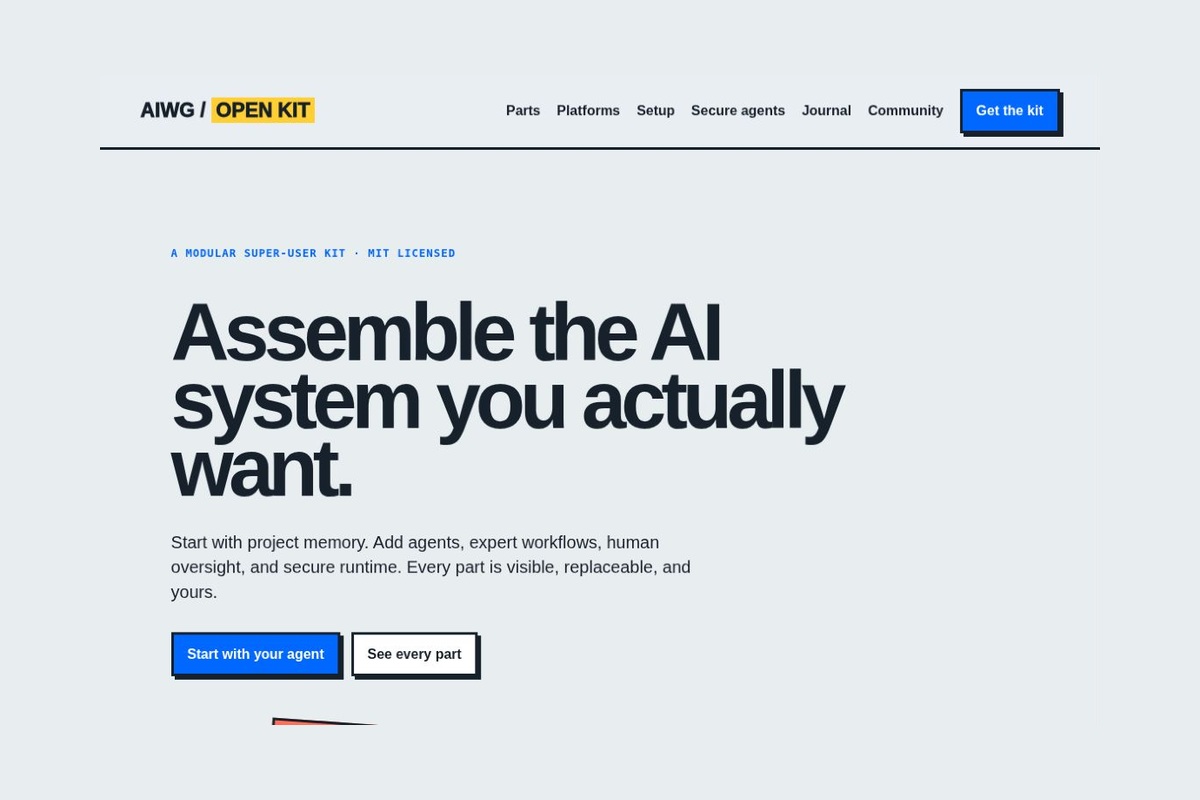
 AIWG
Enhance existing AI tools with reusable project context, specialized workflows, and human review steps, so that the results of one conversation become the starting point for the next task.
AIWG is an open-source toolkit primarily designed for users who are already working with AI programming assistants or agents. It organizes agent roles, skills, rules, and templates, then places them in locations accessible to various tools. Project data, decisions, and deliverables are stored in project files, making it easy to continue working when switching sessions, collaborators, or models. The official repository is maintained by the GitHub account jmagly, and the release history indicates that the maintainer is Joseph Magly.Official Repository,Release Notes
It addresses a common problem: teams already have AI assistants, yet they still find themselves repeatedly explaining the context, improvising prompts on the fly, and struggling to recall why a particular decision was made last time. AIWG provides a method for organizing these experiences into readable documents and reusable workflows. It does not provide a standalone large language model, nor does it imply that, once set up, it can replace the project lead.
Published on October 26, 2026v2026.10.9Focus on how keys and tokens are passed: Access to protected resources can be granted via environment variables, private files, system credential stores, standard input, or hidden input; background services and storage connections also support additional methods for referencing credentials, reducing the need to write secrets directly into commands and configurations. Diagnostic output remains redacted by default.Official Release Notes
This update is relevant for users who have already begun connecting code resources, chat channels, or databases. However, the release notes also caution that authentication remains disabled when no web token is configured, and some features related to webhooks have not yet been implemented. Users must verify their actual deployments and should not assume that a single security enhancement means all services are now securely accessible.
A common prerequisite for these abilities is that someone maintains the project documentation. Outdated rules and erroneous historical conclusions are equally likely to be reused; therefore, “remembering more” does not automatically equate to “making more accurate judgments.”Official Ability Description
Multi-session software projects:Place the scope of requirements, architectural decisions, test criteria, and outstanding issues on the same workflow. We recommend starting with a small feature that already has acceptance criteria to see if the next session can correctly identify the context, rather than immediately applying the full process to overhaul the entire codebase.
Collaboration and Handoffs:When different team members use different AI tools, establishing a unified set of shared facts and constraints is easier to implement than standardizing everyone’s model preferences. It is essential to clarify which data is endorsed by the team and which is merely a one-time model recommendation.
Research or Content Projects:You can use a process to organize sources, conclusions, and items requiring confirmation. For important facts, you should request links to specific materials and conduct manual spot checks; a well-structured report alone does not prove that all citations and inferences are valid.
The official basic installation deploys content such as Markdown and YAML to locations recognized by the assistant and does not require the AIWG background service to run continuously; components that run continuously are part of a separate, optional solution. It is generally easier to troubleshoot conflicts if you first validate the minimal workflow and then add components.Official Installation and Verification Guide
AIWG provides support for Claude Code, Codex, Copilot, Cursor, Warp, and other tools; however, the same capability may appear in different tools as a native feature, a configuration file, or an index query. The official support matrix also separately highlights experimental integrations. Therefore, you should not assume that all features are available simply because a tool is listed; you should check the specific support status for the installed version and the target platform.Official Platform Matrix
| artifact | Main Focus | Suitable Needs | Points to Consider When Selecting a Model |
|---|---|---|---|
| AIWG | Cross-Tool Context and Multi-Domain Workflow Integration | We hope to preserve project experience over the long term and combine capabilities as needed. | Compatibility, rule conflicts, and licensing dependencies need to be verified |
| GitHub Spec Kit | Specification-Driven Development and an Extensible Structured Process | Organize development around requirements, planning, implementation, and verification | Existing AI programming assistants are still needed; community extensions should be reviewed before use. |
| BMad Method | Collaboration on Product, Architecture, and Delivery in Agile AI Development | We hope to choose the level of detail in planning and implementation based on the scope of the task. | A distinction must be made between the stabilization line and the preview line; the process cannot replace technical acceptance. |
Basis for Comparison:Spec Kit Official Repository,BMad Official Repository. All three approaches involve structured work methods, so their effectiveness cannot be judged solely by the number of roles or templates. A more useful comparison is how rework, the burden of manual review, and data traceability change when completing the same task.
AIWG’s own code is licensed under the MIT License, but the AI services, optional external capabilities, and operating infrastructure it uses may still incur fees. Multi-round reviews and multi-agent processes can also increase model usage; therefore, you should set a budget and start by testing with small tasks. Outputs still require manual verification, especially for research, security, or business conclusions that require professional judgment.Official Terms of Use
It is also important to distinguish between frameworks and dependencies: the official third-party statements outline the AGPL licensing boundaries for Fortemi and Bytecask; therefore, one cannot broadly characterize the entire installation environment as “entirely MIT, with no additional obligations for any deployment method.” When modifying, distributing, or providing related services, the terms should be verified based on the actual components used.Third-Party License Information
AIWG is not a substitute for access control. The “confirm first” requirement specified in the rules must still be implemented in conjunction with the host tool’s authorization mechanisms, account permissions, and manual reviews. Project data may contain trade secrets, so the service provider’s data processing terms must be considered when integrating cloud models; optional external decision-making services also have their own independent data boundaries.
If your main concerns are a loss of context between sessions, difficulty in reusing team experience, or scattered review criteria, it’s worth piloting a small AIWG project. We recommend using two separate sessions to verify continuity, then checking whether the final output can be understood by another colleague. If you’re only engaging in occasional Q&A, or if you don’t yet have clear tasks and acceptance criteria, it’s more effective to first clearly define your work objectives than to implement an entire new process.




 简体中文 简体中文
 English