
Aether AI
We focus on reconstructing the underlying logic of AI using causal reasoning to build a causal world model for embodied intelligence that can understand "why" rather than merely identifying "what."
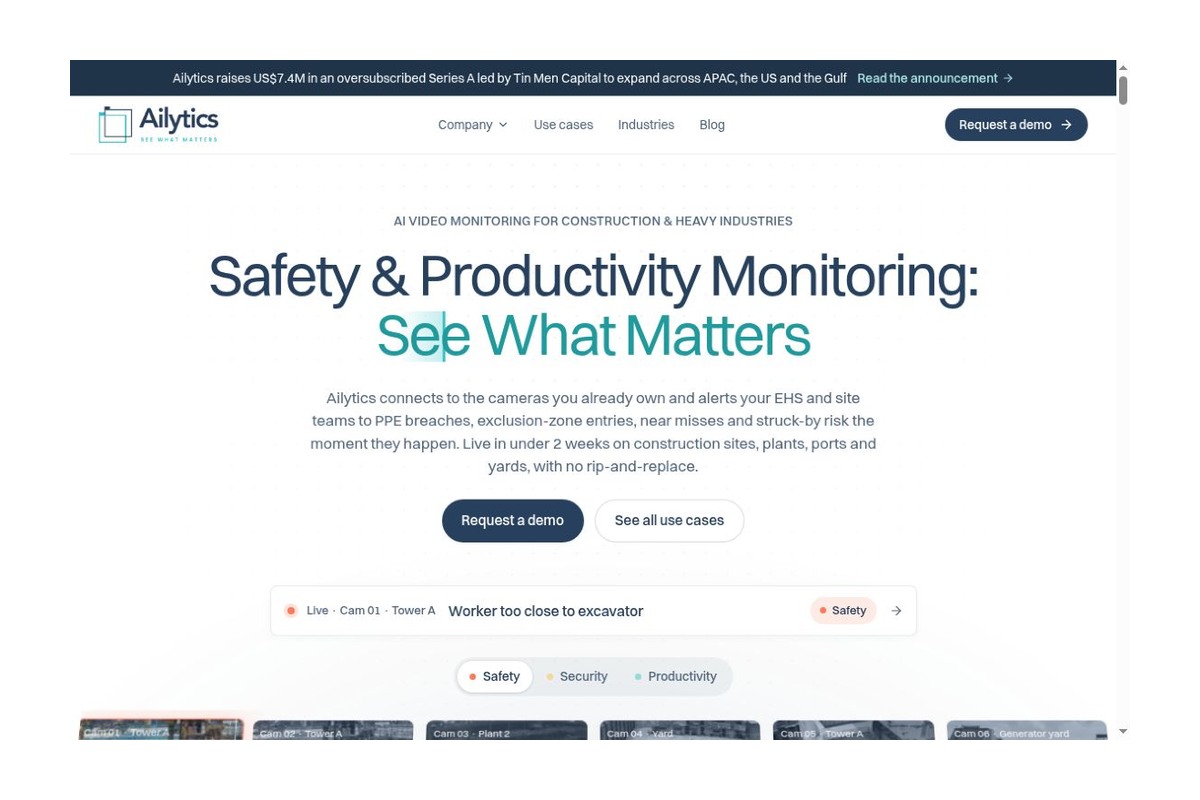
Identify risks in industrial settings using existing cameras, helping companies convert video footage into actionable safety and operational incidents.
 Ailytics
Industrial sites are often well-equipped with cameras, but what they lack is the ability to promptly identify hazards, pinpoint problems, and drive corrective actions. Ailytics applies computer vision to environments such as construction sites, factories, ports, and yards to analyze people, equipment, and activities captured on camera, helping safety and operations teams shift from reviewing footage after the fact to continuously monitoring for risk events.
Ailytics is based in Singapore; its official website traces its origins to a 2019 research and development partnership between the National University of Singapore and the Housing and Development Board. The company’s team brings expertise in engineering, operations, and industry experience, and its products are designed for on-site management at enterprises, rather than for individual users’ video editing or general image-based Q&A.
On October 26, 2026, the company announced the completion of $7.4 million Series A funding round led by Tin Men Capital... and plans to further expand into markets such as the Asia-Pacific region, the United States, and the Gulf region. This announcement concerns financing and business expansion and should not be equated with a product launch on that specific day. The deployment scale disclosed by the company is based on its own operational data and cannot directly serve as validation of results for specific customers.
Protective Equipment and Area Rules. The platform offers inspections of protective equipment such as hard hats and reflective vests, as well as the ability to identify personnel entering specific areas. Its value lies not merely in “detecting a person,” but in linking the observations to on-site rules to generate incident leads that managers can act upon.
Dangerous proximity between personnel and equipment. In scenarios such as lifting operations and vehicle movement, the system monitors the spatial relationships between personnel, equipment, and high-risk areas. The official website highlights the system’s ability to perform in-depth analysis using monocular imagery for distance estimation and risk assessment in scenarios involving suspended loads. During actual deployment, however, factors such as camera angles, obstructions, and the operational environment must still be verified; visual estimates should not be treated as error-free measurements.
Observations on Safety, Security, and Production Operations. The official website lists various types of configurable detection scenarios that cover security and productivity-related needs. Enterprises should first identify the incidents that truly warrant action, rather than enabling all detection rules at once: a high volume of alerts that go unaddressed does not equate to better risk management.
Ailytics is best suited for businesses with fixed worksites, camera infrastructure, and a dedicated management team. Construction sites can focus on areas where lifting operations take place and where people and vehicles intersect; factories can focus on personal protective equipment and hazardous areas; and logistics and storage yards can monitor operations where vehicles and personnel work side by side.
Its true value lies in the closed-loop management process: identifying which areas are prone to recurring risks, determining when these risks are most concentrated, and assessing whether they have been reduced following corrective actions. For teams with only a few cameras and no capacity for continuous response, improving rules and response procedures may be more important than adding more monitoring capabilities.
This is an enterprise solution. The official website focuses primarily on demonstrations and business communications; there is no publicly available, standardized pricing that can be directly applied to all projects. The number of cameras, deployment environment, rules, and scope of services must all be confirmed in the quote; making a public reservation does not equate to being placed on the waiting list for the beta test.
The Privacy Policy states that the videos, images, and event information processed by the platform may involve identifiable individuals and activities. Although the model is designed to identify objects, devices, and activities—rather than identify individuals—this does not mean that the footage is inherently anonymous. The policy also addresses the use of selected training data under appropriate legal grounds; therefore, prior to procurement, the purpose of training, retention period, data location, and employee notification arrangements should be clearly defined. It is not permissible to make a blanket statement such as “the video will never be used for training.”
Visual AI can only assist in identifying risks; it cannot replace on-site containment measures, protective equipment, work permits, or human safety responsibilities. False positives, false negatives, and camera blind spots should all be included in the pilot evaluation.
| flat-roofed building | Official Highlights | Suggested Comparison Dimensions |
|---|---|---|
| Ailytics | Industrial On-Site Visual Analysis: Safety and Operational Scenarios | Compatibility with Construction Sites, Lifting Operations, and Existing Camera Setups |
| Intenseye | Workplace Safety Analysis and EHS Action Management | Closed-Loop Process from Alerts to Remediation; Hardware and Deployment Solutions |
| Protex AI | Security and Operational Insights Based on On-Site Video | How to Turn On-Site Data into a Continuous Improvement Process |
Don’t just compare the number of recognized scenarios. For businesses, the ability to explain events, manage the alert load, and ensure that frontline staff are willing to use the system often has a greater impact on long-term value.




 简体中文 简体中文
 English