
This is ChatGPT.
Highly recommended by OpenAI CEO Sam Altman!
From search, perception, and learning to reasoning, this book establishes a knowledge framework for understanding artificial intelligence from a general education perspective, making it ideal for Chinese readers who wish to grasp the technical principles and limitations of the technology.

New models and tools emerge every day, but product names are not a reliable starting point for understanding artificial intelligence. *The Underlying Logic of Artificial Intelligence* is ideal for readers who want to connect disparate concepts: how machines perceive their environment, how they learn from data, how they represent knowledge, how they reason, and how these capabilities work together. With this knowledge map in hand, it becomes much easier to distinguish—when examining chatbots, image recognition, or intelligent agents—which problems they solve and which ones they leave unresolved.
Author: Zhang Changshui; Tsinghua University Press; Published in October 2024; ISBN 9787302674887. The publisher positions this book as a textbook for general artificial intelligence courses; the author has long been engaged in the teaching and research of artificial intelligence. This entry refers to the original Chinese edition. The publication date and subsequent reprint dates are not the same; when purchasing, you can use the ISBN to verify the edition.
The book covers topics such as search, computer vision and audio processing, natural language processing, knowledge representation, machine learning, reasoning, multimodal systems, multi-agent systems, and trustworthy AI. Its value lies in its breadth of coverage: readers can progress from individual technologies to a systems-level perspective, rather than understanding the entire field solely through the lens of generative AI.
You can approach this reading with three questions in mind: What is the input for a task? How does the system organize and utilize information? How is the output verified? For example, the ability to generate a coherent explanation does not mean that the conclusion is supported by facts; the ability to recognize a certain type of image does not mean that the system possesses human-like common sense. Keeping these questions in mind as you read will help you develop your own criteria for evaluation.
If your goal is to train a model, deploy a service, or reproduce a research paper right away, we recommend using this as foundational reading and then selecting a technical book that includes code and experiments. General reading and engineering training serve different purposes.
On your first read-through, get a broad overview of the entire book without dwelling too long on every mathematical detail. On your second read-through, select skills relevant to your work—such as natural language processing or computer vision—and break them down into five categories: tasks, data, methods, evaluation, and limitations. Finally, find a real-world case study and try to explain why the system succeeded or failed.
A simple exercise is to compare search and generation: Where do the results returned by a search come from, and where does the text generated by a model come from? If the answer is incorrect, should you check the data, the search process, or the reasoning chain? Being able to ask questions like this has greater long-term value than simply memorizing model names.
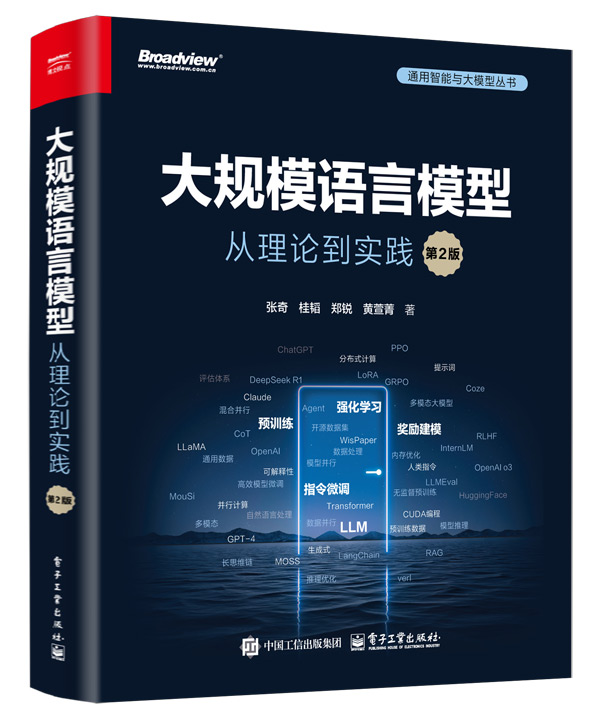
If you want to continue learning about the training and application of large models, you can move on to *Large-Scale Language Models: From Theory to Practice (2nd Edition)*; if you’d rather focus on improving your day-to-day data work, you can turn to *Data Analysis with AI*. This book is best suited as foundational reading. For readers with a background in machine learning, it can also serve as a reference for organizing cross-disciplinary concepts and explaining technology to non-technical colleagues.
We recommend it because fundamental concepts are more enduring than specific product versions. Readers should still apply the principles in this book to real-world tasks; they cannot judge the reliability of a system based solely on their familiarity with the concepts. This entry does not claim to be on today’s bestseller list, nor does it promise that readers will be able to complete engineering projects independently after reading it.
Bibliographic information verified on October 17, 2026. The reading recommendations and comparisons above were compiled by the editors of this site; please refer to the publisher’s website for purchase prices and resource availability.
The cover is used solely for the purpose of identifying and introducing this book; copyright belongs to the respective rights holders.



 简体中文 简体中文
  English