
AI has become more affordable—do ordinary users still need to pay for it?
Suppose you’re rushing to turn in a report, and halfway through uploading the file, the AI prompt tells you you’ve used up your quota. At that moment, the membership fee might seem well worth it. Consider another scenario: if you only open the app a few times a month—mainly to edit headlines or ask general knowledge questions—you’ll inevitably hesitate when the renewal reminder pops up.
Two recent developments make it worth revisiting this choice.
October 7, 2026,Anthropic Releases Claude Haiku 5.5, reducing the prices of certain API calls. On the same day,OpenAI Announces a New Version of the GPT-6 Chat ExperienceIt will be released first for the Paid tier, and will be expanded to the Free and Go tiers starting October 8.
The barriers to using AI are changing. Whether or not to continue spending money on it ultimately comes down to your own priorities.
I. API Price Cuts: Why Don’t Membership Prices Necessarily Follow Suit?
First, let’s break down the three usage types: The free version lets you start chatting right away; the membership plan provides access to more models and tools; and the API is an interface that allows developers to integrate models into their software, with charges based on the number of calls.
Therefore, API price cuts primarily affect the billing for model calls. While this provides app developers with room to reduce costs, an app’s selling price must also cover expenses such as R&D and services, and is influenced by business strategies; thus, it cannot be directly concluded that membership fees will decrease accordingly.
How cheap is Haiku 5.5? ClickOfficial Price, When the prompt length does not exceed 100,000 tokens, the fee is $0.10 per million input tokens and $0.50 per million output tokens; for prompts longer than this, the fees are $0.50 and $2.50, respectively. A token is the unit used by the model to process text and should not be equated directly with the number of Chinese characters.
Let's look at a simple example: Suppose each request involves a total input of 1,000 tokens and a total output of 500 tokens, with no caching used, and all charges are based on standard input and output rates—excluding tool and platform surcharges as well as taxes for now.
Cost per transaction = 1,000 ÷ 1,000,000 × 0.10 + 500 ÷ 1,000,000 × 0.50 = $0.00035.
If you make the same request 1,000 times, the model fee is $0.35.
This figure is quite low, but it’s based on a set of strict assumptions. In real-world use, historical conversations, system prompts, and reference materials may also consume input quotas; follow-up questions and retries will continue to use up the quota. Integrating the model into your own software also requires time for configuration and maintenance. Comparing this $0.35 directly to a monthly subscription fee can easily lead to an inaccurate calculation.
II. Is the Free Version Enough? The Difference Often Lies in the “Next Step”
be facing (us)ChatGPT Pricing PageDaily plain-text chat in the free tier is unlimited, but subject to fair use and anti-abuse policies. Features such as file uploads, image generation, voice messages, and in-depth research still have their own usage limits.
So, “being able to chat” and “being able to complete my work consistently” are two separate issues that need to be considered individually. If you just need to polish emails occasionally, the free version might be sufficient; but if you need to repeatedly upload files and generate images, you’ll need to check the limitations of those specific features.
Models are also categorized. In this instance,Chat UpdateIn this plan, the Free and Go tiers use GPT-6 Luna, while the Plus tier and above use GPT-6 Sol.
Anthropic, on the other hand, positions Haiku 5.5 asFor high-frequency tasks with well-defined scopes, such as summarization and classification, the manufacturer believes that the larger Sonnet and Opus models are better suited for complex, multi-step programming tasks. This is the manufacturer’s positioning and should not replace your own testing.
For users, it’s a good idea to start by assigning tasks that are easy to check to the more affordable option. If a task involves many steps or correcting errors is time-consuming, then compare it with a higher-tier option using the same material. It’s more useful to see if the higher-tier option actually leaves out less information and requires less rework than simply looking at how long an answer is.
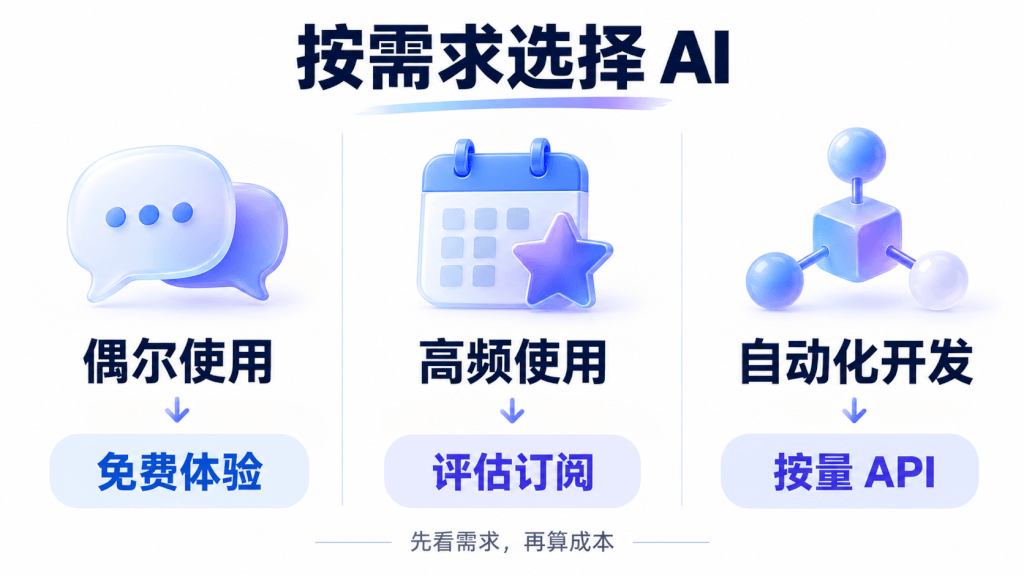
III. The thing people are most likely to overlook is their own time
Suppose it takes just a few seconds to generate a summary, but you have to spend ten minutes checking it item by item; or suppose a first draft is beautifully written, but it takes another half hour to revise it until it’s ready for publication. Calling the model is inexpensive, but getting the job done isn’t necessarily cheap.
Why not draw up a more comprehensive breakdown for yourself: subscription or call charges, plus configuration and maintenance costs, as well as the time spent waiting, verifying, and making changes. This is a way to evaluate the costs—not a vendor’s quote.
If a paid plan consistently reduces these efforts, there’s a reason to keep it. If it’s just a different model name and your work hasn’t gotten any easier, it makes perfect sense to put off renewing your subscription. And paying for the service doesn’t guarantee that the answers will be accurate.
IV. AI Money-Saving Tips: Spend Your Money First on the Areas Where You’re Really Stuck
Saving money doesn't have to start with searching for promo codes. Start by taking a moment to review your usage habits—that often makes it easier to identify which subscriptions you should keep.
- Try it for a week first, then decide whether to upgrade. Choose three tasks you do regularly and track whether the results meet your goals, how long it takes to make adjustments, and whether you’ve hit any quotas. If the free version handles your daily tasks well, stick with it for now; only if a specific limitation repeatedly holds you back should you consider whether a paid plan can resolve the issue.
- Check for any duplicate subscriptions. Make a list of the AI products you’re currently paying for, and note the unique uses of each. If two tools do the same thing, keep the one you use more often and find easier to use. Before canceling auto-renewal, confirm the billing cycle, data, and export rules to avoid accidentally deleting your data.
- Payment is billed on a monthly basis. If you only plan to use the service intensively for a specific month—such as to prepare reports, apply for jobs, or organize materials—you may want to consider a monthly payment plan first. Once you’re certain you’ll continue using the service, you can then compare long-term plans. Be sure to review the automatic renewal and cancellation terms before making a payment; canceling the renewal does not guarantee a refund.
- Gather all the necessary materials to minimize the need to redo work. Clearly specify the purpose, target audience, and output format upfront. Have AI process a small segment first to confirm the direction before proceeding. Organize batch tasks into a uniform format in advance; select only the relevant portions of files and verify that you have permission to upload them—do not include entire bundles of client data or company documents just for the sake of convenience.
- When using an API, start by identifying invalid usage. Check for duplicate submissions of the same data and whether the system keeps retrying after a failure; set a limit on the number of retries, delete irrelevant historical conversations, and avoid requiring unnecessarily long responses. Retain essential background information, constraints, and verification steps, then use a small sample to check quality—don’t sacrifice quality just to save a few tokens and end up with more rework.
There is one more prerequisite that cannot be overlooked: As of October 10, 2026,OpenAItogether withList of Regions Officially Supported by AnthropicNone of these list mainland China. Readers in mainland China should prioritize products that can be used in compliance with local regulations; when dealing with customer information or company documents, they should also verify permissions and data processing rules before uploading.
The next time you receive a renewal reminder, ask yourself this specific question: Over the past month, what exactly has it helped me accomplish? The answer to this question—rather than the fact that “another, even more powerful model has been released”—is what truly determines whether it’s worth the money.
© Copyright notes
The copyright of the article belongs to the author, please do not reprint without permission.
Related posts


No comments...
 简体中文
简体中文  English