Wenxin Unlimited OCR 2 is a document parsing model released by Baidu. Its focus extends beyond simply recognizing text in images to processing continuous paragraphs, cross-page tables, and complex layouts within multi-page documents. It serves as an ideal front-end solution for knowledge bases, archive digitization, and data processing workflows, converting hard-to-search pages into content that can be further utilized by subsequent programs.
Project Background and Versions
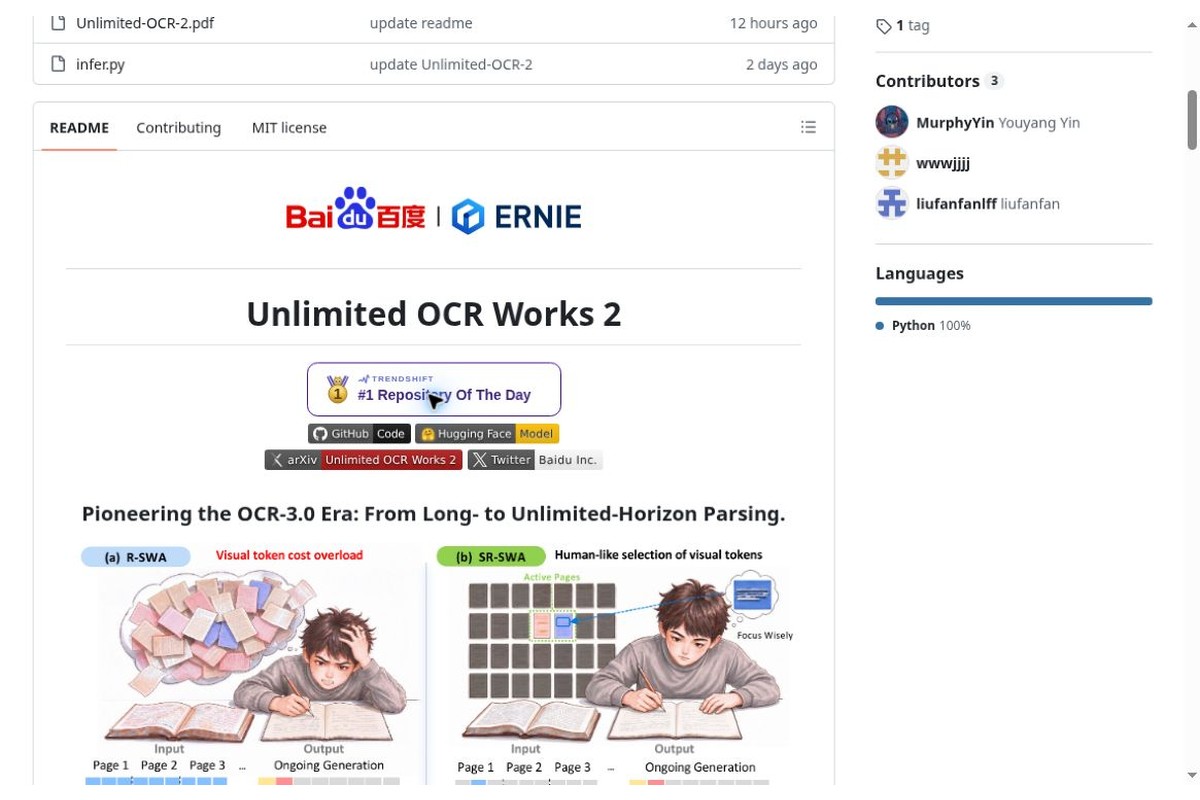
On October 27, 2026, Baidu released and open-sourced its second-generation model. The official GitHub repository is baidu/Unlimited-OCR, and the model weights can be found at baidu/Unlimited-OCR-2. Both the repository and the model page are licensed under the MIT License. The first generation of the project was released in June 2026. The second generation focuses on the introduction of SR-SWA (Sparse Reference Sliding Window Attention), which reduces computational and GPU memory pressure when processing extremely long sequences.
It is important to distinguish between two usage scenarios: open-source models, which developers can deploy and integrate on their own; and Baidu’s fully documented cloud service, which is still in the public beta phase. The open-source license does not mean that the cloud service is free, nor does it imply that self-deployment incurs no computing costs.
Key Competencies
- Understand the layout, not just copy the text. The official description covers elements such as titles, paragraphs, tables, equations, and images, as well as reading order and structural relationships, to facilitate subsequent indexing, display, and extraction.
- Handling cross-page continuation. Link tables and paragraphs that have been split across pages to reduce the disjointed appearance caused by simply identifying them page by page and mechanically splicing them together.
- Multi-page combined input. The repository example allows sequentially arranged page images to be processed as a single multipage request using cross-page context; it also provides an entry point for single-page processing.
- Balancing research and service. The official documentation supports the Transformers test path and recommends SGLang for service deployment; actual deployment requires adjusting the project's dependencies and configuration accordingly.
What problem does it solve?
Standard OCR can often identify characters, but it does not necessarily recognize that the table headers on one page and the values on the next page belong to the same table. For financial reports, technical manuals, and lengthy documents, this loss of structure further impairs search and question-answering capabilities: even if the system retrieves the text, it may mismatch fields or omit contextual information.
The value of Unlimited OCR 2 lies in incorporating cross-page relationships into the parsing process. However, the parsing results do not constitute business conclusions. Financial figures, contract terms, table consolidations, and formulas, in particular, must be cross-referenced with the original pages; subsequent Q&A should also retain page numbers or references to the original text to prevent the model’s output from replacing the original evidence.
Who and What Situations Is It Suitable For?
Ideal for developers with deployment capabilities, knowledge base teams, document digitization teams, and enterprises that need to process large volumes of multi-page documents. You can start by testing three representative sample types: standard scanned documents, multi-page tabular documents, and complex multi-column pages. For each, track metrics such as text omissions, reading order, table structure, and processing time—rather than relying on just one or two demonstration examples.
If you only need to recognize a few receipts from time to time, building your own model might be overkill; if the documents are sensitive and require a controlled processing environment, the value of on-premises deployment becomes more apparent, but you’ll still need to set up data isolation, access controls, and log management on your own.
How to use
- Read the installation and inference instructions from the official repository to obtain the corresponding model weights.
- Convert the PDF to images in page order, preserving the original file and page number mappings.
- When running single-page or multi-page inferences in a test environment, first verify the dependencies, video memory, and output format.
- Perform structural validation and manual sampling on the recognition results, then feed them into the knowledge base or document processing workflow.
- If you choose a cloud service, use the access point described in the official documentation to participate in the public beta, and verify the account, billing, and data processing terms separately.
Restrictions and Deployment Reminders
“Unlimited” describes a technical goal for processing long documents; it is not a guarantee of support for any number of pages, any hardware, or unlimited concurrency. The repository example uses Python 3.10 and lists dependencies tested on an NVIDIA A800 80GB setup; this is not a commitment to a minimum amount of video memory. Deployments should still measure peak VRAM usage, timeouts, and output length, and verify the retry strategy following failures. The partial-load approach enables custom remote code; review the source’s credibility and the code’s content before use.
Comparison of Similar Solutions
| sports event |
Focus |
Applicable Scenarios |
Points to Note |
| Unlimited OCR 2 |
Multi-Page Joint Parsing and Cross-Page Relationships |
Extremely long documents, continuous paragraphs, and tables that span multiple pages |
Model Deployment Costs and Actual Sample Accuracy |
| Docling |
Multi-format Document Conversion and Unified Document Representation |
Incorporating Mixed Media Such as PDFs and Office Files into Generative AI Workflows |
Analysis of the Selected Parsing Pipeline and Underlying Model |
| PaddleOCR |
OCR and Document Structuring Systems |
Multilingual Text Recognition, Document Parsing, and Engineering Integration |
Adapting to Different Models, Modules, and Deployment Paths |
You cannot judge which of the three is better based solely on a single ranking. The true criteria for selection should be your document type, structural fidelity requirements, throughput, and maintenance capabilities.
Official Website:GitHub Projects - Model Weights - Baidu Release Notes - Cloud-Based Document Analysis - Docling - PaddleOCR






 简体中文
 English