
Black Forest Labs
Black Forest Labs has developed the FLUX vision model, expanding its business from image generation to video, audio, and motion prediction, and offers APIs, open weights, and enterprise deployment options.
A robotics company spun out of MIT CSAIL combines models, hardware, remote operation, and on-site deployment to offer the Cassie and Sonny robots for palletizing, depalletizing, case packing, and piece-by-piece picking.
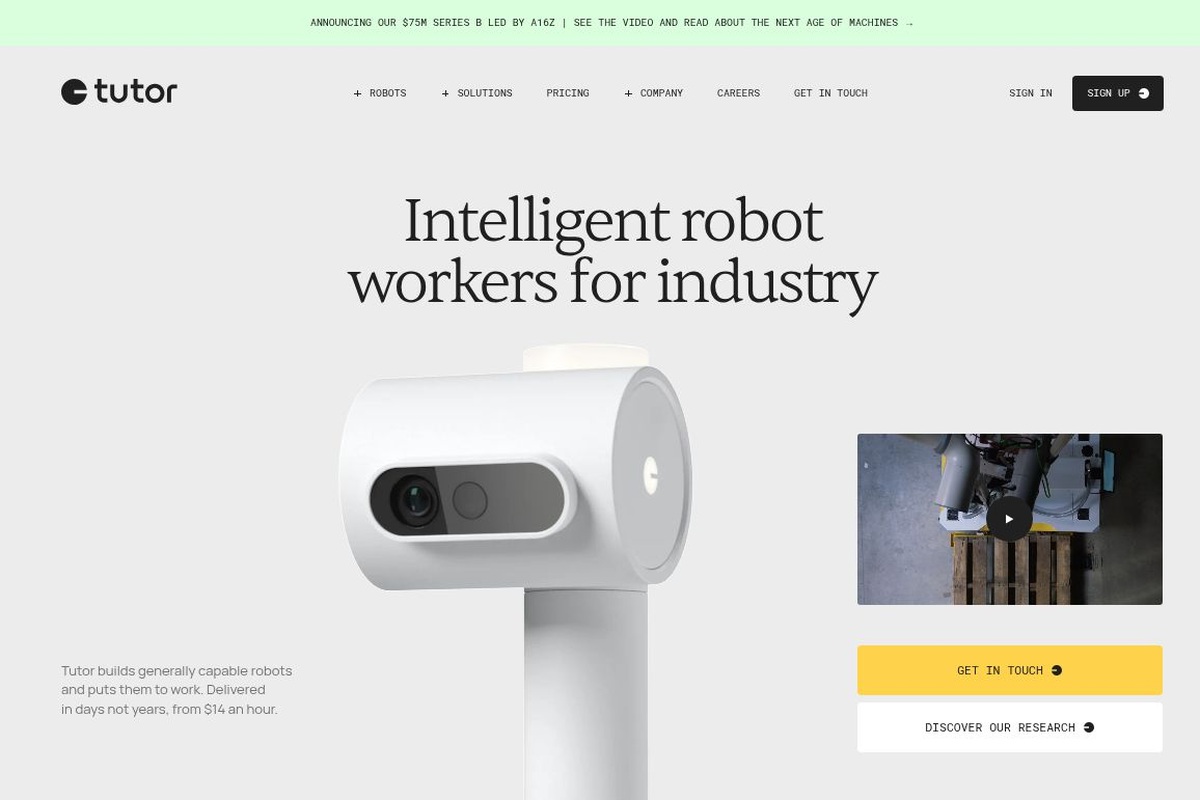
 Tutor Intelligence
 is a robotics research and deployment company spun out of MIT CSAIL and headquartered in Watertown, Massachusetts. The company integrates robotics hardware, foundational models, software, and operational services into a single business ecosystem to deliver robots capable of performing specific tasks for manufacturing, logistics, and warehousing companies.Company Profile
On November 2, 2026, the company announced the completion of a $75 million Series B funding round led by a16z, with participation from Union Square Ventures and Neo, bringing its total funding to $117 million. The funds will be used for model training, manufacturing, and deployment. This makes it an AI manufacturing company worth watching, but the size of the funding round alone does not indicate how much revenue a particular factory will generate.Company Financing Announcement
Cassie handles full-case and pallet shipments. This is a single-arm mobile robot primarily designed for palletizing, depalletizing, and full-case picking. Its suction cup gripper is suitable for handling goods such as cardboard boxes; it can operate at the end of a production line or enter a warehouse to fulfill full-case orders. The manufacturer provides a tablet-based operating interface and remote operation support, making it suitable for processes involving repetitive handling of cartons and frequent changes in SKU combinations.Cassie Product Overview
Sonny is designed for more precise, piece-by-piece operations. It features a dual-arm, height-adjustable design and is primarily intended for single-item picking in e-commerce fulfillment—retrieving items from shelves and transporting them to the packing station. The company is also exploring applications in manufacturing, packaging, assembly, and maintenance; these expanded applications should be distinguished from the primary use case already described.Sonny Product Overview
Another key feature of Tutor is its remote human “mentors”: the robot first works on real-world tasks, with human operators providing guidance, and the task data is then used to train the model. Therefore, when evaluating it, one should consider its automation capabilities, human support, and service processes collectively; the entire service should not be equated directly with a robot operating without any human intervention.a16z Investment Statement
Scenarios worth prioritizing for evaluation include end-of-line palletizing in manufacturing facilities, full-case order processing at third-party logistics centers, and unit-level picking in e-commerce warehouses. This solution is suitable for business leaders and warehouse operations teams looking to start with a single process and gradually expand automation. Individual developers or home users cannot simply register and start using the solution immediately, as they would with online tools; the official website is primarily intended for learning about the solutions and scheduling corporate consultations.
The published rates for palletizing and depalletizing are $14–18 per robot-hour, with a minimum of 80 hours per month. There is also a $10,000 implementation fee, an $8,000 refundable deposit, $1,000–$3,500 in shipping costs, and a $50–$300 setup fee per production line. The hourly rate includes support, maintenance, and model updates; however, the pay-as-you-go model still involves upfront costs.Official Price
Pricing for full-case and individual-item picking is based on the number of picks and must be calculated based on on-site operations; there is no standard, publicly available unit price. The savings percentages provided on the official website are sales estimates and do not represent the results for every customer. The company’s deployed network covers the continental United States; to confirm whether delivery is available in other countries or regions, please contact our team first.Pricing Information.;Business Coverage
| firms | Main Areas of Focus | Processes Suitable for Evaluation | Important Boundaries |
|---|---|---|---|
| Tutor Intelligence | Cassie, Sonny, and Model: Integrated Delivery with Remote Operations | Palletizing, Depalletizing, Full-Case Picking, and Unit Picking | There are minimum usage requirements and an initial fee; technical support is included as part of the overall service. |
| Pickle Robot | Truck and Container Unloading Robot | Loading bulk cartons from the truck into the subsequent logistics process | This product is designed for loading and unloading docks; please verify the size and weight of the cargo as well as the conditions of the truck bed. |
| Dexterity | Physical AI and Industrial Robotics Platform for Enterprises | Vehicle Loading and Unloading, Palletizing, Depalletizing, and Piece Picking | Since the scope of the process is quite broad, comparisons should be made based on the specific system and on-site integration plan. |
The area where these three overlap is logistics and material handling, but we cannot simply conclude that one will replace the other just because “they are all robots.” First, identify where the pain points lie—whether at the unloading dock, the end of the production line, or during shelf picking—and then compare the total costs and on-site suitability; this will make it easier to find the right solution.




 简体中文 简体中文
 English