Salesforce is an enterprise software platform based on customer relationship management (CRM) that covers sales, customer service, marketing, commerce, and related data and process management. Its AI capabilities are built on the customer data, permissions, and business systems that enterprises already use: these include both predictive analytics and content assistance, as well as intelligent agents that—when configured through Agentforce—can answer questions, access tools, and perform tasks. For enterprise users, the key value lies in integrating AI into actual business processes, rather than simply providing a standalone chat window.
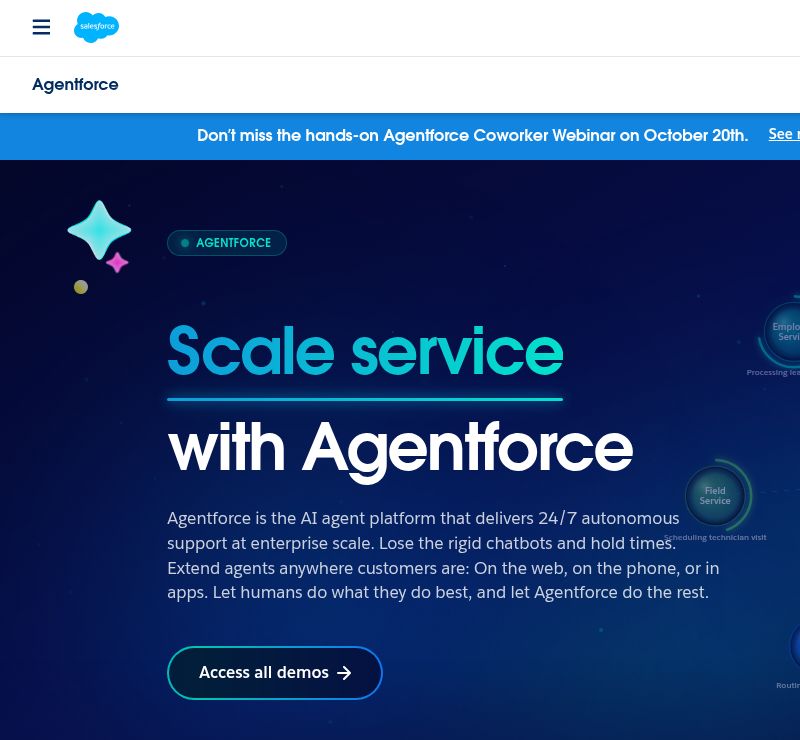
Salesforce Agentforce Official Introduction Page, Source: salesforce.com
Salesforce was co-founded in 1999 by Marc Benioff, Parker Harris, Frank Dominguez, and Dave Moellenhoff; its official history lists February 7, 2000, as the date of its official launch. In 2016, the company launched Einstein, introducing AI to CRM; in September 2024, it announced Agentforce, and in October of the same year, declared it generally available; on October 13, 2025, it released Agentforce 360, continuing to integrate people, agents, data, and applications. Salesforce is an enterprise platform that has evolved over the long term, and Agentforce is a key component of its AI agent capabilities.Company and Product History|Agentforce Announces|General Availability Announcement|Agentforce 360 Released
Key Features
AI Integrated with Business Data:Salesforce's AI can leverage CRM data and connected data sources to provide business context. Traditional predictive capabilities are suited for identifying trends and aiding decision-making, generative capabilities are suited for organizing information and drafting content, while agents further handle the execution of specific tasks. These three types of capabilities address different problems: generating an accurate summary does not mean the system is fully equipped to modify customer accounts or process orders.
Agentforce Task Execution:Companies can assign roles, scopes of work, and permitted actions to AI agents, enabling them to retrieve knowledge, obtain data, and take appropriate steps in response to customer requests, while escalating matters to human agents when they exceed their scope. For example, in service scenarios, agents can check status updates and answer policy questions; in sales scenarios, they can be used to practice communication and handle leads; and in e-commerce scenarios, they can assist with product searches and the shopping process. Each capability requires supporting data and processes; full system permissions cannot be granted based on a single prompt alone.Agentforce Capabilities Overview
Creating and Reusing Business Actions:Agentforce Builder is used to build and customize agents, and it can integrate with Salesforce’s existing Flows, prompt templates, Apex code, and API connections. For teams with existing platform expertise, this means that some of their existing business logic can be leveraged as tools for the agents, avoiding the need to write all complex rules directly into natural language prompts. Administrators manage business scope and permissions, while developers can add the logic and integrations required for precise execution.Agentforce Builder|Tutorial on Connecting Flow Actions
Testing and Observability:Builder offers both simulated and live tests, and allows users to view the action trigger and processing flow. Simulated tests can be used to validate configurations, while live tests may alter data within the organization. Teams should make testing a standard procedure before deployment and after every modification, paying particular attention to verifying that the agent calls the correct actions and that it pauses and seeks assistance when encountering insufficient data.Official Testing Guidelines
Usage Scenarios
For organizations that have already migrated their customers and business processes to Salesforce, Agentforce is ideal for starting with repetitive tasks that have clearly defined boundaries. For example, customer service representatives may need to quickly access a customer’s recent issues, sales representatives may need to prepare pre-meeting information for a specific opportunity, or internal employees may need to look up applicable service procedures. These scenarios share the common characteristics that the information has a reliable source, access permissions can be restricted, and the results can be verified by business users.
When a company wants to enable customers to interact directly with AI, it can start with simple knowledge-based Q&A and then gradually add status inquiries and transaction processing. For example, “Does a certain service support a specific region?” is a knowledge-based question; “Where is this customer’s order currently?” requires identity verification and actual order data; and “Modify this customer’s order” also involves execution permissions and error handling. Breaking these down into distinct layers typically makes it easier to control quality than striving for fully autonomous customer service from the outset.
For small teams that have not yet established CRM standards, they should assess implementation resources before making a purchase. Complex fields, cross-system data, and custom permissions may require the involvement of administrators, developers, or implementation partners. The capabilities enabled by enterprise-level scalability also entail ongoing responsibilities for data governance and operations; if your needs are limited to occasionally writing emails or summarizing publicly available information, it may not be necessary to implement a full-fledged platform system.
How to use
Step 1: Define a specific goal and list the information the agent can access, the actions it can perform, and the situations that require human intervention. Step 2: The administrator confirms the required version, licenses, feature toggles, and data access scope, and cleans up the knowledge base and key fields. Step 3: Create the corresponding roles and task descriptions in Agentforce Builder, configure the necessary actions, and clearly define inputs, outputs, and exception conditions.
Step 4: First, use simulation to validate common queries, then verify actual behavior in a controlled testing environment. The test suite should not consist solely of successful cases; it should also include scenarios such as insufficient permissions, non-existent objects, duplicate requests, rule conflicts, and user requests that exceed the scope. For actual execution tests, ensure that any potential modifications to records are accounted for, and avoid using production data for arbitrary testing. Step 5: Roll out the feature to a limited set of channels or users, monitor failures, manual interventions, and actual usage, and then gradually expand coverage.
In terms of costs, the provider offers options such as Flex Credits, per-conversation billing, and per-user licensing, each with different scopes of application. A single user request may include multiple actions; therefore, a single conversation, a single action, and the completion of a business transaction should not be conflated as a single billing unit. When evaluating your budget, you should also factor in the CRM base subscription, data services, integration, and implementation costs, and set up alerts using usage monitoring. Ultimately, you should refer to the current quote and contract terms rather than relying on a single price listed in earlier announcements.Agentforce Billing Guide
Comparison of similar products
together withHubSpotIn contrast, HubSpot embeds Breeze Assistant and intelligent agents into its customer platform, making it suitable for connecting daily workflows around marketing, sales, and service modules; Salesforce’s Agentforce, on the other hand, emphasizes the reuse of data, processes, and custom actions within its own enterprise platform. Organizations that have already invested in Salesforce customization and integration should prioritize evaluating the value of reusing native agents; teams using HubSpot’s lead generation and CRM systems should also first assess the native approach, rather than migrating their entire system solely for a specific AI feature.HubSpot Agent Platform
together withMicrosoft Dynamics 365 and Sales AgentIn contrast, Microsoft’s approach integrates AI with the Microsoft 365 work environment, providing support for CRM records, emails, and meetings—with specific capabilities varying by license. Companies where a significant amount of work takes place in Outlook and Teams should compare these types of workflow integrations; organizations that already rely on Salesforce business objects, Flow, and platform apps as their core systems should focus on evaluating Agentforce. When making a selection, use the same real-world business scenarios to compare data accuracy, access controls, action reliability, and total cost of ownership.Microsoft Sales Agent Guide


 简体中文
 English