
InspireMusic
Open source AIGC toolkit with integrated music generation, song generation, and audio generation capabilities.
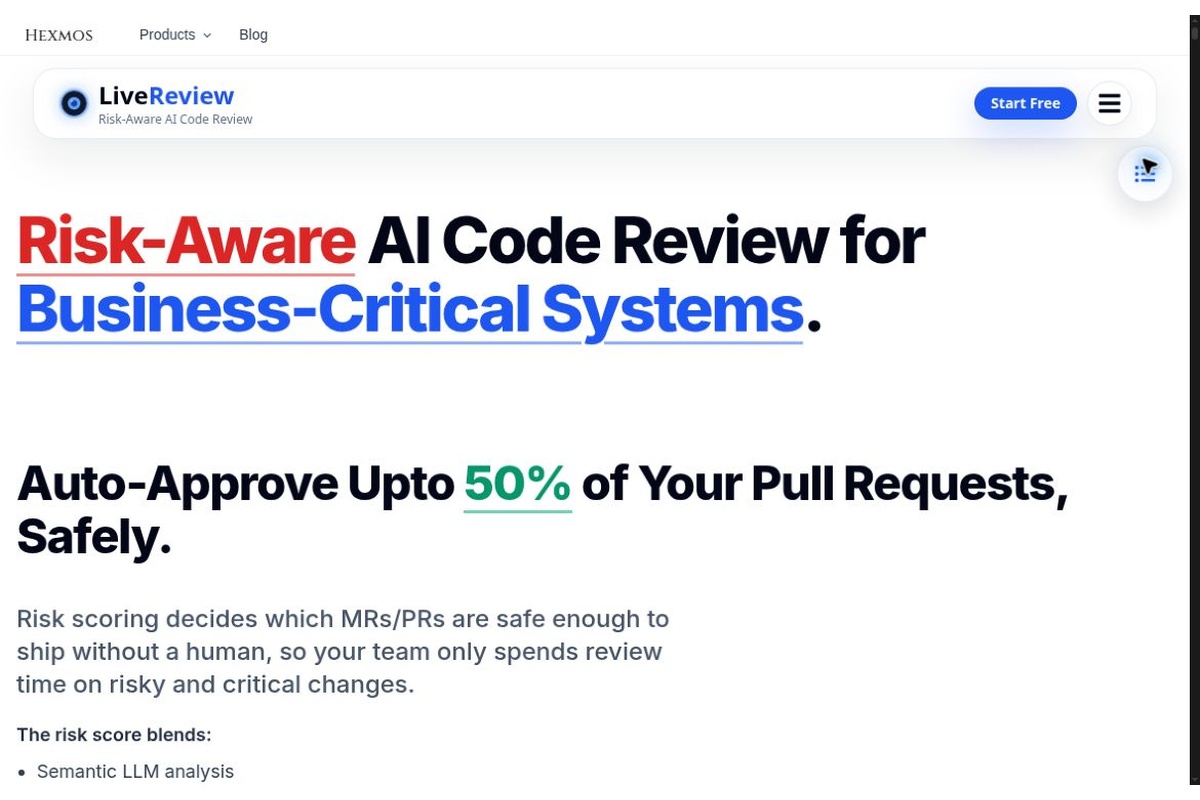
LiveReview is a risk-aware AI code review platform launched by Hexmos. It prioritizes reviews by combining model analysis, code relationships, and team feedback, and supports five types of Git platforms. The free version offers 30,000 lines per month for up to three users; paid plans are tiered based on the number of lines reviewed, with no additional charges per seat.
 LiveReview: Schedule reviews based on code risk to focus human attention on critical changes
LiveReview, developed by Hexmos Technology LLP in Bengaluru, India, is designed for team code reviews and quality management. On November 7, 2026, the company released a risk-aware review solution that emphasizes first determining which changes warrant manual review and then prioritizing the review order. While the product has a history of earlier development, the risk prioritization and automated approval workflows introduced in this release are particularly noteworthy.LiveReview Official Website,Official Statement Released on November 7,Early Update History
It is well-suited for teams experiencing an increase in code commits where experienced reviewers have become a bottleneck—especially projects that maintain critical modules such as payment, permissions, or databases. Individual developers can also try it out using the free quota, but the tool’s value should be judged by its ability to identify issues that truly matter to the team and whether the feedback can be integrated into existing fix workflows.
The risk scoring system integrates analysis from large language models regarding the implications of changes, code dependency relationships, and production signals such as incidents and rollbacks recorded by the team. It prioritizes code changes with a broader scope, approves low-risk changes according to established policies, and delegates uncertain or high-risk items to human review. The default model, built-in model keys, repository rules, organization-level prompts, and review dialogs provide varying degrees of configurability.Official Statement Released on November 7,Feature Description
Teams can connect to GitHub, GitLab, Bitbucket, Gitea, or Azure DevOps to receive feedback on PRs/MRs; they can also use git-lrc to review staged changes locally before committing. The latter is a pathway to the full platform; the free command-line tool should not be confused with enterprise deployments, dashboards, and all team features.Feature Description,git-lrc Workflow
1. First, choose a repository with clear permissions and a moderate scope of changes. Go to the "Start Free" page on the official website; when using the GitHub App, select only the pilot repository; for other platforms, configure permissions according to the corresponding integration documentation.
2. Choose the built-in LiveReview AI or a model approved by your team, and write repository-specific rules. Include only requirements that apply to all projects in organization-wide prompts to prevent a single team’s specific rules from affecting other repositories.Official Price,Feature Description
3. Use a real, small PR to check the review results, and ask for the basis of the review in the comments. If you’re starting from scratch locally, install `git-lrc` according to the official guidelines, complete the setup, stage your changes, run `git lrc review`, then fix the issues and resubmit for review. The installation will set up machine-level hooks, so you should first understand how this affects other repositories.git-lrc Workflow
4. Initially, maintain manual review and track false positives, false negatives, and review time. When automated approval is needed, first use a strategy based on past PRs to verify thresholds, then gradually enable it. Maintain testing and branch protection; do not equate model approval directly with the ability to safely deploy.Official Statement Released on November 7
The Free plan offers a monthly review quota of 30,000 lines, supports up to three members, and has no limit on the number of projects; the Premium plan starts at $32 per month, includes 100,000 lines, and supports an unlimited number of members; for higher usage, upgrade to the next fixed tier. Here, "LOC" refers to the number of lines of code in the reviewed changes, not the size of the entire repository. Self-hosting, SSO, and custom controls are included in the Enterprise plan; please contact us for a quote.Official Price,common problems
Self-hosting does not automatically guarantee that code will not leave the network: When connecting to external models, the review context is still sent to the corresponding service; only by using Ollama on your own infrastructure can you keep inferences internal. The official website does not list a complete list of regions where the service is available; support for access, payment, and models must be confirmed separately for each region. The company has also explicitly stated that it has not yet obtained SOC 2 Type II certification.Safety Instructions,common problems
The figures cited on the official website—“a 50-fold reduction in incidents and a 3-fold reduction in rollbacks”—come from Meta’s RADAR study and are not actual test results from LiveReview customers. The official low-risk automatic approval rate should not be viewed as a guarantee for every repository; a more reliable basis for judgment is the error approval rate, rollbacks, and manual review results from the pilot program.Official Statement Released on November 7
| artifact | Positioning and Functional Focus | Suitable Tasks | Billing and Important Restrictions / Official Source |
|---|---|---|---|
| LiveReview | Risk Prioritization, Strategy Approval, and Pre-Submission Review | Teams with multiple repositories that require standardized review guidelines | Grouped by the number of lines reviewed; self-hosting requires a company proposal.functionality/prices |
| CodeRabbit | PR, IDE, and CLI Reviews: Fix Suggestions and Checks | Teams that want to incorporate feedback into their development process | Priced by seat package; fees may be charged per document for reviews exceeding the quota.functionality/prices |
| Greptile | Code Graph Context, PR Reviews, and Team Learning | Teams Focused on Cross-File Impact and Review Depth | Pro: 1 point per $1; Base/Plus/Apex: 1, 3, and 10 points, respectively, regardless of seat type.functionality/prices |
Since the billing units for these three options differ, it’s not possible to determine which is more cost-effective based solely on the base rate. Only by applying the same set of real-world changes to a pilot program and simultaneously comparing the number of valid issues, false positives, resolution times, and monthly usage can we determine whether the risk management approach aligns with the team’s processes.


 简体中文 简体中文
 English