
WiseGen Robotics
Focusing on the research, development and production of humanoid robots and embodied intelligence products, we are committed to promoting the deep integration and innovative application of AI and robotics.
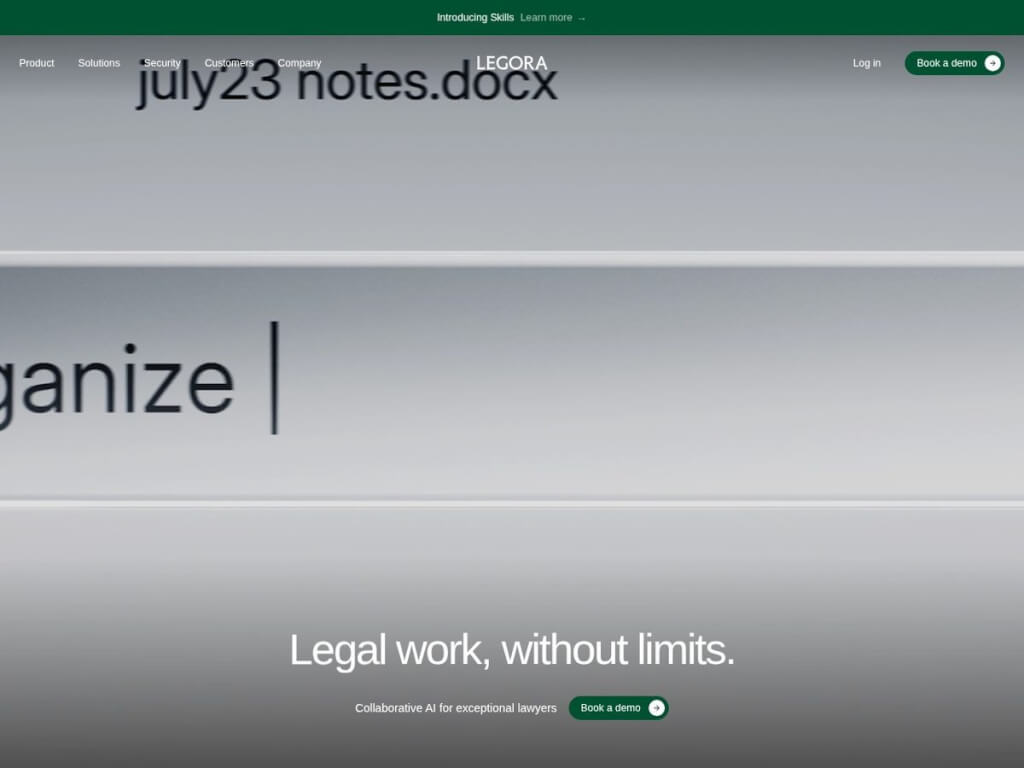
Legora, formerly known as Leya, provides collaborative AI for law firms and in-house legal teams, covering document review, research, drafting, and multi-step tasks, with an emphasis on source traceability and access controls.
Legora is a legal tech company founded in Stockholm, Sweden, which began operating under the Leya brand in 2023. Its co-founders include Max Junestrand and Sigge Labor. The company serves law firms and in-house legal departments, using AI to assist with processing large volumes of documents, retrieving information, drafting texts, and facilitating collaboration, thereby freeing up legal professionals’ time for analysis, strategy, and professional judgment.
Its products emphasize collaboration with attorneys. Whether it’s transaction due diligence, contract review, or the organization of litigation materials, users need to see the basis for conclusions, be able to refer back to the original documents for verification, and control the scope of data usage. Legora therefore integrates workflows, source traceability, and enterprise security capabilities into a single product ecosystem.
According to the company’s name change announcement, an early version launched in May 2023 quickly caught the attention of lawyers. The team then moved into the offices of the Swedish law firm Mannheimer Swartling to develop the product alongside lawyers, continuously refining the tool while working on real cases and document workflows. The company later joined Y Combinator’s Winter 2024 batch.
On February 19, 2025, Leya officially announced that it had changed its name to Legora. The product continues to expand beyond bulk document analysis, Word assistance, and data integration; the official website now showcases the aOS Agent Platform, as well as capabilities such as Agents, Monitors, and Lists, covering more stages of the process from task receipt to deliverable submission.
Legora’s core technology involves integrating large language models into the data and workflow environments required for legal work. The system reads long documents, extracts clauses, links them to evidence, and then organizes the results into a format that lawyers can review. Cells in Tabular Review can be expanded to view the basis for decisions, reducing the risk of making judgments based solely on summaries; Playbooks in Word transform an organization’s review rules into reusable workflows.
aOS also treats context, system integration, and permission governance as foundational components. The official website describes role-based access, information isolation between tasks, and audit logs, which are used to track tool invocations, file access, and agent actions. While these designs assist professional teams in reviewing processes, the model may still overlook exceptions or misinterpret applicable conditions; ultimately, legal determinations must be made by considering the original text and specific facts.
For example, when comparing termination clauses across a batch of contracts, the team can first define a set of standardized questions, then review the answers and cited paragraphs in the spreadsheet, and finally verify any exceptions on a contract-by-contract basis. This approach leverages batch processing to increase coverage while preserving manual judgment for special provisions. Templates and rules should also be updated in line with business requirements to prevent outdated standards from being repeatedly applied to new matters.
Given the trend toward law firms and in-house legal departments handling increasing volumes of information, Legora is poised to continue expanding its capabilities in bulk review and knowledge reuse. Integrating with commonly used document tools and maintaining links between materials and tasks helps reduce repetitive work and facilitates the transformation of team expertise into maintainable templates and review rules.
Its development continues to depend on content coverage, citation accuracy, confidentiality requirements, and workflow compatibility across different jurisdictions. The value of legal tasks lies not only in speed, but also in the ability to explain the basis for decisions, identify important exceptions, and clearly assign responsibility. For adopters, testing quality using verifiable sample tasks and clearly defining points for manual review are key ways to evaluate such products.


 简体中文 简体中文
  English