What makes Hi3D v1.0 noteworthy is not that it’s yet another tool where you “upload an image and get a complete 3D asset,” but rather that it addresses a step in the production process that is often overlooked:The outline of the existing model is generally correct, but the details aren't quite right yet.It takes a reference image and a coarse mesh of the same object as input and performs high-resolution geometric refinement on the existing structure.
What is it, and who is it for?
This is a modeling and inference project released by Hi3D on October 23, 2026, based on Sparc3D technology. This section introduces the publicly available Hi3D v1.0 Geometric Refinement Model...not a combined overview of other versions, service capabilities, or plans available on the Hi3D commercial website.
For researchers in game art, digital asset production, and 3D generation, it’s more like a step in a production pipeline: first, obtain a usable rough model; then use reference images to add details to the geometry; and finally, pass it on for manual inspection, topology processing, texturing, and engine adaptation. It is not a “one-click solution” that eliminates all post-production work.
Team and Project Background
The project is maintained by the official Hi3D repository, and the licensor listed in the license is OCEANO HK HOLDING LIMITED; it is a technical successor to Sparc3D. The list of authors in the open-source research does not correspond to the list of company founders; therefore, it is not appropriate to infer the company’s founding team based on this information. For enterprises seeking to procure services, the model project, commercial services, and the actual contracting party should also be verified separately.
Key Features and Practical Value
- Combined Input of Reference Images and Coarse Grids: The existing grid provides the basic shape, and the images serve as a reference for adding details, making it suitable for further refining the initial results.
- Multi-level geometric refinement resolution: The project offers nominal extraction grid resolutions such as 512³, 1024³, and 1536³. These numbers represent the processing resolution; they do not indicate the final number of model faces and should not be directly equated with a “guarantee of accuracy.”
- Export the mesh for further processing: The results can be exported as GLB files and then proceed to subsequent review, editing, and asset processing workflows.
- Inference code that can be deployed locally: Suitable for technical teams that need to integrate detailed steps into their own workflows, but the public repository is not a complete training platform.
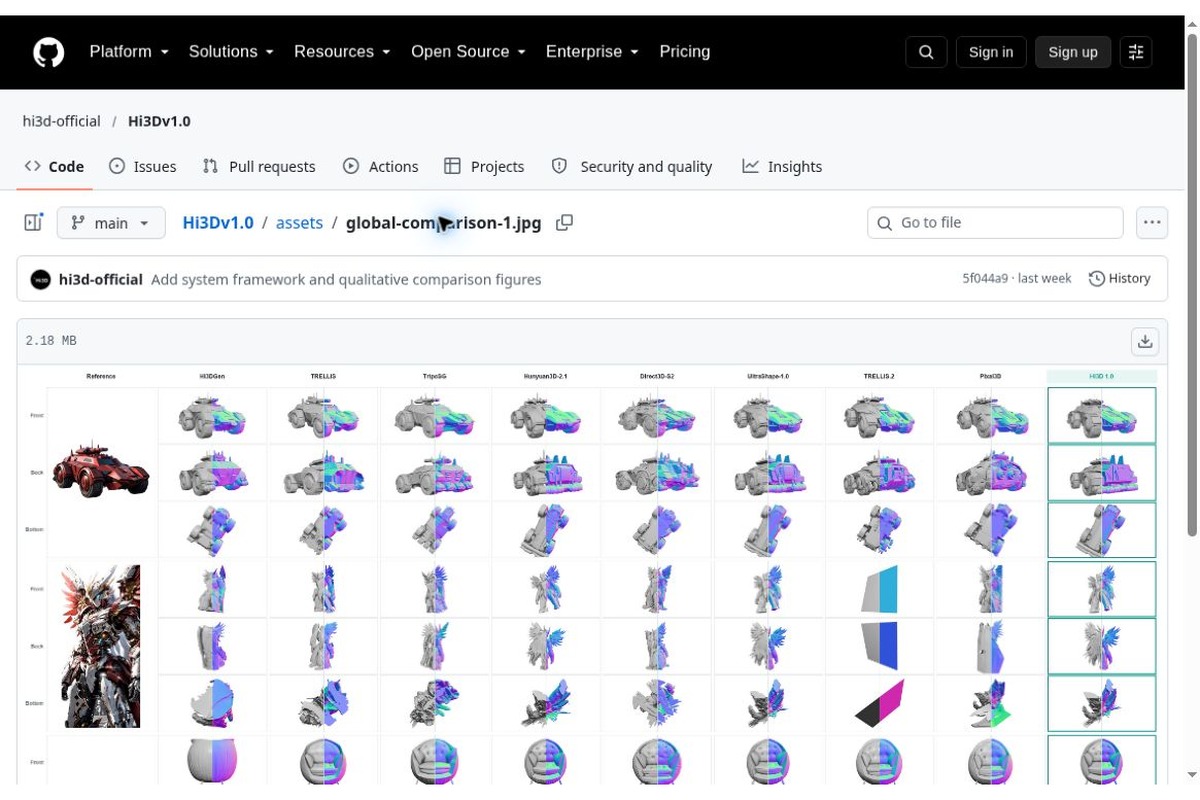
It is important to distinguish between geometry and appearance: The current output focuses onGeometric Structure, The normal map colors shown in the demonstration are not from the actual texture maps that have been generated. The backside, which is not visible in the reference image, may have been reasonably interpolated rather than accurately representing the object’s actual structure.
What's the safest way to use it?
1. Prepare a clear reference image and a rough mesh of the same object to rule out basic issues such as inconsistencies in the subject or severe proportional errors.
2. Set up the Linux, Python, and CUDA environments according to the official installation documentation, then download the model weights. The project is not currently a desktop application that requires no installation and is intended for general users.
3. Start by testing your assets and hardware at a lower resolution, then consider increasing the resolution; do not set the highest resolution as the default.
4. Run the refinement process according to the official example, export the GLB file, and carefully check for thin sections, voids, the back surface, local overlaps, and any deviations in the outline from the reference.
5. Continue optimizing the topology, materials, and performance based on the delivery goals. Just because a model looks detailed doesn’t mean it’s ready for animation rigging, manufacturing, or real-time rendering.
Official system requirements include a GPU with NVIDIA Compute Capability 8.0 or higher,CPU inference is not supported. The 1536³ configuration has only been officially verified on the 96GB NVIDIA H20; this is not a minimum VRAM requirement, and it does not guarantee that consumer-grade graphics cards will run smoothly.
How do I choose among similar tools?
| artifact |
Which step in the process is it closer to? |
Approach to Selection |
| Hi3D v1.0 |
Reference Image + Refinement of Geometry with an Existing Coarse Mesh |
We already have a rough model and would like to continue improving its structure; we also have the capability to deploy it. |
| Tencent Hunyuan3D-2 |
3D Shape Generation and Texture Generation |
It is necessary to start from the generation stage; this is not a complete substitute for refining the model. |
| Meshy |
User-Friendly Online Workflows for Text-to-Image, Image-to-Image, 3D, Textures, and More |
Place greater emphasis on integrating user-friendly entry points with multi-step tools; you can start by evaluating online workflows. |
This table compares product positioning, not quality rankings. When evaluating products, it is best to use the same set of assets and examine their form, details, restoration time, and final usability individually, rather than simply comparing promotional renderings.
Pricing, Licensing, and Commercial Limitations
Making the code and weights publicly available does not mean adopting a uniform, permissive license such as the Apache or MIT licenses. Hi3D v1.0 uses a specialized Hi3D Open License, which permits commercial use under certain conditions, but includes scale thresholds, integration requirements, and other obligations. When the relevant products or services meet the monthly active user or revenue thresholds specified in the license, a separate written authorization must be requested.
The license also distinguishes between model-integrated and standard generative outputs: it should not be interpreted simply as requiring “every generated mesh to display the brand logo,” nor should model licensing be regarded as a guarantee of rights to input images, third-party models, or final assets. Before going live, companies should review the full terms and conditions in light of their specific use cases.
Reasons for Recommendation:If your bottleneck is that “you already have a rough model, but the geometry still needs refinement,” Hi3D v1.0 is worth exploring more than just a generic “one-click 3D” product overview. If your primary need is low-threshold, rapid rendering or finished models with materials, you should first consider a comprehensive production toolkit rather than deploying it directly.
Official Access Points and References
Hi3D Official Website https://hi3d.ai/
Official Project and User Guide https://github.com/hi3d-official/Hi3Dv1.0
v1.0 Release Notes https://github.com/hi3d-official/Hi3Dv1.0/releases
Environmental and Installation Requirements https://github.com/hi3d-official/Hi3Dv1.0/blob/main/docs/installation.md
Hi3D Open License https://github.com/hi3d-official/Hi3Dv1.0/blob/main/LICENSE
Basis for Comparison:Hunyuan3D-2,Meshy https://github.com/Tencent-Hunyuan/Hunyuan3D-2 https://www.meshy.ai/



 简体中文
 English