What is Heuristica?
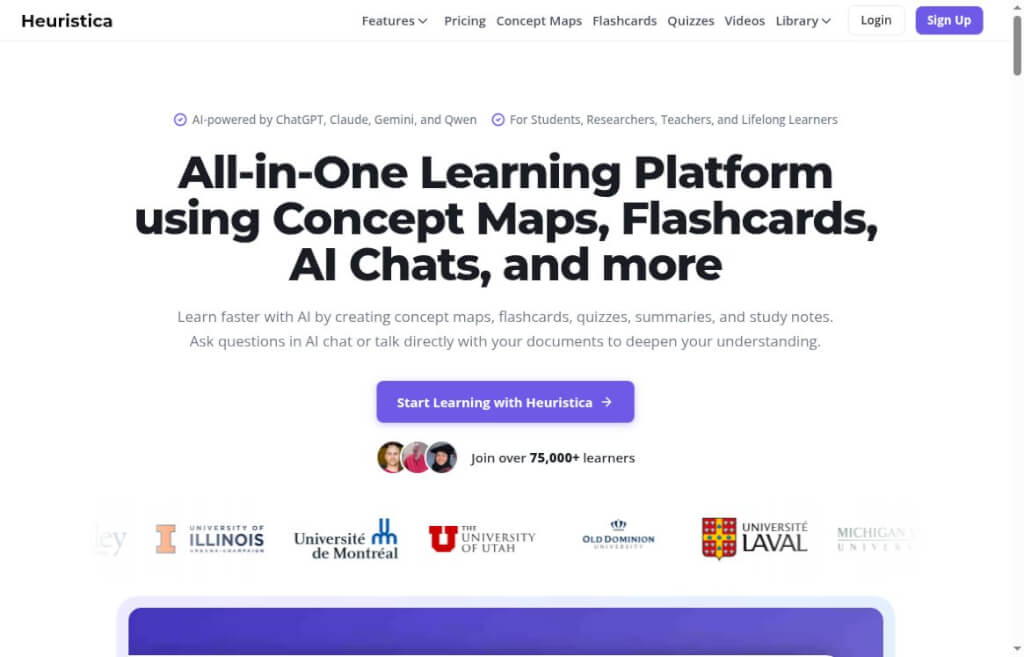
Many learners have saved numerous articles and courses, only to find they can’t recall the key points when they really need them—a problem many face. Heuristica is an AI-powered learning platform designed around comprehension and review. It organizes materials such as PDFs, web pages, and videos into concept maps, flashcards, quizzes, and study notes, offering multiple ways to learn from the same content.
It is suitable for students to organize their coursework, for teachers to prepare teaching materials, and for self-learners to explore a new field. When using it, you can first use concept maps to understand the connections between pieces of knowledge, then convert key content into practice questions and flashcards, gradually progressing from simply “having seen” the material to being able to “explain and recall” it.
Key Features
- Concept Maps and Mind Maps:Break down complex topics into nodes to illustrate related concepts; this allows you to further explore topics, ideas, or questions, helping to build a knowledge framework.
- Import from Multiple Sources:It supports organizing content from PDFs, YouTube videos, web pages, and academic sources, and generating summaries and study materials. Web Clips allows you to save web content to your library.
- Flashcards and Quizzes:Turn your materials or notes into flashcards and practice questions, and use active recall and spaced repetition to assess your level of mastery.
- AI Q&A and Text Conversion:Continue asking questions based on the material, and convert conversations or mind maps into study notes or similar formats; concept maps and mind maps can also be presented node by node.
Core Value: Integrating Materials into the Learning Process
The best way to use it is to link together an introduction, an overview, questions, and exercises around a specific learning objective. For example, after reading an introductory article, first use a concept map to identify terms you don’t understand, then ask questions based on those key points, and finally create a few flashcards with questions you need to answer yourself. This makes it easier to identify gaps in your understanding.
For teachers, the same set of materials can be adapted into various forms of classroom aids; for self-learners, diagrams help clarify the structure, while quizzes help determine whether they have truly mastered the material. It is important to note that the accuracy of the generated materials depends on the source material and the processing model; definitions, formulas, and technical details should all be cross-checked against reliable sources.
How to Use: Complete One Learning Cycle with One Set of Materials
- Set Goals:Choose an article, a section of a course, or a chapter from a textbook, and clearly state which concepts you want to understand—avoid taking on too much material right from the start.
- Building a Knowledge Framework:Create a concept map or mind map, review the hierarchy and relationships between nodes, add any missing information, and remove content unrelated to the learning objectives.
- Key Challenges:Provide explanations or examples for unfamiliar concepts, while retaining the original source material to verify terms that are easily confused.
- Convert to exercises:When creating flashcards and quizzes, try answering the questions yourself first, then check the answers; use your mistakes to adjust your review priorities for later.
Try to upload materials you have the right to use, and do not treat the generated answers as definitive answers without first reviewing them. Specific models, import capabilities, and plan quotas are subject to the current product page; we recommend starting with small-scale learning tasks to get a feel for the service.
How do I choose among similar tools?
| artifact |
Focus |
Suitable Tasks |
| Heuristics |
Conceptual Relationships, Exercises, and Review Materials |
Course Organization, Self-Study, and Lesson Preparation |
| Elicit |
Academic Literature, Evidence Screening, and Extraction |
Literature Review and Synthesis of Research Evidence |
| Napkin |
Text-to-Image Conversion and Visual Representation |
Report Illustrations, Process Explanations, and Presentations |
If your goal is to learn and retain a piece of material, you should prioritize Heuristica; if you need to trace the research evidence, Elicit is better suited to the task; and if your main objective is to clearly present the content to others, Napkin is worth considering as a visual tool.


 简体中文
简体中文  English