
Decopy AI
A free, registration-free, multi-functional AI writing and detection platform with integrated content detection, humanized rewriting, intelligent summarization and image identification and other useful tools.
A tool designed to assist in identifying AI-generated text and verifying the originality of the writing process and content, offering text scanning, writing replay, and integration with educational workflows; results may contain errors and should not be used as the sole basis for disciplinary action.
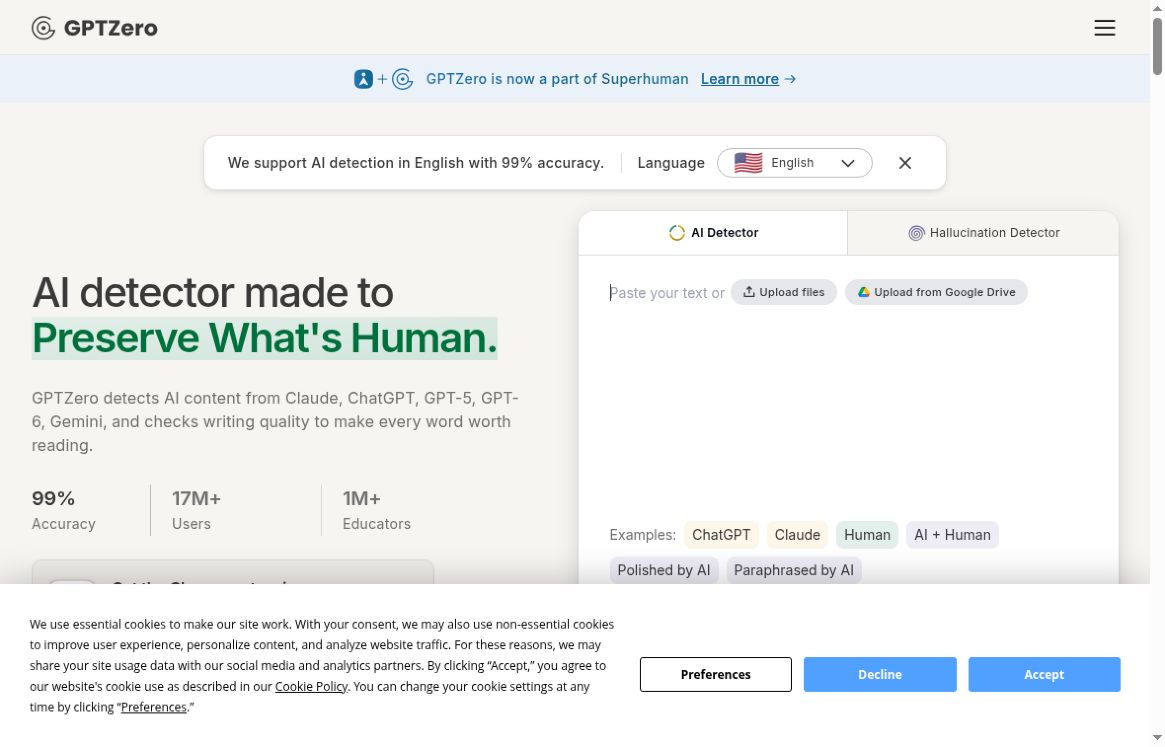
GPTZero is an AI-powered text detection and writing authenticity tool designed for teachers, students, editors, and content teams, co-founded by Edward Tian and Alex Cui. The product was launched in 2023 and later expanded from text classification to writing process verification and broader content authenticity services. As of October 17, 2026,Official Website Home PageIt has been made clear that GPTZero is part of Superhuman; previously,June 2026 AnnouncementExplains how to join the program. For information about the founder, seeOfficial Team Page.
Users can paste text or submit supported documents for scanning to view document-level assessments and flagged passages. Advanced Scan provides a more detailed analysis; the plagiarism check focuses on whether the text resembles external sources, while writing feedback helps users refine their expression. AI detection and plagiarism checks address different issues: just because you haven’t copied someone else’s work doesn’t mean you haven’t used generative AI; and being flagged as suspected AI use does not automatically constitute a violation of the rules.
Writing Replay integrates with Google Docs workflows to display the evolution of a piece of writing, as well as the pasting and editing processes, providing authors with supplementary material to explain their creative process. The official website also lists integration options such as browser extensions, Canvas, Google Classroom, and APIs, allowing institutions to incorporate these checks into their existing teaching or review processes, thereby reducing the need for manual, article-by-article verification.
Teachers can use it to identify assignments that require further discussion, gaining insight by reviewing students’ drafts, classroom performance, and verbal explanations; Students and freelance writers can use it to document the process of creating their work; editorial teams can use it to prioritize submissions for manual review. It is better suited as a guide for review rather than as an automated system for determining whether someone is honest or qualified.
Turnitin’s Feedback Studio is centered around institutional assignments, similarity reports, grading, and feedback workflows; GPTZero provides a scanning portal directly for individuals and emphasizes AI text analysis and Google Docs writing playback. It is important to note that Turnitin also offers Clarity writing process reports and Originality AI detection as add-on products; therefore, the verification of the writing process should not be considered exclusive to GPTZero. Schools should select a solution based on existing licenses, submission management, and instructional needs, while individuals can compare self-checking access and process logging methods. These are differences in workflow and do not imply that either platform is more accurate across all languages and writing styles. Functional boundaries can be verified.Turnitin Official Authorization Statement.
The official FAQ explicitly acknowledges missed detections and false positives, and recommends against punishing students based solely on test results. Longer texts typically provide a more reliable basis for judgment than single sentences; since the training data consists primarily of English prose written by adults, extra caution should be exercised when dealing with Chinese text, short sentences, specialized writing styles, and edited mixed-text samples. The benchmark scores presented by the official source do not guarantee reliable results for every detection. The aforementioned limitations are described inOfficial FAQ.
The service offers both free and paid options, with variations in quotas, character limits per request, batch processing capabilities, and organizational integration requirements. Monthly and annual payment plans are available; API fees should be verified separately. According to the official website, data processing methods differ between the API and the web console; users should review the applicable privacy policies and organizational requirements before uploading sensitive documents. Prices for individual plans may vary depending on the billing cycle and plan selected; prices, quotas, and features are subject toCurrent Subscription PageThe quotes in your account are final.
Data Verification: October 17, 2026.Visit the official website, Features and pricing are subject to the latest official specifications.

 简体中文 简体中文
 English