
AcademicIdeas
AI academic writing platform helps users to complete high-quality academic papers efficiently by generating outlines, first drafts and providing full-process support such as literature management and grammar proofreading in one click.
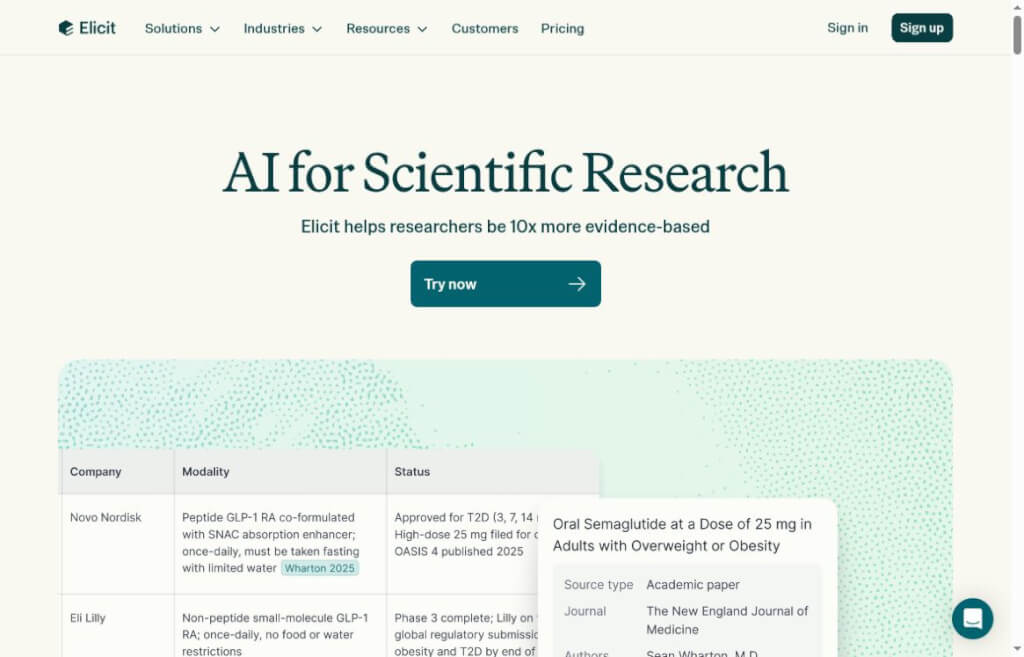
Elicit is an AI assistant designed for scientific research. It supports semantic search, literature screening, data extraction, and source citation reporting, and can use "Routines" to periodically track new evidence, helping researchers keep their research materials up to date.
When preparing a literature review, finding papers is just the beginning. Next, you need to screen studies, compare methods, extract data, and verify the sources of each conclusion. Elicit provides AI-assisted support for these tasks, linking research questions, paper sources, and structured results. It is ideal for graduate students, researchers, and professional users who need to conduct analyses based on academic evidence.
It supports semantic search, so it does not have to rely entirely on exact keywords; it can also organize relevant materials into reports and tables. Researchers can adjust the scope of the papers covered and the information extracted, gradually narrowing a broad question down to a list of verifiable evidence.
The practical value of Elicit lies in integrating searching, organizing, and verifying into an interconnected workflow. When faced with dozens of papers discussing similar topics, you can first establish consistent extraction fields, then identify the commonalities and differences among the studies, thereby reducing the need to switch back and forth between documents, notes, and tables.
For topics that researchers follow over the long term, Routines can repeatedly search for new relevant evidence, update materials, and provide summaries of changes. This is useful for maintaining research briefings or tracking rapidly evolving topics; however, researchers must still evaluate the significance of new papers, the quality of the research, and whether they alter their original conclusions. Summaries generated by AI cannot replace reading the full text, and correlation does not imply causation.
It is safer to first validate the results using a small-scale project you are familiar with. Report, extraction, and automated task quotas may vary by plan; please refer to the current product page for details. When dealing with unpublished research or sensitive materials, you should also review the data usage terms first.
| artifact | Focus | Suitable Tasks |
|---|---|---|
| Elicit | Searching for, Screening, and Extracting Academic Evidence | Literature Review and Ongoing Research |
| Heuristics | Concept Maps, Flashcards, and Quizzes | Understanding the material, organizing knowledge, and reviewing |
| Exa | Web Search and Research API | Developers Build Connected Research Apps |
If the deliverable is a traceable document evidence table, you should prioritize learning about Elicit; if the goal is to memorize and understand learning materials, Heuristica aligns more closely with the learning process; and if you need to integrate search functionality into your own software, you should focus on Exa’s development interface.


 简体中文 简体中文
  English