
New One Technology
An innovative company specializing in AI-generated video applications and technical services
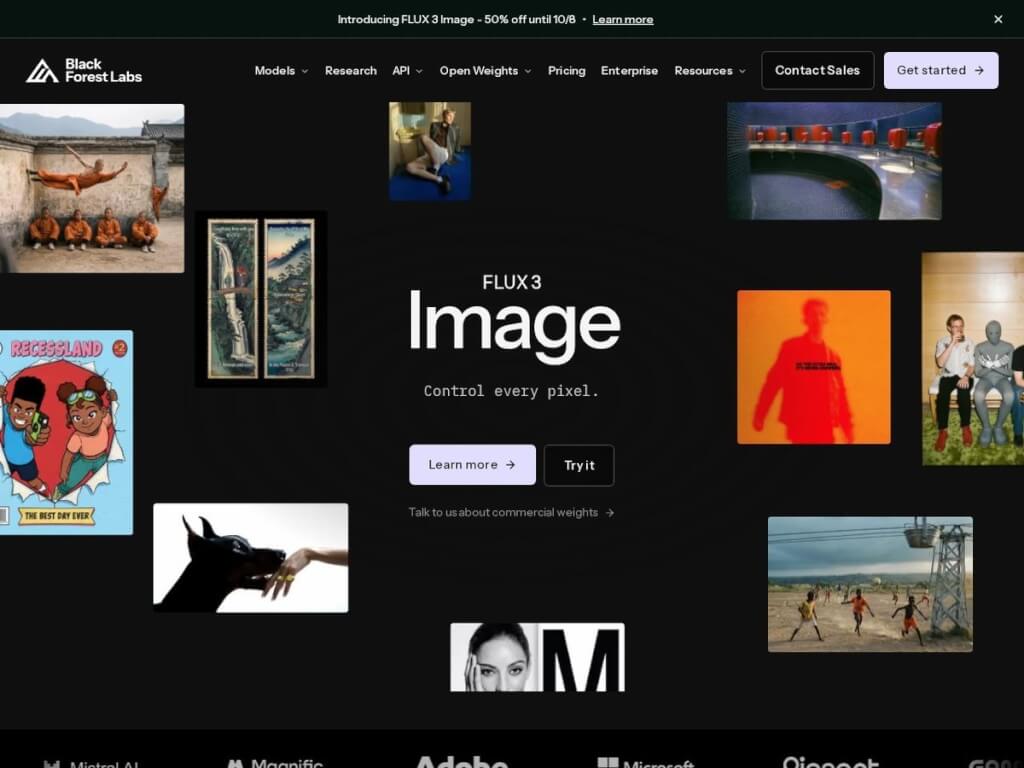
Black Forest Labs has developed the FLUX vision model, expanding its business from image generation to video, audio, and motion prediction, and offers APIs, open weights, and enterprise deployment options.
Black Forest Labs, or BFL for short, is an AI research company focused on visual intelligence. It made its public debut in 2024 and conducts R&D in Freiburg, Germany, and San Francisco, USA. Its co-founders include Robin Rombach, Andreas Blattmann, and Patrick Esser. The founding team has previously contributed to research on generative vision technologies such as latent diffusion models and Stable Diffusion. FLUX is the name of the company’s model family, and its official website is bfl.ai.
The company's goal is to enable models to understand and generate information from the visual world, serving creators, software developers, and businesses. The service can be accessed through online experiences, API calls, and licensed deployment of model weights, catering to a range of needs, from rapid creative experimentation to product integration.
On August 1, 2024, BFL announced the launch of its FLUX.1 image-generation model, offering pro, dev, and schnell versions tailored to different use cases. Early product priorities include adherence to text prompts, image detail, and the rendering of complex scenes, with a dual-track approach combining managed services and open weights.
On July 23, 2026, the company announced FLUX 3, shifting its focus to jointly learning images, videos, and audio within a unified architecture, and initially rolling out these capabilities through early access. In September of the same year, BFL released FLUX 3 Action with open weights, extending its expertise in visual models to robot action prediction. This development path reflects the company’s expansion from content generation to visual understanding and physical interaction.
BFL’s early FLUX.1 model employs an architecture that combines multimodal and parallel diffusion Transformer modules. The diffusion and flow models gradually transform the initial representation into a valid image by learning the evolution of the data; inputs such as text and reference images help control the generated results. The team also focuses on model efficiency, ensuring that different versions are suitable for both research and production tasks.
FLUX 3 further leverages the correspondences between images, videos, and audio to learn world representations: images provide spatial structure, videos capture motion changes, and audio supplements clues about the occurrence of events. FLUX 3 Action then adapts this representation to the specific motion space of a robot through joint training of video and motion. The release of the model weights facilitates experimentation and customization, but this does not mean that all versions are available for unrestricted commercial use.
When selecting a model, developers should also distinguish between its generative capabilities and deployment methods. Hosted APIs facilitate rapid product validation, while self-hosted deployment requires the provision of computing power, a runtime environment, and maintenance capabilities. The fact that a model is available for download does not automatically mean there are no additional obligations regarding training data, output content, or commercial deployment. The licensing and usage policies for specific versions should be reviewed alongside product testing.
From the perspective of a research approach that shares a common foundation across images, videos, and motion models, BFL is expected to enable technology reuse between creative software and robotics R&D. For content teams, the value lies in more precise control over characters, styles, and camera shots; for industrial teams, the value lies in leveraging extensive visual data to improve machines’ predictions of environmental changes.
This outlook remains contingent on generative consistency, inference costs, copyright and licensing arrangements, and the robots’ reliable performance in real-world environments. The model evaluations published by the company reflect results under specific settings only; when implementing the technology in practice, organizations must test it using their own data and tasks, and verify the availability and licensing terms of the selected version.


 简体中文 简体中文
  English