
Google AI Studio
Google's Gemini Prompt Experiment and Application Development Platform supports model testing, API integration, and application prototyping.
An AI development platform for building natural language-powered applications and websites, featuring integrated database, user authentication, hosting, and business connectivity capabilities. It is ideal for quickly creating internal tools, customer portals, and product prototypes.
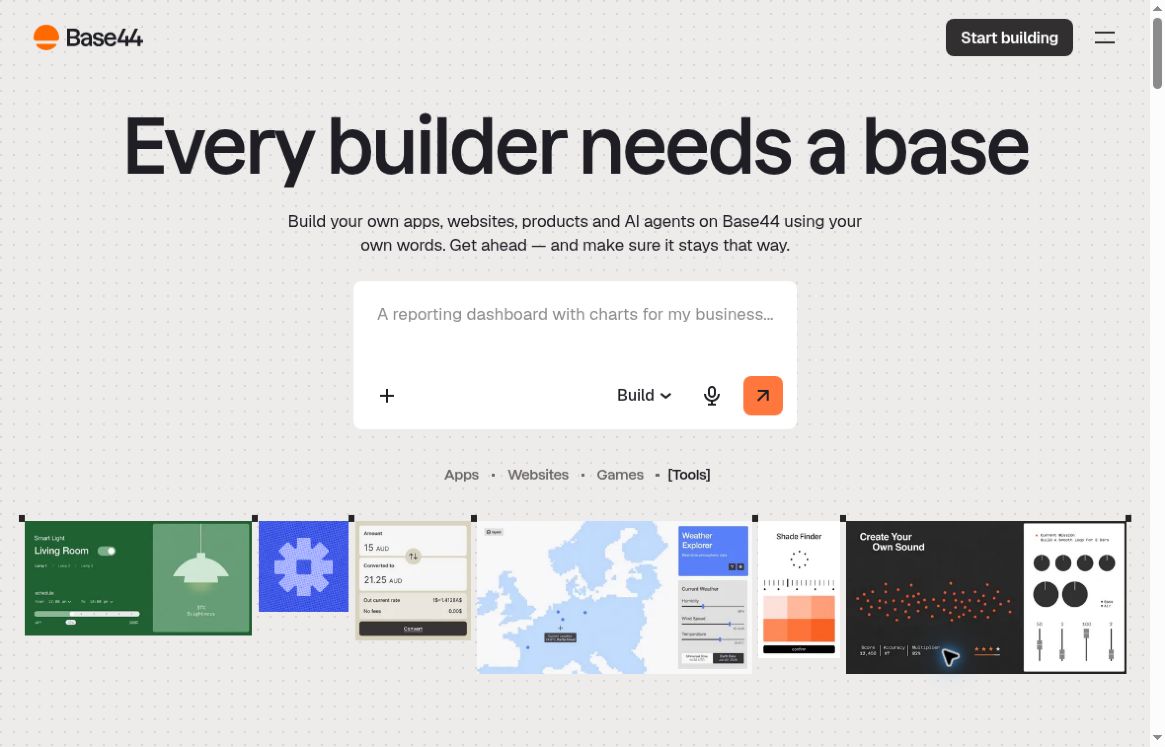
Base44 is a platform for building applications, websites, and AI agents using natural language conversation. It was founded by Maor Shlomo and joined Wix in June 2025.Official Announcement Regarding the Acquisition of WixNote that Base44 will continue to operate as a standalone product and business. It aims to allow users to first describe their business objectives, after which AI will generate the interface, structure, and logic, while also providing common foundational capabilities such as databases, user login, and hosting. For entrepreneurs and business professionals who lack a full-fledged development team, this approach can shorten the path from an idea to a functional prototype.
Users can interactively adjust pages, forms, menus, data fields, and interaction flows within the editor and view the changes in the preview area. The platform provides backend and database capabilities, identity authentication, cloud storage, analytics dashboards, visual editing, and collaboration features, and also supports integration with common business services. Suitable plans also offer options such as code editing, GitHub integration, and custom domain names, enabling technical staff to participate in ongoing maintenance.
The official website currently offers Superagents for connecting tools, processing data, and automating tasks. It’s important to note that creating a page, setting up a workflow, and operating a stable product are tasks at different stages; for projects involving login, payment, or external services, permissions, error handling, and actual costs must still be verified on a case-by-case basis.
It can be used to build customer relationship management systems, appointment scheduling, project progress dashboards, customer portals, event registration systems, and lightweight online communities. It can also transform simple form-based workflows into applications with role-based permissions. For example, a small team can start by defining the relationships between customers, orders, and follow-up records; after generating the business interface, they can gradually add filtering, reporting, and reminders. For projects where requirements are not yet clear, conducting a small-scale trial is usually a safer approach than demanding a complete system all at once.
Both Base44 and Lovable support the creation, preview, and visual adjustment of conversational applications, and both offer hosting and backend capabilities. Base44 provides databases, authentication, storage, and analytics all on a single platform;Lovable CloudIt also includes built-in databases, authentication, storage, and functions, and is built on Supabase’s open-source foundation. Therefore, the old comparison that “only Base44 comes with a built-in backend” no longer applies. A more useful approach to selecting a platform is to use the same small project to compare role permissions, target integrations, code handoffs, data migration, and actual operating costs, and then determine which workflow is best suited for your needs.
During the verification period, the free plan provides 25 message credits, 100 integration credits, and support for up to 5 applications per month; paid plans start at $16 per month (based on an annual payment). Message credits are used for building and modifying AI models, while integration credits are used for related service operations within applications; a single conversation should not be simply understood as always consuming a fixed number of credits. Terms may vary depending on the model, action, and plan; please checkReal-Time Pricing Page. Third-party services may incur additional fees, which should be factored into the budget.
Official Quick Start GuidePlease note that exporting code as a ZIP file or syncing to GitHub requires the Builder plan or higher. The ability to export code does not guarantee that all hosting capabilities will function independently without modification. Security scans are designed to identify risks but do not replace a comprehensive audit; applications that involve real customer data, payments, or critical business operations should be reviewed by someone with relevant experience before going live.
Data Verification: October 17, 2026.Visit the official website, Features and pricing are subject to the latest official specifications.


 简体中文 简体中文
 English