
Kuse AI
The AI-based knowledge management and collaboration tool aims to enhance users' information processing and creative expression through infinite canvas and multimodal interaction.
AtScale for AI integrates business definition, metric calculation, and AI query capabilities. This article provides a detailed overview of the delivery status, integration processes, pricing models, feature comparisons, and usage limitations for Ava, ACE, CoModel, and Canary.
When the finance team talks about “revenue,” the sales team talks about “revenue,” and even the AI assistant talks about “revenue,” those three figures may actually come from three different sets of algorithms. AtScale for AI addresses precisely this kind of data verification challenge in enterprises: it links the meaning of metrics, calculation rules, and validation processes, ensuring that AI has a solid foundation to rely on when querying existing business data.
It is better suited for companies that already have a data warehouse, BI reports, and a data team. When evaluating it, first determine whether your metrics can be clearly modeled and whether the AI can reliably access these metrics within its authorized scope. This article is based on data as of October 17, 2026Compiled from official documentation, including selection analysis and recommended validation procedures; no deployment or paid testing has been conducted.
AtScale for AI is a product from AtScale launched on October 15, 2026The enterprise AI capabilities suite that has been released includes question clarification, business metric calculation, AI-assisted semantic modeling, and answer evaluation. Please pay special attention to the delivery status:Ava and ACE are now available; CoModel and Canary are still coming soon....You shouldn't assume that all features are already available for use.Official Announcement
To understand this, we can start with the “semantic layer.” Enterprise databases store records such as orders, customers, products, and dates; the semantic layer organizes these records into business concepts such as “net revenue,” “active customers,” and “year-over-year growth,” while clearly defining relationships and algorithms. This way, business users can ask questions using familiar terminology, while the data team is responsible for maintaining reusable interpretation rules.AtScale Help Center: Introduction to the Semantic Layer
For example, “sales in the East China region this quarter” raises at least three questions: Should the data be based on order creation dates or revenue recognition dates? Are refunds deducted? Does “East China” refer to the customer’s location or the store’s location? Such discrepancies are difficult to resolve solely through more articulate AI responses. AtScale’s product approach is to first map the question to a well-defined business definition and then perform the calculation.
AtScale is a provider of enterprise semantic layers. The company’s history traces the origins of its product back to 2013; the team has a background in Yahoo’s data team and has long addressed issues related to metric consistency across BI tools and large-scale data analysis. Consequently, AtScale for AI extends AI workflows based on the existing semantic layer, rather than being a consumer-grade Q&A service built from scratch.Company Profile
The base platform supports data platforms such as Snowflake, Databricks, and Google BigQuery, and also connects to analytics tools such as Power BI, Excel, and Tableau. AI is integrated via the AtScale MCP Server, allowing BI and AI to reuse the same set of metric definitions. Specific data platform versions, deployment methods, and client support should still be verified on a case-by-case basis.Official Integration Guide
See Design Center Official Interface Guide, to learn about the semantic modeling canvas of the underlying platform; this page does not indicate that CoModel or Canary has been officially released.
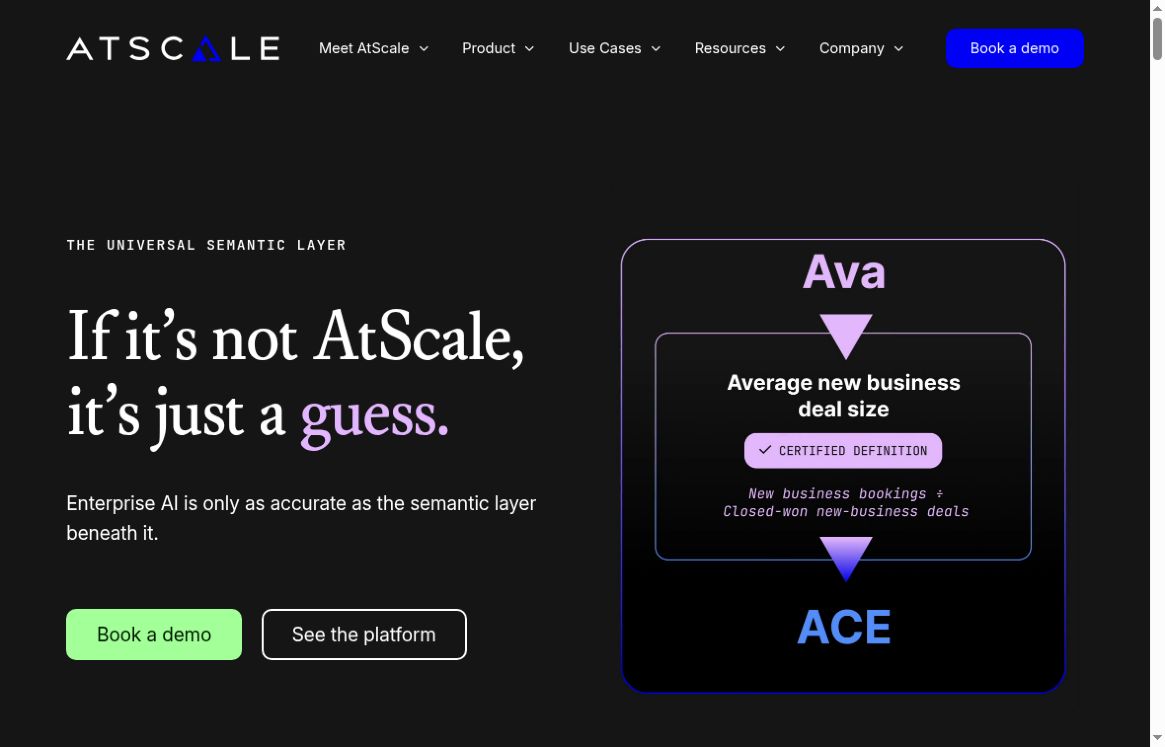
Ava stands for Ask, Verify, Answer, and focuses on aligning natural language questions with governed metrics. When faced with a term like “revenue,” which can have multiple meanings, it clarifies the intended meaning before performing calculations, thereby reducing instances where the system provides a seemingly correct answer despite using the wrong metric.Status: Available.
ACE, which stands for AI Computation Engine, is responsible for implementing business logic and computational logic while balancing query performance and computational cost.Status: Available.
CoModel is designed to translate business context into metrics, dimensions, and relationships to assist with model maintenance. Proposed changes still require manual review.Status: Coming soon.
The Canary project plans to use a BIRD-Interact-based evaluation framework, along with the company's own questions and verified answers, to identify errors and track regressions.Status: Coming soon.The above four items and their status are subject to the official announcement.Components and Usability Guidelines
Simple summation is relatively easy to understand, but “inventory balances,” “gross profit margins,” and “cumulative revenue through this month” involve different calculation rules. Inventory can typically be summed across warehouses, but daily inventory levels cannot simply be added together to arrive at the end-of-month inventory; ratios also often require first aggregating the numerator and denominator before recalculating. AtScale’s technical documentation lists multi-stage calculations, semi-additive balances, and financial calendars as key areas of focus for ACE processing, and explains that calculations are pushed down to the enterprise’s existing data platform.AtScale for AI: Technical Overview
The implication for model selection is this: during a demonstration, don’t just look at “sales totals by region.” Instead, identify the metrics most likely to be disputed within the company and verify whether the aggregation granularity, time boundaries, and filter criteria remain consistent throughout.
The following is an application analysis based on the product's mechanics; it does not represent the actual test results from this article.
Suitable for scenarios requiring strict consistency in metrics, such as revenue recognition, budget execution, and regional profit margins. We recommend first selecting a metric that has already been approved by the finance department, and then comparing the results from BI tools, databases, and AI responses using the same metrics. Figures related to official financial statements, settlements, or decision-making should still follow the existing approval process.
It is suitable for comparing sales, inventory, and delivery data by store, region, product category, and time period. Pay special attention to inventory snapshots, cumulative totals across periods, returns processing, and hierarchical summaries—and avoid mistaking “being able to look it up” for “being calculated correctly.”
This is suitable for providing employees within an existing permission framework with a natural language query interface. The official documentation includes connection instructions for Claude, ChatGPT, Databricks, and Google Gemini, among others; however, the integration methods and prerequisites vary slightly across different clients.AI Application Documentation
If a single company uses Excel, Power BI, Tableau, and AI assistants simultaneously, maintaining consistent business definitions is valuable in and of itself. Conversely, if an individual is merely analyzing a few CSV files from time to time, the costs associated with modeling, deployment, and operations on an enterprise-grade semantic platform typically require particularly careful evaluation.
The following are implementation recommendations based on the official onboarding process; they are not records of completed tests.
Select a business domain, such as order analysis. Prepare 20–50 questions and have the metrics owner verify the answers; the questions should cover edge cases such as refunds, cross-month transactions, currencies, zero values, null values, and synonyms. This number is a recommendation for the pilot program and does not represent an official product threshold.
At the same time, clearly specify the person responsible for each metric, its definition, data source, authorized users, and update schedule. Without this information, no matter how quickly the model generates results, it will be difficult to determine whether the results meet business requirements.
The data team confirms the deployment plan and data connections, builds the model in Design Center, and checks the dimensions, metrics, relationships, and time logic. The official canvas displays the model structure, and the text editor allows you to edit SML; the model validator also displays structural errors, data validation prompts, and warnings.Design Center Documentation
Administrators must first enable the AtScale MCP Server, then configure the connection according to the documentation for the corresponding client. Taking Claude as an example, the official requirements include having MCP enabled, holding the appropriate administrative role, and using the instance’s MCP address and specified authentication settings. Authentication keys should only be handled by authorized administrators during the trusted configuration process and must not be included in chat logs, public repositories, or article examples.MCP Management Documentation,Claude Integration Documentation
The official MCP tool recommends first discovering the model, then exploring the fields, confirming the fields, querying the results, and finally checking the actual query sent to the warehouse. This indicates that effective validation should cover both “what definitions were used” and “what was ultimately calculated”; it is not sufficient to merely check whether the response text is coherent.MCP Tool Reference
You can use the following test questions to check the key points:
These are examples of test questions; they do not imply that the product will necessarily respond in the specified format.
Include accuracy, handling of unanswered questions, permission isolation, latency, and cost in the acceptance criteria. Rerun the question set after replacing the large model, modifying metric definitions, or adjusting the data table. If Canary has not yet been released, you can first perform these checks using your team’s existing testing processes and then evaluate whether to adopt its automated evaluation features at a later stage.
The following comparison is based on the positioning described in each manufacturer’s official documentation; it is not a performance ranking, nor should it be used to conclude that any particular solution is more accurate in all scenarios.
| programmatic | Key Official Competencies | What to Consider When Selecting a Model |
|---|---|---|
| AtScale for AI | Integrating modeling and evaluation capabilities in AI question-answering, computation, and planning based on an independent semantic layer | With multiple BI tools, different data platforms, and complex metric logic, is it necessary to reuse a single set of definitions across the board? At the same time, verify the delivery status of new components. |
| dbt Semantic Layer | Use MetricFlow to define metrics, build semantic graphs, and generate queries in dbt projects | If a team already has a mature dbt project, it should first assess the cost of unifying metrics within the existing workflow, and then compare the required data connections and computational resources. |
| Looker's Semantic Layer and Conversational Analytics | Using LookML to parse natural language requests based on business definitions, with Looker organizing the queries and interpreting the results | Teams that already have a large number of LookML assets should prioritize evaluating the feasibility of reusing models and permissions; Looker should not be reduced to a tool that merely displays charts. |
| Snowflake Cortex Analyst / Cortex Agents Track | Cortex Analyst can generate SQL using semantic models or semantic views; the current official documentation recommends migrating to Cortex Agents. | When data is primarily stored in Snowflake, compare the operational maintenance, model reuse, and cross-tool requirements of native solutions versus those with a separate semantic layer, and keep the migration direction in mind. |
Basis for Comparison:dbt MetricFlow Documentation,Looker Conversation Analysis Documentation,Snowflake Cortex Analyst API Documentation.
A pragmatic approach is to conduct a pilot using the same set of real-world business problems, the same set of correct answers, and the same scope of permissions, and then compare development hours with total costs. Do not assume that just because a product uses terms like “semantic layer” or “MCP,” it offers the full range of capabilities provided by another product.
AtScale's current official pricing is as follows: DSO (Deployed Semantic Object)Based on this, measurement is performed using semantic elements such as metrics and dimensions that are in production and available for use. The pricing page lists two editions—Standard and Enterprise—indicating that there are no charges based on user seats or query counts; objects that are under development or not yet available to users are not included in the same production deployment metrics.This page does not list a standard price for placing an order directly; you should request a quote and confirm the scope of the contract.Official Pricing Information
When making a purchase, we recommend verifying the following additional details: which items are subject to billing; how duplicate deployments are calculated; how adjustments are made for usage exceeding the agreed-upon scope; whether all AI components are included; the trial period and scope of technical support; and who is responsible for covering the costs of the repository and model services. The items listed above are for reference purposes only and do not imply that any specific additional charges are imposed by the official provider.
Historical references to “starting at $2,500 per month” from a 2024 article can still be found online. This figure should not be taken as the current pricing for the AtScale for AI suite in 2026.Historical Pricing Articles
What makes AtScale for AI noteworthy is that it enables enterprise AI decision-making to be based on maintainable, quantifiable, and verifiable business metrics. For teams that already have a data warehouse, cross-tool analytics needs, and a foundation for metrics governance, it’s worth adding to their pilot list; if they’re only dealing with scattered files, or hope that AI will automatically understand the entire business without any rules, they should first assess whether the investment aligns with their needs.
The most valuable next step is to approach vendors with a controversial metric, a set of questions with confirmed answers, and clear budget constraints to request demonstrations and quotes, and then verify the capabilities they have already delivered.
Date of data verification: October 17, 2026. Features, compatibility, and commercial terms are subject to change; procurement and implementation are subject to the vendor’s latest documentation and contract. This document does not claim to have completed installation, integration, performance testing, or accuracy testing.


 简体中文 简体中文
  English