
GALAXEA
Focusing on the field of embodied intelligence, with AI algorithms and ontology synergistic research and development as the core, to create intelligent body products and solutions that can serve the human world.
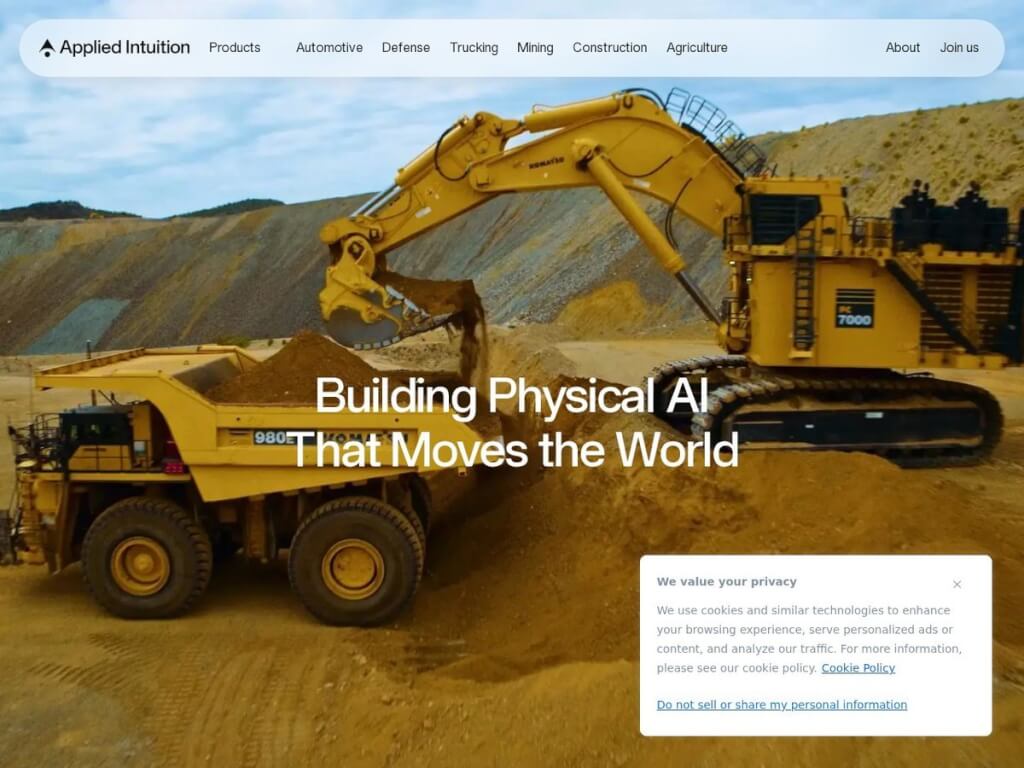
Applied Intuition provides physical AI infrastructure for automotive and industrial equipment, connecting data, simulation validation, vehicle operating systems, and autonomous driving capabilities.
Applied Intuition is an artificial intelligence and software company focused on physical machines. It was co-founded in 2017 by Qasar Younis and Peter Ludwig and is headquartered in Sunnyvale, California. Its clients include automakers, as well as organizations in the trucking, mining, construction, agriculture, and defense sectors. The company focuses on the core question of how to enable machines to perceive, make decisions, and act in complex real-world environments, while ensuring that the associated software can be continuously developed, validated, and updated.
Younis previously served as Chief Operating Officer at Y Combinator and has a background in automotive engineering; Ludwig worked on map and automotive software development at Google. Their combined backgrounds have enabled the company to focus on bridging the gap between algorithms and industrial engineering, helping clients integrate smart features into vehicles and devices throughout their entire lifecycle.
The company began by focusing on vehicle software development and simulation tools, gradually expanding its business to encompass more comprehensive intelligent systems. On March 14, 2022, Applied Intuition announced the acquisition of Mechanical Simulation Corporation, adding vehicle dynamics software such as CarSim to its product portfolio. Vehicle dynamics describes how a car accelerates, brakes, and steers; this integration enables virtual testing to more closely mimic real-world vehicle behavior.
Currently, its product portfolio spans development tools, vehicle operating systems, and self-driving systems, and extends to various types of industrial machinery. As its product range expands, the company positions itself as a provider of physical AI infrastructure, emphasizing a continuous workflow from data processing and model training to deployment and operation.
Applied Intuition’s technical approach involves creating a feedback loop that combines real-world data with virtual testing: first, sensor data is collected from vehicles and devices; then, segments with training value are filtered out and used for training, simulation, and evaluation; finally, the identified issues are fed back into the development process. This enables continuous improvement of the system, particularly for rare but critical edge cases.
Its tool platform publicly introduces visual language models, world foundation models, and methods such as neural reconstruction and rendering, which are used for data understanding, scene generation, and high-fidelity simulation, respectively. A modular interface allows customers to integrate their own components and organize their work in the cloud, on-premises, or in isolated environments. While simulations provide a basis for validation, actual safety performance must still be assessed in conjunction with real-vehicle testing, operational monitoring, and specific scenario requirements.
For example, when upgrading a specific driver-assistance feature, the engineering team can compare different software versions across similar road scenarios and then determine whether failures stem from perception, planning, or control. Preserving data sources, test conditions, and results helps reproduce issues and ensures greater continuity in the validation of subsequent upgrades. This engineering traceability is a key component of the platform’s value.
From a product portfolio perspective, Applied Intuition is poised to benefit from the demand for continuous vehicle software updates and the intelligent transformation of industrial equipment. Its ability to seamlessly integrate data, development tools, operating systems, and autonomous operation capabilities helps reduce interface and collaboration costs in large-scale projects and lays the foundation for software reuse across vehicle models and devices.
Its long-term development will continue to depend on the pace at which customers’ mass-production projects are implemented, its reliability in complex scenarios, and its ability to adapt to different hardware and industry processes. For potential customers, key evaluation criteria should include the degree of alignment between simulation and reality, system maintainability, validation evidence, and total cost of ownership—rather than relying solely on the autonomous driving performance demonstrated in presentations.


 简体中文 简体中文
  English