
FlashDocs
An AI-driven intelligent document creation and collaboration platform for efficient writing and knowledge management.
A speech recognition API for Swift developers that provides unified access to Apple, Parakeet, and Qwen3-ASR, and supports speaker separation.
 AnySpeechRecognizer
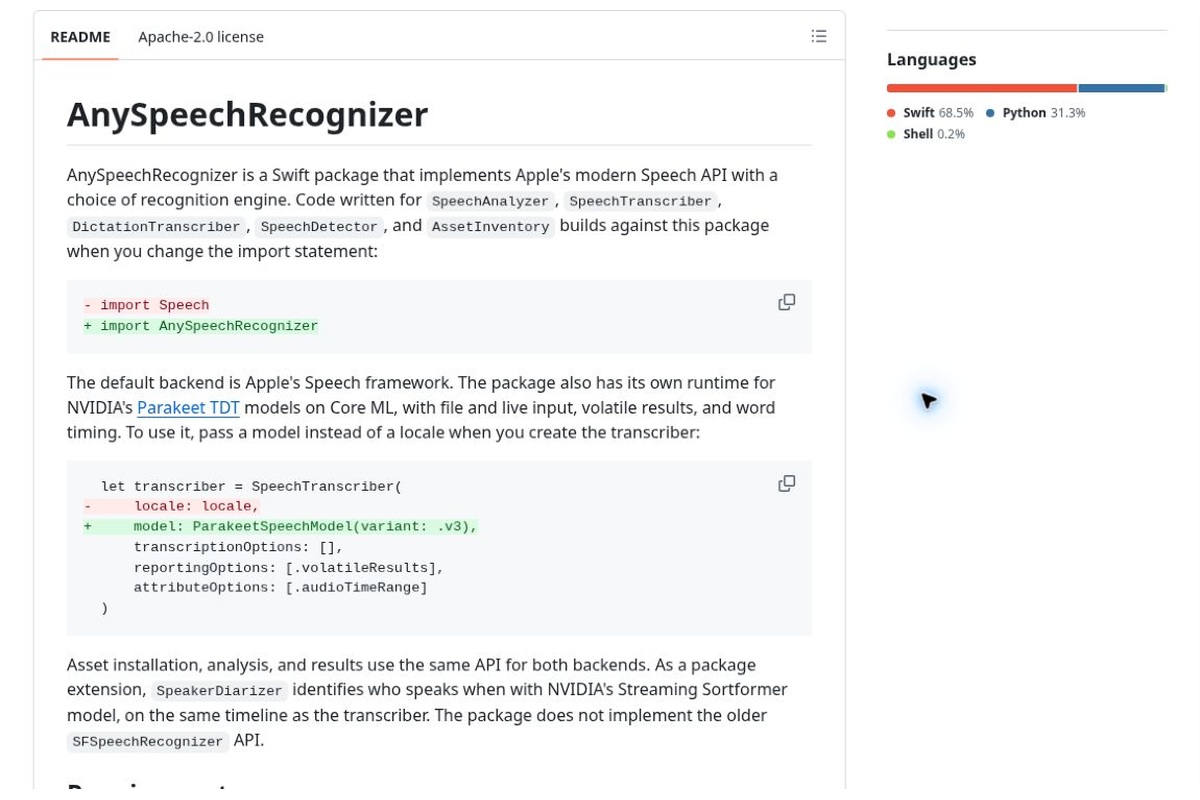
Website Description: AnySpeechRecognizer is a native speech recognition package for Swift developers. It connects to backends such as Apple, Parakeet, and Qwen3-ASR using an interface similar to the Apple Speech API, and provides speaker separation capabilities.
AnySpeechRecognizer is not a web service that can be used simply by uploading a recording; rather, it is a Swift package designed for developers to integrate into their applications. Its primary value lies in minimizing the need to rewrite APIs when switching recognition engines, allowing existing Apple speech processing workflows to explore different models without having to build each audio pipeline from scratch.Official Projects
This project was published by Mattt. On October 29, 2026, the author introduced both AnySpeechRecognizer and AnyDecisionModel on the official Hugging Face blog: the former handles speech-to-text conversion, while the latter is designed for structured decision-making with probabilistic outcomes. Both follow the familiar development approach of using a Swift API combined with optional models, but they are not the same product.Release Overview
AnySpeechRecognizer, create a recognition module and explicitly install the required resources.For teams already using the Apple Speech API, this offers a path to explore alternative recognition models; for developers building meeting note-taking, recording archiving, or multilingual applications, it provides composable building blocks. It does not automatically provide complete note-editing, summarization, team accounts, or cloud synchronization features—developers still need to implement these application-level functionalities.
| programmatic | Positioning and Focus | Reasons Why It's a Good Choice | Important Limitations |
|---|---|---|---|
| AnySpeechRecognizer | A multi-engine Swift package that closely aligns with Apple's Modern Speech API | I would like to switch the recognition backend while keeping the API similar. | New project; backend capabilities are not entirely consistent, so the application must be developed in-house. |
| Apple SpeechAnalyzer | Native Speech Analysis Framework for the Apple Platform | The team hopes to prioritize the use of system interfaces and native resource management. | The third-party model switching layer added by AnySpeechRecognizer is not provided. |
| Argmax Open-Source SDK (includes WhisperKit) | Apple Silicon On-Device Speech Component Suite | I would like to use WhisperKit for recognition and combine it with capabilities such as SpeakerKit. | It has its own API and model roadmap; some advanced features are available through the separately provided Pro SDK. |
Reference Materials:Apple Official Documentation,Argmax Official Project. The performance of different solutions should be compared on the same device and with the same set of audio files; one should not simply combine the results presented for each solution to create a ranking.
The software package uses Apache 2.0...It is not a SaaS service that charges by transcription minute. The application is still responsible for device computing power, storage, and model download costs; model weights are subject to their own licenses, and the fact that a software package is open-source does not mean that all models are licensed under exactly the same terms.Project Permit
The choice of backend affects the user experience. For example, the segmented final results from Qwen3-ASR are not the same as real-time word-by-word captions; it does not provide the same intermediate results or word-by-word timing information as Parakeet. The measurements provided by the author at the time of publication were taken in a Mac environment and have not yet been verified on an iPhone; therefore, the platform statement should not be interpreted as implying that the app has been thoroughly tested on all devices. When recording audio, conducting meetings, or handling customer calls, the app must explicitly obtain the necessary consent for recording and processing.Back-End Differences and Test Scope
Official Website: AnySpeechRecognizer Project





 简体中文 简体中文
 English