
Some APIs in the GPT-4 Series Have Been Deprecated: What Enterprises Need to Calculate Is the Transfer Cost Behind the Models
The true maintenance costs of an AI feature that has been running smoothly often don’t become apparent until the upstream model is retired. Questions like “Who configured the prompts?” “Which department is still using the old version?” and “Will the quote omit any fields after the model is replaced?” may seem insignificant on a day-to-day basis, but they tend to all surface at once as a single deadline approaches.
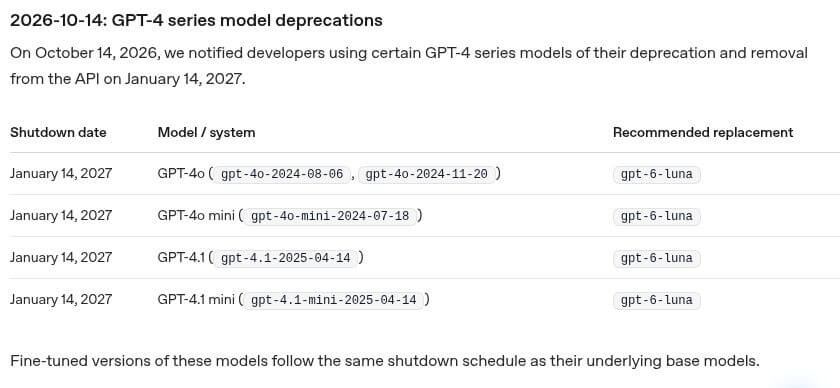
OpenAIThe API deprecation announcement updated on October 14, 2026, provided relevant teams with a migration window of approximately three months. The most valuable step companies can take right now is to treat this model change as an opportunity to review their business dependencies:The cost of an AI service should include the cost of replacing it in the future.
1. First, review the specific snapshots, then schedule the migration time.
groundOpenAI's Official Archived Documentation, This update involves gpt-4o-2024-08-06, gpt-4o-2024-11-20, gpt-4o-mini-2024-07-18, gpt-4.1-2025-04-14, and gpt-4.1-mini-2025-04-14. The dates on which API access will be discontinued are allJanuary 14, 2027, The recommended replacement model is GPT-6-Luna. Related fine-tuned models also follow the decommissioning schedule of their base models.
These conditions define the scope of the investigation: October 14 is the notification date, and the actual deactivation will take place in January of next year; the announcement lists specific model snapshots, so it cannot be interpreted to mean that “all GPT-4 models are being taken offline today.” The team needs to verify the complete model identifiers in their configurations while also checking dependencies in third-party services, scheduled tasks, and fine-tuned models. Finding a single call in the main application does not necessarily mean that all instances have been identified.
We recommend specifying the business owner, call volume, impact of failure, and alternative solutions for each dependency. For a financial reconciliation task that runs only once a day, the call volume may be very low, but the cost of an error could be higher than that of a high-frequency copywriting assistant. Migration priorities should be determined based on business risk.
II. The API unit price is only part of the migration invoice
The most easily underestimated cost of switching models is the time the engineering team spends re-proving that “this feature is still reliable.” The prompt texts, retry rules, and manual review practices that have developed around the old model over time actually form a set of implicit product logic. Replacing the underlying model may render some of these rules obsolete or render previously complex workarounds unnecessary.
Therefore, when comparing the old and new proposals, one should calculateTotal Cost per Qualified Task: Model calls, tool calls, retries after failures, manual reviews, and necessary operations and maintenance must all be taken into account. A solution with a lower per-call cost but one that requires business personnel to make repeated modifications may not necessarily be more cost-effective; a solution with a slightly higher per-call cost but one that delivers stable results may actually be more cost-effective. The only way to reach a definitive conclusion is through your own business testing.
It is also important to distinguish between one-time migration costs and ongoing operational expenses. Test set preparation, interface adaptation, and employee training primarily occur during the initial phase, while delays, reviews, and troubleshooting will continue over the long term. Mixing these two types of costs can easily lead to retaining a process that will continue to consume manpower in the future, simply to save a few days of modification work.
III. Transform “Looks Good” into Acceptable Business Criteria
Just because a response reads more smoothly doesn’t mean the entire business process is better. For contract information extraction, the key lies in handling fields, amounts, and missing information; for customer service routing, the key lies in category boundaries and the conditions for transferring calls to a human agent; and for assistants capable of invoking tools, the key also includes selecting the right tool, passing the correct parameters, and knowing how to terminate a task when encountering insufficient permissions.
OpenAI's Evaluation GuidelinesPlease note that generative AI involves output uncertainty. Therefore, transfer validation must cover typical samples, samples where errors have previously occurred, and business boundaries; it should not rely solely on a few demonstrations. Organizations can start by saving a set of anonymized real-world tasks, running both the new and old solutions under the same conditions, and then having business personnel determine which differences are acceptable.
The test subject should be the final deliverable.If the model’s output must undergo retrieval, format conversion, and approval, testing chat responses in isolation will overlook a significant number of risks. It is also important to document delays and failure recovery scenarios: a process that returns the correct result but causes the user to wait so long that they give up still does not meet the criteria for deployment.
IV. The three-month window should allow time for parallel verification.
The migration can proceed in stages: dependency inventory, comparative testing, low-traffic testing, and final switchover. In the initial phase, standardize the performance of existing workflows to prevent the team from simultaneously switching models and making major changes to prompts, which could result in uncertainty about the source of any changes. Applications involving fine-tuning, in particular, require confirming alternative paths in advance; do not assume that the official recommended replacement model will automatically carry over existing fine-tuning results.
In tests conducted in a production-like environment, the actual business owners should be involved in the acceptance process. The customer service team knows which responses can trigger follow-up complaints, and the operations team knows which missing fields will result in subsequent data entry—these judgments cannot typically be left entirely to technical metrics. Specific acceptance criteria should also be agreed upon in advance to avoid making last-minute decisions based on subjective impressions before the system goes live.
After the switchover, a monitoring period should still be maintained, and clear fallback procedures should be established for critical tasks—such as suspending automated execution, switching to manual processing, or using a validated alternative plan.The old model can only serve as a temporary fallback until it is decommissioned.If the so-called contingency plan continues to rely on the same snapshot that is about to be decommissioned, the ability to roll back will disappear as soon as the deadline passes.
V. When I Retire Next Time, Will I Be Able to Pay Less in “Re-adjustment Fees”?”
What this announcement should prompt companies to reflect on is whether model dependencies have been treated as formal supplier dependencies. If model versions, prompt versions, evaluation datasets, and runtime logs are scattered among different employees, personnel changes and upstream updates will significantly increase the difficulty of maintenance. Centralizing these resources is often more practical than designing a complex multi-model platform from the outset.
Technically, it is possible to gradually separate business rules from model calls: the business system should clearly define which fields must be present, which operations require approval, and under what circumstances a manual intervention is required. The model is responsible for understanding and generating data, while verifiable records should be maintained to document key boundaries of responsibility. While this approach does not eliminate the need for migration work, it makes it easier to pinpoint discrepancies.
For small teams, there’s no need to build out a complete infrastructure in advance for all the changes that haven’t happened yet. By first establishing version history, regression test cases, and viable workarounds for the most critical process, you can begin to build long-term value.While models will continue to evolve, what companies truly need to maintain is the ability to consistently deliver business results.
Information current as of October 14, 2026. The scope and dates of deprecation, as well as the officially recommended replacement models, are based on OpenAI’s API deprecation documentation; evaluation principles are based on OpenAI’s official evaluation guidelines. The discussion in this article regarding migration costs, acceptance testing, and architecture constitutes an industry analysis; specific costs and results must be determined through actual business testing.
© Copyright notes
The copyright of the article belongs to the author, please do not reprint without permission.
Related posts


No comments...
 简体中文
简体中文  English