Reintegrating Large Model Development into the Complete Engineering Workflow
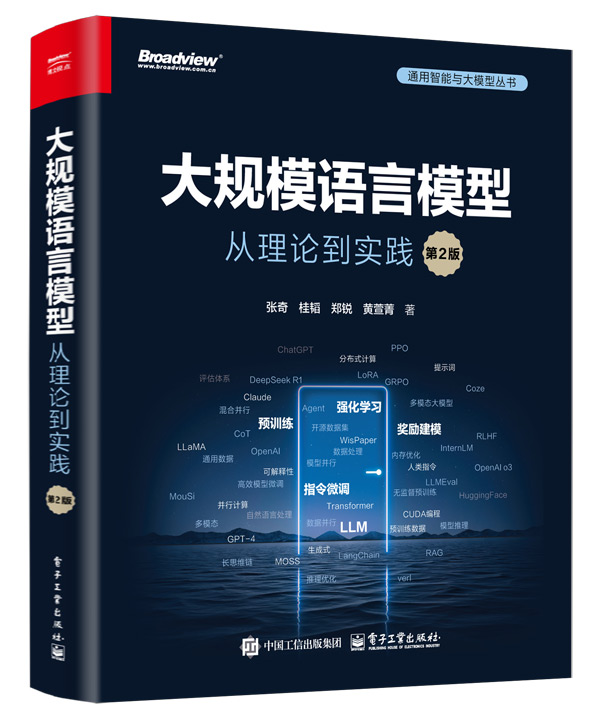
Calling a model interface once is easy, but explaining why a system works often requires a comprehensive understanding of data, models, training, inference, and evaluation. *Large-Scale Language Models: From Theory to Practice (2nd Edition)* is ideal for Chinese-speaking readers who want to connect these elements. Its value lies not in providing a one-size-fits-all solution, but in helping you identify at which layer a problem occurs and, based on that, choose your next experimental steps.
Author and Edition
This entry refers to the 2nd edition edited by Zhang Qi et al., published by Electronics Industry Press in April 2025, ISBN 9787121500572. When purchasing, please verify that it is the “2nd Edition” and check the ISBN to avoid confusion with the first edition. The publisher’s website provides a table of contents and edition information; please refer to the official description for specific print runs and accompanying materials.
Core Theme: From Model Fundamentals to Applied Systems
The official table of contents covers Transformers, training data, distributed training, instruction-based fine-tuning, reinforcement learning, multimodal models, agents, retrieval-enhanced generation, efficiency optimization, evaluation, and application development. Related practical examples involve tools such as DeepSpeed, verl, vLLM, and Ollama. The second edition’s table of contents also includesDeepSeek-R1, GRPO, and other topics.
These topics can be divided into three levels of understanding: understanding how models acquire capabilities; understanding how those capabilities are adjusted and invoked; and understanding how the system balances trade-offs between cost, quality, and safety. This layered approach is more helpful for making project decisions than simply memorizing technical acronyms in isolation.
Who is it for, and what do you need to prepare?
- Students and developers with a foundation in Python and machine learning who wish to systematically enter the field of large language models.
- Engineers currently working on RAG, agents, or model deployment who need to strengthen their foundational knowledge and evaluation methods.
- Technical leaders who want to understand the relationship between training, inference, and application development.
If you have absolutely no experience with programming or machine learning, we recommend first building a foundation of basic knowledge or reading some general-interest books on the subject. When reading, there’s no need to commit to reproducing every training experiment; computing power, dependency versions, and data availability can all affect the feasibility of practical implementation.
Two More Efficient Ways to Read
Model Route:First, establish the architecture and data concepts; then focus on training, fine-tuning, and reinforcement learning; and finally, return to evaluation. For each experiment, clearly document the input conditions, baselines, and evaluation metrics to avoid simply comparing the visual quality of a single output.
Application Process:First, understand the model’s capabilities and limitations, then read up on RAG, agents, inference efficiency, and deployment based on your specific task. We recommend starting with a simple problem—such as a question-and-answer task using a set of publicly available documents—and gradually adding features like retrieval, citation checking, and failure cases, rather than building a complex system right from the start.
What Should We Take Away from This Reading?
Rather than simply collecting the names of more frameworks, what’s truly valuable is a set of reusable experiment records: Why was this model chosen? How was data quality checked? Which metrics improved as a result of the changes? How much did costs increase? Were the errors due to a lack of knowledge, insufficient retrieval, failed tool calls, or flaws in the evaluation method itself? Only by consistently answering these questions can you truly transform what you’ve read into engineering expertise.
Differences from Other Chinese AI-Generated Reading Materials
While *The Underlying Logic of Artificial Intelligence* is good for gaining a broad overview, this book is better suited for in-depth technical study; *Data Analysis with AI* focuses on specific workflows, whereas this book concentrates on the models and systems themselves. Those currently working on applications don’t need to read the entire book before getting started; instead, they can work through a small project while reading, referring back to relevant chapters as they encounter problems.
Limitations and Purchasing Tips
Large-scale model tools and open-source projects evolve rapidly. Code interfaces, model licenses, hardware requirements, and terms of service should be verified against the official documentation available at the time of actual use; the publication date of a book does not guarantee that it covers all subsequent developments. This entry is recommended for its systematic approach and value for technical learning in Chinese; it is not labeled as an unverified “current bestseller.”
View the official book pages and catalog from Electronics Industry Press
Date of bibliographic information verification: October 17, 2026. The reading guide and comparisons were compiled by the editors of this site.
The cover is used solely for the purpose of identifying and introducing this book; copyright belongs to the respective rights holders.




 简体中文
简体中文  English