Understand how agent systems are organized through 21 design patterns, taking into account tool invocation, multi-agent collaboration, reliability, and evaluation.
Bibliographic Information
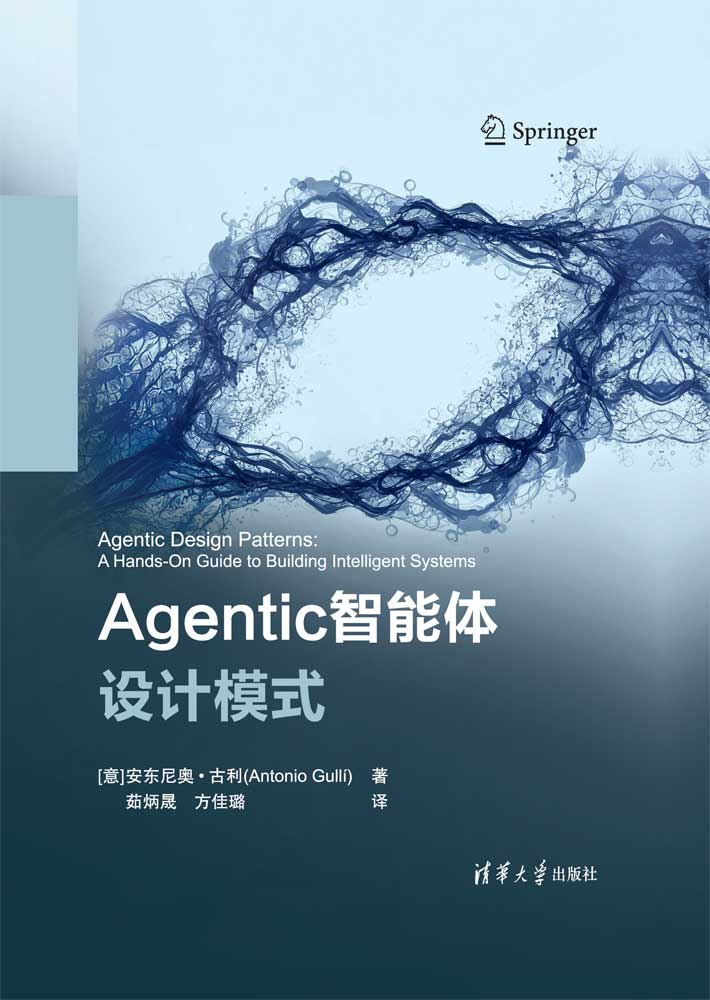
- Title: Design Patterns for Agentic Agents
- Author: [Italy] Antonio Gullí
- Translators: Ru Bingsheng, Fang Jialu
- Publisher: Tsinghua University Press
- Publication Date: May 1, 2026
- ISBN: 9787302712435
- Language: Simplified Chinese
- Publisher's List Price: 99.8 RMB; Non-real-time transaction price
What is this book about?
Being able to call a model is just the beginning. How tasks are broken down, when tools are executed, how to recover from failures, and which steps require human confirmation—these factors determine whether an agent is controllable. This book addresses these recurring engineering challenges by organizing solutions around design patterns; it is ideal for readers who have already built prototypes and are ready to take their skills to the next level.
Author and Translator
The author, Antonio Guli, has a professional background in artificial intelligence, search, and cloud computing; the publisher highlights his experience in technical management roles at Google. The Chinese edition was translated by Ru Bingsheng and Fang Jialu. When considering this book, readers should base their decision on the specific models and code examples presented in the book; they should not assume that just because the author has a certain background, all the solutions will be suitable for their own projects.
Content and Structure
The official syllabus is divided into two parts: Models and Supplementary Content, comprising a total of 29 chapters. The first 21 chapters cover topics such as prompt chains, routing, parallelism, reflection, tool invocation, planning, collaboration, memory, as well as MCP, fault recovery, human-in-the-loop, retrieval, security, and evaluation. Subsequent chapters cover prompt design, frameworks, computer interaction, command-line agents, and coding applications. The code examples draw from ecosystems such as LangChain, LangGraph, CrewAI, and Google ADK.
Who Is This Book For?
This book is intended for developers, technical leads, and architects with basic programming skills who are working on large-model applications. Product managers may choose to read the sections on task decomposition, human-in-the-loop, and evaluation to improve requirements and acceptance criteria. Readers with absolutely no programming experience are advised to complete a simple application before reading the chapters on coding.
Suggested Pronunciation
It is more effective to learn by working through a single project than to try to memorize all patterns at once. Start by creating the simplest possible implementation and test suite for the current task, then introduce routing, retrieval, or reflection as needed to address the actual problem. Compare the success rates, latency, and costs before and after making these changes; before adding multiple agents, verify that the new approach is indeed superior to a simpler process.
Value and Limitations
This book provides a common language for analyzing system architecture, facilitating team discussions on reliability and trade-offs. Design patterns alone do not guarantee results, and using more of them does not necessarily make the system better. Framework interfaces and model services change rapidly, so code must be validated against the actual versions; when external operations are involved, permission isolation, auditing, and manual approval must also be implemented.
Resources and Purchasing Guide
Bibliographic Information and Basis for Content StructureTsinghua University Press Official Book Pageup toOfficial CatalogCompiled and verified on October 18, 2026. Reading recommendations and analysis of limitations are based on the judgment of this site’s editors. Purchase options can be viewed on the publisher’s page; actual inventory and final sale prices are subject to the retailer’s listing.



 简体中文
 English