
From Personal Assistant to Enterprise-Wide Platform: What Insights Does Ant Group’s QwenWork Case Study Offer Businesses?
As different departments gradually adopt AI, companies will soon face a new challenge: writing tools, Q&A systems, and project assistants each have their own interfaces, forcing employees to keep moving data back and forth between systems. While each tool is useful on its own, when integrated into a typical workday, they may not actually reduce the number of times employees have to switch between systems.
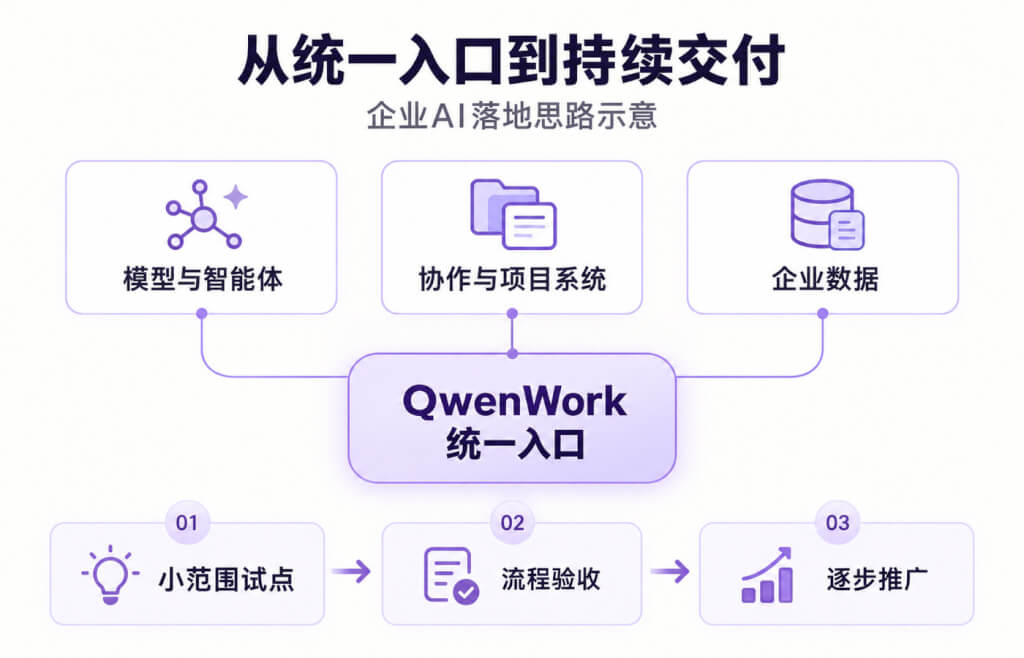
The Ant Group QwenWork case study released by Alibaba Cloud on October 13 is worth examining from this perspective. By placing personal AI assistants, enterprise digital employees, and existing services on a common foundation, it raises a more practical question:How can the models, tools, and systems a company already has work together to complete a task?
I. The value of a unified entry point lies in how many times it reduces the need to move data.
据Alibaba Cloud Official Case StudiesAnt Group uses QwenWork as the foundation for its enterprise-level intelligent office agent platform, combining its own models and agent capabilities while integrating services such as internal collaboration and project management. The solution covers both personal assistants and corporate digital employees, providing an infrastructure accessible to all employees to support various work scenarios.
The most immediate benefit of a unified entry point is that it saves employees from having to decide “which tool to use for this task.” However, once access points are centralized, if background information still needs to be uploaded repeatedly and the same request must be reexplained to multiple assistants, the burden of use will simply shift from the desktop to the chat window. When evaluating a platform, one should consider whether tasks can carry the necessary context into subsequent stages.
For example, when an employee is compiling a project progress report, they need to look up meeting minutes, verify task statuses, and summarize unresolved issues. Only if these materials can be integrated within the scope of existing work will the platform truly reduce the workload. The process described here is an illustrative example and does not represent an actual task disclosed in a case study.The number of connected tools reflects the scope of coverage, but reducing redundant work is what truly adds value for users.
II. When integrating with existing systems, the process should follow the business workflow.
It is difficult for companies to completely replace their existing collaboration and business software just to use AI. A more realistic approach is to first integrate AI into a specific stage of existing workflows: having it retrieve necessary data, generate verifiable results, and then deliver those results to the workstations employees are already accustomed to using. This also makes it easier to determine whether the new capabilities are actually reducing the workload.
During integration, it is essential to clarify which system will maintain the final, valid record. If the project manager has already updated the delivery date in the original system, the assistant should not continue to generate reminders based on the old information; similarly, if the AI has compiled new progress updates, the relevant personnel should be informed whether these have been written back into the official record. Otherwise, the unified portal may end up with another copy that is not being maintained.
Permissions are the boundaries that must be addressed in this process. The case study highlights capabilities related to private intranet deployment, log auditing, and result verification; during actual implementation, the respective authorization requirements for reading, modifying, and sending data externally should still be followed.The platform should strive to preserve the clear lines of responsibility from the original process.A single interface can handle multiple actions, but employees need to know who performs each action, where the results are stored, and who to contact if an error occurs.
III. In-House Development vs. Outsourcing: Categorized by Long-Term Maintenance Responsibilities
An important detail in the Ant Group case is the coexistence of external platforms alongside the company’s own models, agents, and internal services. This offers other companies a new way of thinking: sourcing mature capabilities while retaining those components closely tied to their business. Companies do not need to decide upfront whether to “develop everything in-house” or “outsource everything to vendors”; instead, they can assess on a case-by-case basis which layers warrant long-term investment.
One approach to consider is to treat capabilities such as general interactions and common document processing as candidates for procurement, while keeping proprietary data standards, business rules, and integration with key systems within your own control. This approach should be adjusted based on your team’s capabilities and does not imply that QwenWork has publicly committed to providing all related features.
The procurement evaluation should also cover upgrades, data migration, changes to interfaces, and procedures for handling service interruptions. When evaluating an in-house solution, it is important to factor in subsequent operations and maintenance as well as staff handover; one should not limit the comparison to prototype development time alone.The key to determining a border is who can maintain it continuously at an affordable cost.If a particular capability does not contribute to business differentiation but requires a long-term commitment of scarce engineering resources, procurement may be the more appropriate approach; conversely, rules that impact core delivery must retain sufficient flexibility for interpretation and adjustment.
IV. Start by rolling out changes in a few processes to give employees time to adjust
“Availability to all employees” is a basic requirement, but it takes time to truly establish a habit. A single training session can help employees get started, but it’s difficult to identify suitable tasks for every position. Platform adoption should begin with tasks that occur repeatedly, have relatively complete documentation, and yield easily verifiable results—so that employees can experience tangible changes the next time they perform the same task.
Pilot programs should not be limited to a small group of people who are most familiar with AI. Tech-savvy employees are willing to repeatedly refine prompts, while ordinary employees are more concerned with whether tasks can be completed directly. Involving employees with varying levels of proficiency can help identify issues earlier on—such as difficult-to-understand terminology, excessive steps, or results that cannot be directly applied. This feedback often has a greater impact on the user experience than adding yet another generative capability.
Each pilot project should ideally have a business lead who can determine which outputs are ready for immediate use and which still require manual modification, and who can document effective practices as step-by-step procedures that others can follow.The pace of promotion should be guided by replicable results.If a task consistently requires expert guidance, it is usually safer to fix the process first and then expand its scope than to have more employees run into the same problem.
V. Whether the platform is worth continuing to invest in depends on whether the work is moving forward.
The official case study does not disclose quantifiable ROI, time savings, or business benefits that can be verified; therefore, it is impossible to determine from this data how much return Ant has achieved. For other companies, establishing their own evaluation criteria is more important than simply applying an external success story. The number of users and the number of calls may reflect reach, but they cannot, on their own, prove operational efficiency.
You can observe more specific changes by breaking down the tasks: After conducting research, do employees still have to repeatedly ask colleagues for information? After a report is generated, does it still require significant additional data entry? After project results are submitted, can the next collaborator use them directly? Only by accounting for the operations both before and after generation can you determine whether the time saved has been offset by verification, corrections, or transferring data between systems.
The long-term value of a platform also lies in ensuring that a successful use case becomes a lasting practice: whether effective workflows can be reused for similar tasks, whether appropriate methods can be shared across departments, and whether work can continue even after personnel changes. The QwenWork and Ant Group case study points to a direction, but its effectiveness should ultimately be demonstrated by data from ongoing operations.Progress in AI for all employees should ultimately be reflected in the ability of ordinary employees to steadily move their work forward without having to repeatedly trial and error.
Information current as of October 14, 2026. The case facts are based on an official article published by the Alibaba Cloud Community on October 13, 2026. The original article did not disclose quantified ROI, time savings, or verifiable business benefits; the discussion in this article regarding tool integration, in-house procurement, and promotion methods constitutes industry analysis and does not represent specific internal processes that Ant Group has made public.
© Copyright notes
The copyright of the article belongs to the author, please do not reprint without permission.
Related posts



No comments...
 简体中文
简体中文  English